Environment-Clean-Generations

Environment-Clean-Generations
THE DEFINITIVE BLOG FOR EVERYTHING YOU NEED TO KNOW ABOUT THE ENVIRONMENT YOU LIVE IN, WITH REFERENCE TO LIFE, EARTH AND COSMIC SPACE SCIENCES, PRESENTED BY ENVIRONMENTAL ENGINEER DORU INDREI, ENVIRONMENTAL QUALITY AND ENERGY SPACIALIST
"Life is not about what we know, but what we don't know, craving the unthinkable makes it so amazing, that is worth dying for." Doru Indrei
Custom Search
Showing posts with label astronomers. Show all posts

Two Behemoth Black Holes Could Swallow Billions of Suns

Astronomers have measured the two most enormous supermassive black holes found so far, vast realms of titanic gravity large enough to swallow 10 of our solar systems. The black holes are much bigger than predicted, suggesting extra-large galaxies and their black holes grow and evolve differently than smaller ones.
One of the monstrous black holes, in the center of the galaxy NGC 3842, weighs as much as 9.7 billion suns. It is about 331 million light-years away in the constellation Leo. The other one, NGC 4889, is of comparable or even greater mass, the researchers say — they’re not positive, but the numbers suggest it could be up to 21 billion solar masses. It's 336 million light-years away in the Coma galaxy cluster.

..........................................................................................................................................................
...........................................................................................................................................................

Behemoth Black Hole This figure shows the immense size of the black hole discovered in the galaxy NGC 3842. The black hole is at its center and is surrounded by stars (shown as an artist's concept in the central figure). The black hole is seven times larger than Pluto's orbit. Our solar system (inset) would be dwarfed by it. Pete Marenfeld

The former heavyweight champ is a dwarf by comparison, tipping the scales at 6.3 billion solar masses. That black hole is at the center of the giant elliptical galaxy Messier 87.
Supermassive black holes of 10-billion-sun magnitude have been predicted based on the brightness of quasars, ultra-luminous distant objects that are largely thought to be spiraling discs surrounding the event horizons of black holes in the very early universe. But this is the first time such enormous black holes have ever been seen. They could be a missing link to the quasars, according to astronomer Michele Capellari, writing in a companion piece to the new black hole paper.


"These objects probably represent the missing dormant relics of the giant black holes that powered the brightest quasars in the early universe," she wrote.
To weigh the black holes, Nicholas McConnell and Chung-Pei Ma at the University of California-Berkeley used the Keck and Gemini observatories to measure the speed of stars moving around the black holes. The faster the stars were moving, the more gravity was needed to keep them in check, so the researchers used these velocities to calculate the black holes’ masses.
They found the black holes were much bigger than predictive math would suggest, which means astronomers still have a lot to learn about how the biggest black holes form and evolve.
“Our measurements suggest that different evolutionary processes influence the growth of the largest galaxies and their black holes,” the researchers write.
The paper will appear in the journal Nature.

Our Own Black Hole, Through Adaptive Optics: Image of the center of our galaxy from laser-guide-star adaptive optics on the Keck Telescope. If a 10 billion solar mass black hole resided at the Milky Way's center, its immense event horizon would be visible, as illustrated by the central black disk. The actual black hole at the galactic center is 2,500 times smaller, however.  Andrea Ghez, Lynette Cook
 BBC
 Environment Clean Generations

Nobel Prize for Dark Energy


For today’s Nobel Laureates in Physics, it was pretty much a matter of when, not if. When the three winners and their teams announced back in 1998 that the universe was not only expanding, but accelerating, they shook cosmology to its core: Their findings said the universe would end not with a bang, but a whimper.
And the question of why — the mysterious force of dark energy, which accounts for about three-fourths of the mass-energy of the entire universe — is one of the greatest questions in modern science. 


Saul Perlmutter, Brian Schmidt and Adam Riess won for their shared discovery that the cosmos is expanding at an accelerating rate. They used ground and space telescopes to map the most distant Type Ia supernovae, and found these exploded stars seemed dimmer than they should have been. Type Ias are used as standard candles because astronomers know their brightness, which is extremely consistent, and can use this to measure their distance from us.

But measurements showed that these standard candles were not properly bright; they were fading. Something was going on, and it could easily have been blamed on the technology, or maybe the calculations. But both teams — the Supernova Cosmology Project and the High-z Supernova Search Team — found the same thing. The data showed that these standard candles were moving away at an accelerating rate.

This was an astounding finding. Everyone knew since Edwin Hubble that the universe was being flung apart as a consequence of the Big Bang, some 13.7 billion years ago. But for it to be speeding up? It meant something else was at work, a force much more mysterious and bizarre than anyone had thought. No one knows what this force is, but after another decade of calculations, physicists know it makes up about 74 percent of the universe. “We call it dark energy to express ignorance,” Perlmutter said in a lecture I attended in 2008. 

The work is exciting by itself, but these physicists are also some of the best young science evangelists you'll meet. Perlmutter, 52, is an animated and enthusiastic speaker, the exact type of person you want explaining phrases like “baryonic oscillation” and the Big Fade. He has continued his dark energy research as a senior scientist at Lawrence Berkeley National Laboratory. He wants a supernova observatory, the Supernova Acceleration Probe (SNAP), to be built like a Works Progress Administration project: “Everybody talks about dark energy, but nobody does anything about it,” he said back then. 

Riess, who is just 41, is an astronomer at the Space Telescope Science Institute and a professor at Johns Hopkins University. He's also the recipient of a MacArthur Foundation genius grant and numerous other honors for his cosmology work. 

Schmidt, who is 44 and works at the Australian National University, conducted some of the calculations that verified Riess' findings. 

I still have Perlmutter's business card on my desk, because that talk is one of the reasons I wanted to write about things like redshift and the cosmological constant. This is fundamental stuff — the everlasting nature and the future of all things, still enigmatic and mysterious but almost, because of Perlmutter, Riess and Schmidt, truly knowable. 

“The findings of the 2011 Nobel Laureates in Physics have helped to unveil a Universe that to a large extent is unknown to science,” the Nobel Assembly wrote. “And everything is possible again.”
by "environment clean generations"

A Brown Dwarf - Interstellar Destination


We are on the verge of uncovering a "really cool" universe of potentially millions of never before seen objects.
By "really cool" I’m not trying to sound hippy-dippy, but rather am talking about objects in space that are less than 1,000 degrees Fahrenheit. And, this might lead us down the path to an interstellar mission to a cryoplanet where surface temperatures hover tens of degrees above absolute zero. 

             This "cool" survey of the comparatively chilly universe will be conducted by NASA's WISE mission (Wide Infrared Survey Explorer). The mission's small cryogenic space telescope in a Thermos bottle is scheduled to launch on Dec. 9 from Vandenberg Air Force Base in California. It will complete making an all-sky infrared map by the middle of next year. The catalog is expected to reveal the coolest stars, 100,000 asteroids, and some of the brightest star forming galaxies that are shrouded in dust, among many other targets.

             I'm predicting two potentially news breaking headlines from WISE (and no doubt there will be other stories too). The first would be the discovery of an entirely new class of dark astronomical object that has previously escaped detection. Since I can’t imagine what that could be, there isn't much more I can say except to expect the unexpected. 

            The other headline would be the discovery of a brown dwarf that is even closer to Earth than the nearest star, the Alpha Centauri system at 4.3 light-years. Brown dwarfs are objects that form along with stars but do not have enough mass to trigger or sustain nuclear fusion. They are so cool and dim very little is known about their distribution in the galaxy.

            A survey of the local stellar neighborhood by Tod Henry of Georgia State University leads him to estimate there is at best a 50/50 chance of a brown dwarf being closer to Earth than Alpha Centauri. But within a year we may have the answer from the WISE survey where astronomers predict finding 1,000 brown dwarfs. 

  
             As a hypothetical, let's say a brown dwarf is found to be no more than a couple light-years away. That's roughly 120,000 times the distance between Earth and the sun. There would certainly be talk of launching a mission to the dwarf. Today's fastest interplanetary payloads would take 40,000 years to get there. A vastly advanced propulsion system, such as an interstellar laser, would push an ultra miniaturized probe like a leaf caught in a jet of water from a garden hose. A transit time of 40 years would require blistering velocities of no less than 5 percent the speed of light. That's fast enough to travel from Earth to the moon in 30 seconds!

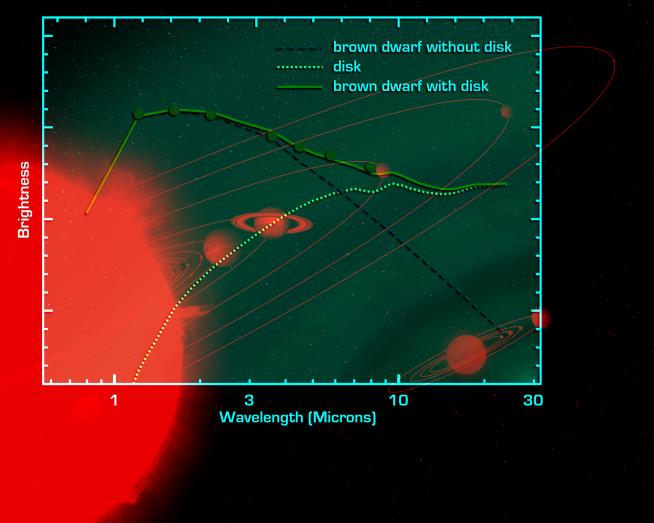
            Why bother visiting the dwarf even if it is so close by? Simulations predict that protoplanetary disks should form around brown dwarfs. In 2006, NASA’s Spitzer Space Telescope surveyed 35 nearby browns dwarfs and found dusty disks around a third of them. The remainder of the sample possibly had disks that are much fainter because they have already been cleared out by planets, say researchers.

            "There should be enough material present to form terrestrial planets in the inner disks [of brown dwarfs], and therefore the closest brown dwarfs should be important targets for future planet searches," wrote Danial Apai, of Stewart Observatory in Science magazine in 2005. What’s more, exoplanet candidates have been found orbiting three brown dwarfs so far

             Any cryoworlds around a neighboring dwarf would be an unlikely place to look for life. Brown dwarfs cool off quickly. The coolest found so far is at 700 degrees Fahrenheit. But if Jupiter’s moon Europa is any example, brown dwarf planets could have subsurface oceans kept warm by gravitational tidal interactions with the dwarf or other planets.

            The flyby would last just a few hours. The encounter timeline would be crammed with a barrage of imaging and spectroscopic observations. No astrobiology experiments could be done. But imagine if there were tantalizing fleeting snapshots of water ice plumes erupting from a planet, like the geysers on Saturn's frigid  moon Enceladus. 

           The builders of the probe would have spent their entire professional career waiting for the close encounter. The public would be enticed by the prospect of the first interstellar mission that can be completed with a single lifetime. The biggest cultural impact from the mission would be a photograph of the dwarf, with our sun seen as merely a bright star among background constellations.


 by "environment clean generations"

Related Posts Plugin for WordPress, Blogger...

Search

Custom Search

 
Design by Wordpress Theme | Bloggerized by Free Blogger Templates | coupon codes