Environment-Clean-Generations

Environment-Clean-Generations
THE DEFINITIVE BLOG FOR EVERYTHING YOU NEED TO KNOW ABOUT THE ENVIRONMENT YOU LIVE IN, WITH REFERENCE TO LIFE, EARTH AND COSMIC SPACE SCIENCES, PRESENTED BY ENVIRONMENTAL ENGINEER DORU INDREI, ENVIRONMENTAL QUALITY AND ENERGY SPACIALIST
"Life is not about what we know, but what we don't know, craving the unthinkable makes it so amazing, that is worth dying for." Doru Indrei
Custom Search
Showing posts with label earth. Show all posts

Any Hope for Doomed Earth's Last Organsims?


Billions of years from now, life on Earth will be extinguished when the dying sun scorches the surface of our planet. New research has aimed to determine what the last life forms on Earth will be, and what kind of abodes they will cling to before the Earth becomes sterilized.

We are fortunate that our planet orbits a star that has a long main-sequence lifetime. However, the sun’s luminosity is gradually increasing, and in about one billion years the effects of this will start to be felt on Earth.

Surface temperatures will start to creep relentlessly upwards over the next few billion years, which will increase the amount of water vapor in the air. This will act to further increase temperatures and will thus signify the beginning of the end for life on Earth.

The rising temperatures will cause excessive amounts of rain and wind, and thus increase the weathering of silicate rocks, which will suck extra carbon from the atmosphere. (Top 10 Ways to Destroy Earth)
Ordinarily, the carbon is replaced via plate tectonics in the carbon-silicate cycle as it is released in volcanic gases.

However, the oceans will start to evaporate as the temperatures continue to rise, which will probably put a stop to plate tectonics as scientists believe that water is an essential lubricant for the motion of tectonic plates on Earth. This will deplete the number of active volcanoes, and the carbon will not be replenished in the atmosphere.

The lack of carbon dioxide will effectively choke plant life on Earth, since plants require atmospheric CO2 for their respiration. The death of oxygen-producing plants will in turn lead to less oxygen in the atmosphere over a few million years. This will spell disaster for the remaining animal life on Earth, with mammals and birds being the first to become extinct. Fish, amphibians and reptiles would survive a little longer, as they need less oxygen and have a greater tolerance to heat.

The last type of animal present on the far-future Earth would likely be invertebrates. Once the insects finally succumb to the increasing temperatures, the Earth will once again be solely populated by microbial life, just as it had been for the first few billion years of our planet’s history. The last lingering life will desperately seek out niches of the planet that are still habitable, but  even extremophile forms of life will find this to be a challenge.

A habitable niche in an inhospitable world
 
As the Earth’s oceans evaporate, the few remaining pools of water could provide a last refuge for some microbes. The present average depth of the oceans is 2.5 miles (4 kilometers), but this extends to 6.8 (11 km) in the Mariana Trench, which is the deepest known ocean trench.

Trenches carved in the sea bed could be among the last places to harbor liquid water, with the looming walls offering some source of shade from the unforgiving sun. However, this potential haven is not quite as inviting as it may first seem. Air moving into the trench will become compressed as it sinks lower, and this pressure will greatly increase the air temperature above the water.

"By the time we get to the point where there's a trench with a small pool of water at the bottom, a large mass of ocean water would have evaporated, so surface temperatures on the planet would be rapidly increasing," said Jack O’Malley-James of the University of St. Andrews, and lead author of the new study. "Therefore, water at the bottom of a trench wouldn't remain cool enough for long enough to make a good refuge for life."
Another potential haven for the last microbial life on Earth could be in underground caves.

Microbes have been found living in caves on the present-day Earth without any need for sunlight. Most caves in the far-future Earth would not be suitable for life, as temperatures increase with depth. However, caves that have large chambers below a narrow entrance might be colder, as the dense cold air is sucked in, but lighter warmer air is barricaded out.

 Ice caves could be a final abode for microbial life in a far-future Earth with horrendous surface temperatures. CREDIT: Einreisenwelt

Such caves are formed from collapsed lava tubes, and the cold air in the caves will cause in-falling snow to compact into ice during the winter, as well as freeze any incoming water. When the outside temperature climbs again, the cold air is still trapped within the cave, along with the ice. However, the ice will melt eventually as heat is conducted through the walls of the cave, so it must be continually replaced and therefore some source of water would still be necessary on the far-future Earth for such a cave to retain its cool climate.

Life could also exist in subsurface environments other than ice caves. Microbial life today has been found at depths of 3.3 miles (5.3 km) below the Earth’s surface. The increase of temperature with depth is around 86 degrees Fahrenheit (48 degrees Celsius) per mile (1.6 km); however, the exact increase depends on the type of rock. Such a subsurface refuge could be one of the last to contain life on Earth.

At the other end of the scale, temperatures will decrease by around 18.9 degrees Fahrenheit (10.5 degrees Celsius) per mile above the Earth’s surface. This is because the surface of the Earth re-radiates heat that has been received from the sun, thus heating the lower atmosphere.

The lower temperatures at high altitude would encourage microbial life on the far-future Earth to reach for the skies and seek refuge in the last remaining lakes in the mountains in an attempt to escape the heat. However, as tectonic plates cease to crash into each other, there will no longer be a force to drive mountains upwards. Instead, the mountains will succumb to weathering and eventually there will be fewer regions of high altitude on the planet.

The remaining high-altitude regions would likely be comprised of volcanoes, as convection of molten rock in the mantle of the Earth will still occur even after the cessation of plate movement. The lack of plate tectonics will allow these "hot spot" volcanoes to reach heights that are currently impossible to achieve today.
"Sites around active volcanoes on Earth today host life, so living near an active volcano shouldn't be a challenge for extremophilic microorganisms," said O’Malley-James. "It's likely that volcanic activity would decline as the planet cools, but it may not stop completely during the time period in which planet is still habitable."

Isolated pools from the remnants of the ocean will have high salt concentrations, meaning that bacterial life would have to withstand high saline as well as high temperatures. Such microbes are called thermohalophiles, and they exist today in such conditions around hydrothermal vents. Microbes on the far-future Earth would also have to contend with being bombarded with high doses of ultraviolet radiation, as the ozone layer would have been stripped away when the oxygen in the atmosphere diminished.

Biosignatures of a dying planet

Studying what life will be like on Earth at the end of the habitable era helps scientists narrow down what kind of biosignatures might exist on Earth-like exoplanets orbiting aging stars near the end of their main sequence. So what kind of biosignatures would the last life on Earth exhibit?

Thermohalophiles, such as those found at volcanoes in Chile's Atacama Desert, use carbon monoxide to obtain energy, and the by-products of their metabolic processes include carbon dioxide, hydrogen, and ethanol.

Carbon dioxide could be seen as an indicator of life, considering that the carbon dioxide inherent to the planet would have been severely reduced million of years previously. Carbon dioxide by itself is not a biosignature and its presence, such as on Mars, does not indicate that life exists on a planet. However, biologically produced carbon dioxide would cause a disequilibrium of the CO2 in the atmosphere that could reveal the presence of microbial life.

Similarly, the biological production of hydrogen by the thermohalophiles could create an excess of hydrogen in the atmosphere, which could be used as an indicator of life. However, all of these biosignatures would likely be weak, as biological productivity would be severely diminished in a dying world.

Microbes can adapt to extreme conditions, such as the harsh conditions that existed on the early Earth. The first life to appear on Earth, as far back as 3.8 billion years ago, was unicellular life. Similarly, microbes will be the sole occupants of the Earth during its final days as a habitable planet. Microbial biospheres would exhibit biosignatures that are very dissimilar to what is present on the current Earth, but whether late-type biospheres would appear similar to early-type biospheres is another question.

"It looks like they would be similar to the biosignatures for early-type microbial biospheres, but the strength of the various atmospheric signatures would be much lower for the late-type microbial biospheres," said O'Malley-James. "So it may be possible to distinguish between early and late microbial biospheres purely by looking at the strength of the various biosignature gases in the atmospheric spectra of Earth-like planets."

Future work will seek to refine what these biosignatures could be, and ultimately search for the telltale signs of a dying habitable planet among the Earth-like planets that have been discovered so far.


Clouds Closer to Earth


Chicken Licken was right, the sky really is falling. Nasa satellite data has shown that the Earth's cloud tops have been lowering over the last decade.


 Cloud-top height fell one percent on average between March 2000 and February 2010, according to measurements from the multi-angle imaging spectroradiometer mounted on Nasa's Terra satellite. That one percent means a reduction of 30 to 40 metres in the average maximum height of clouds, during the 00s.

While the short record means it's difficult to draw any strong conclusions from the data, it does hint towards a longer-term trend. Roger Davies, the lead researcher on the project, warns that it's something that should be monitored in the coming decades to determine how significant it is for global temperatures.


If there is indeed a consistent reduction in cloud height, and this isn't just natural variability, then Earth would begin cooling to space more efficiently, reducing the surface temperatures and slowing the effects of climate change. 

.........................................................................................................................................................
..........................................................................................................................................................

"We don't know exactly what causes the cloud heights to lower," says Davies. "But it must be due to a change in the circulation patterns that give rise to cloud formation at high altitude." The Terra spacecraft, which launched in 1999 and records three-dimensional images of clouds around the globe, will continue gathering data in the coming years.

Which Volcanoes Will Erupt This Year?


After 50 days of silence, Sicily’s Mt. Etna rang in the New Year with a new eruption the morning of January 5. Plumes of black ash and lava rose 5,000 meters high in a style reminiscent of the volcano’s 18 eruptions last year.

Etna was not the first volcano to wake up in the first days of 2012 (scroll down for our Top Five New Eruptions of 2012), but it was certainly the most spectacular. Etna's snow-capped slopes enhanced the beauty of these latest fireworks; the snow also made the eruption smokier than some.

Europe’s tallest and most active volcano, Etna got its explosive start about half a million years ago as a series of submarine eruptions off the ancient coastline of Sicily. The restless mountain rose to its current grandeur via the accumulation of layer upon layer of erupted debris.

A similar process is just getting underway off the coast of El Hierro in Spain's Canary Islands, where ongoing eruptions are just beginning to break the ocean surface:

.........................................................................................................................................................

More...

..........................................................................................................................................................


This past week’s report from the Smithsonian/USGS Global Volcanism Program listed nine ongoing eruptions from last year, including El Hierro and Kilauea, on the Big Island of Hawaii.

Note that Germany's Laacher See was NOT on the official list of new activity, despite a recent Daily Mail story suggesting otherwise.
TOP 5 NEW ERUPTIONS OF 2012
  1. Etna (Italy): Plumes of black ash and lava began erupting in the early morning hours of January 5.
  2. Lewotolo (Indonesia):  Earthquakes intensified on January 2, following a month of white plumes rising 50 to 250 meters above the mountain’s summit; local officials raised the alert level from 1 to 3 in response to this change in activity.
  3. Tungurahua (Ecuador): A plume of gas and steam plume rose 200 meters above the crater on January 3. Explosions the previous week blanketed nearby villages with ash 2 to 4 millimeters deep.
  4. Galeras (Colombia): A webcam showed gas emissions, with steam rising from three separate craters.
  5. Callaqui (Chile): A pilot reported an ash plume above the volcano on January 2, but scientists could not confirm the presence of ash in satellite imagery under clear skies.

Healthier Planet with Zero Population Growth?


  • The world's population is expected to reach equilibrium by mid-century.
  • The stable growth rate will not mean a cure-all for the planet's health.
  • Generally, the more affluent a society, the more it consumes. 
By the middle of this century, the human population may reach an equilibrium, called the replacement level, where births equal deaths, according to UN projections.

But considering that two countries already at or below replacement levels, the United States and China, are also major polluters, will a stable population number really be better for the Earth?
"Population stabilization is not a cure all, but without it, it will be hard to solve much of anything else," John Seager of Population Connection, an organization dedicated to encouraging reduced global population growth.
Dealing with population increases while improving the living standard of the world's poor, yet avoiding environmental degradation, is like juggling chainsaws, said Seager. It's possible, but very difficult.


The "Impact Population Affluence Technology" equation provides a model of the juggling act, said Seager. It goes like this: Impact = Population x Affluence x Technology.
"Generally, the more affluent a society is the more it consumes... Technology can work both ways. If you buy a brand new giant SUV, your impact goes up. If you buy a hybrid your impact goes down," said Seager.
As the population part of the equation goes down it can allow increases in the other two without increasing the net impact on the planet.

.........................................................................................................................................................

More...

..........................................................................................................................................................

"If the developing world reduces population, it provides more time for heavy resource use," Hania Zlotnik, Director of the United Nations' (UN) Department of Economic and Social Affairs Population Division.
"The dilemma about the billion people in Africa, is that they must increase production and consumption [to increase their standard of living]. They must consume more, and that means more strain on environment. [But] They deserve it because they haven't had the chance," said Zlotnik.
In nearly every country, the fertility rate, or average number of children per woman, is already dropping, said Zlotnik, and the UN's projections for continued reductions are fairly reliable since they are based on the central trend of computer models of 100,000 different possibilities.
"It's not like stock market, where anything can happen. The patterns are fairly stable over time," she explained.

But there are no guarantees.
"We are at a very important point, because relaxing on activities to reduce population growth will just bring greater challenges," Zlotnik said.
The practicalities of reducing population growth involve fulfilling the unmet family planning needs of millions of women. Over 35 percent of women in some nations, such as Ghana and Haiti, would like to use family planning but lack the resources, according to UN figures.
Access to voluntary, affordable and understood methods of birth control can bring about transformation in less than a generation, said Seager.
He mentioned the United States, Mexico and Iran as three examples of very different cultures that all reduced fertility rates through purely voluntary methods.
"As families become smaller, education improves. That leads to the human capital necessary to meet environmental challenges," said Seager.

Bee Collapse Because of the Pesticides?


More clues have been found in the case of the disappearing honey bees.
Powdery waste blown off from seed planters was found to contain up to 700,000 times the bee's lethal dosage of neonicotinoid insecticides in a Purdue University study. The study also found the insecticides clothianidin and thiamethoxam in dead bees laying in and around hives in Indiana.

"We know that these insecticides are highly toxic to bees; we found them in each sample of dead and dying bees," said Christian Krupke, associate professor of entomology at Purdue and a co-author of the study published in PloS One, in a press release.

The waste dust is mostly harmless talc, which is used to help coat corn, soy and cotton seeds with insecticides. Without the talc, the polymers used to bind the chemicals to the seeds clog up the seed coating machine and in the planters.

But the excess talc brings some of the pesticide with it when it gets blown off into the air when mechanical planters put the seed in the ground. The talc, along with the pesticides, then settles on nearby vegetation.
"Given the rates of corn planting and talc usage, we are blowing large amounts of contaminated talc into the environment. The dust is quite light and appears to be quite mobile," Krupke said.


"Whatever was on the seed was being exhausted into the environment," Krupke said. "This material is so concentrated that even small amounts landing on flowering plants around a field can kill foragers or be transported to the hive in contaminated pollen. This might be why we found these insecticides in pollen that the bees had collected and brought back to their hives."

The research also consistently found the pesticides at low levels in soil, even up to two years after treated seed was planted. Corn pollen also showed traces of the chemicals.

Greg Hunt, a study co-author, noted that the contaminated talc isn't the only threat to the bees. Parasites, pesticides, and other factors are pummeling the pollinators.
"It's like death by a thousand cuts for these bees," Hunt said.

Engineering in Antarctica


January 15, 2012-- Engineers with British Antarctic Survey have now made it possible to go where no human has gone before: three kilometers down through solid ice, to a buried lake that promises to reveal vital clues to past climate change -- and could harbor life-forms never known before.

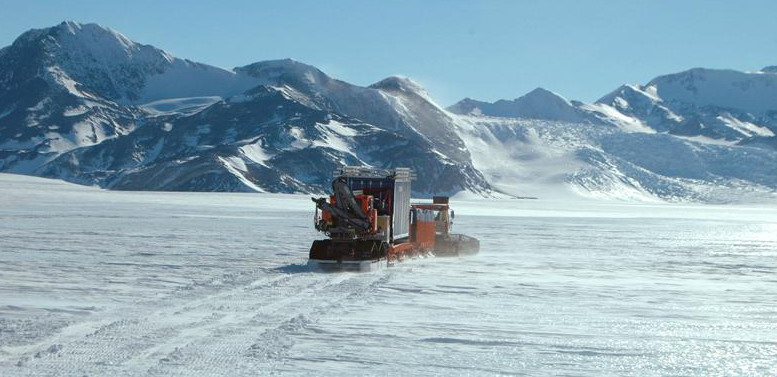
Enduring whipping winds and temperatures of minus 35 degrees Celsius (not counting the wind chill), the engineers used powerful tractor-trains to transport nearly 70 metric tons of drilling equipment across Antarctica's ice, over deep snow and steep mountain passes, to one of the most remote and hostile locations on the planet.

The target of this grueling journey: a spot on the ice high above Lake Ellsworth, a mysterious and untouched pocket of liquid water deep inside the West Antarctic Ice Sheet.

Now that the equipment is in place, a research team will return in November to drill a three-kilometer borehole into Lake Ellsworth to collect water and sediment. If they succeed, Ellsworth will become the first of Antarctica's 387 known subglacial lakes to be measured and sampled directly..


A cargo plane carried the tractors and drilling equipment for the Lake Ellsworth mission as far as Union Glacier, a site in the Ellsworth Mountains that serves as the major hub for all scientific operations to Antarctica's remote interior.


To get the equipment from Union Glacier to the Lake Ellsworth drilling site, the engineers hitched powerful tractors to sledges and skis to haul the heavy blue containers containing the drilling equipment.

.........................................................................................................................................................

More...

..........................................................................................................................................................

Soft, deep snow and concrete-hard sastrugi snow forms slowed progress, but the tractor-train reached the Lake Ellsworth drilling site in three days.


Upon arrival, an engineer fits GPS locators at the corners of the equipment storage.

Windblown snow will partially bury the equipment over the coming Antarctic winter, making it otherwise difficult to find when the science team returns in November to start drilling. (Antarctic summers are too short to transport the equipment and accomplish the drilling in a single season.)

In the coming months, this precious cargo will endure wind chills reaching minus 70 degrees C and wind gusts up to 160 kilometers per hour.
Spectacular explosions of snow, like this one detonated at the Lake Ellsworth drilling site during a previous visit, helped scientists decipher the shape of the buried lake. Researchers set off the explosions and then use seismic equipment to record the sound waves reflecting off rock, ice, water and other materials within the ice.


Seismic studies have revealed that Lake Ellsworth is a long, narrow U-shaped lake approximately 12 kilometers by 3 kilometers. It is 150 meters deep at its deepest point and covers an area of 29 square kilometers.

Ellsworth and other subglacial lakes in Antarctica can persist in a liquid state because the overlying ice provides insulation for the heat rising up through the bedrock from the earth’s core, melting ice near the base of the ice sheet.

This melted water flows into hollows and valleys beneath the ice just as it does on the land surface to form lakes. The largest and most well known subglacial lake is Lake Vostok on East Antarctica, which Russian scientists have been trying to access, so far unsuccessfully.


Small planes can land safely at the Lake Ellsworth drilling site during the summer months. Getting people and basic supplies to the site in November will not take the extreme effort of delivering the drilling equipment. But that doesn't mean the work will be easy. The team will live in tents and work on location for about six weeks.


Researchers will use a stream of high-pressure hot water blasted from the end of this high-tech yellow hose to drill through the frozen ice sheet lying above the Lake Ellsworth. The hose is a continuous 3.4 kilometers (long enough to extend from the surface down into the buried lake) and strong enough to support its own weight and that of the drill nozzle.

Other equipment delivered by tractor-train included: (1) an industrial-sized boiler to heat 30,000 liters of hot water to 90 degrees C for the drill (2) 3 large surface tanks (each with a 5-meter diameter) to store water above freezing point in temperatures as low as minus 20 degrees C and (3) several large-scale generators to provide electrical power to the drill.

Through a borehole carved using hot-water drill, the team will lower a titanium probe to measure and sample the water, followed by a corer to extract sediment from the lake. They will have just 60 hours to collect water and sediment samples before the borehole re-freezes.

The hot water drill will use and recycle the existing ice on site for the drilling fluid, minimizing the potential for contamination of the lake. All equipment was designed and manufactured to meet space-industry standards for "clean" technology.


Soon the sun will set for the last time over the Lake Ellsworth drilling site, bringing several long weeks of darkness. The engineers and scientists will return with the light, ready to make history.

The waters of Lake Ellsworth have been cut of from all light for as long as half a million years. Also under high pressure all that time, the hidden lake may have evolved unusual forms of microbial life.

If such microbes turn out to exist, they could help explain how life managed to survive during global deep freezes of the Earth's distant past -- during the so-called Snowball Earth episodes, when most if not all of the planet was enshrouded in ice. And they might up the odds that life could have evolved in other extreme environments, such as the liquid water known to exist beneath the icy surface of Jupiter's moon Europa.

Now we just have to wait and see.


Kepler Team Confirms First Earth-like Planet in a Habitable Zone, And Finds 1,094 More Worlds


Nestled in the Goldilocks zone of a small, sun-like star is a room-temperature world a little more than twice the size of Earth. Scientists do not yet know if it is rocky or gaseous and whether it has water or clouds, but they do know that it’s the right size, and in the right place, for liquid water to exist. If it does exist, it may be one of the best places to look for life outside of our solar system.

The new planet, Kepler-22, is about 600 light-years away and the smallest planet confirmed to exist smack in the middle of the habitable zone of a sun-like star. It’s one of the most stunning announcements from the Kepler Space Telescope, which stares at a field of stars in the constellations Cygnus and Lyra and looks for blips in brightness to find other planets. While Kepler has (as of today) found more than 2,000 possible planets, finding an Earth-like world in a sun-like environment has proved elusive — until now.


“This is a major milestone on the road to finding Earth's twin,” said Douglas Hudgins, Kepler program scientist at NASA Headquarters in Washington.
On top of this announcement today, the Kepler science team is sharing 1,094 more planet candidates, many of which are also potentially Earth-like and in habitable zones. Now there are 2,326 planet candidates in the sun-orbiting space telescope’s field of view, in a small sliver of the sky.

Kepler-22b’s discovery was first announced last February, when the Kepler team shared its initial treasure trove of planet candidates. Among 1,235 candidate worlds, there were 54 habitable zone candidates, Kepler-22b among them. Now it’s the first of these to be confirmed.
It takes 290 days to orbit around its star, Kepler-22, a G-class star a lot like the one we know best. “It’s almost a solar twin; it is very similar to our sun,” Natalie Batalha, Kepler deputy science team lead at San Jose State University, said in a press conference.

 ...........................................................................................................................................................
...........................................................................................................................................................


The planet is about 15 percent nearer to its star than Earth is to the sun. But this is OK because the star is cooler (by about 220 degrees), a bit dimmer, and a little smaller than our star. So the planet is in a really analogous Earth-like orbit. The planet’s temperature is even pretty close to Earth’s, said William Borucki, the Kepler mission’s principal investigator at NASA’s Ames Research Center. “If greenhouse warming on this planet was similar (to atmospheric warming on Earth), its surface temperature would be something like 72° F,” he said.


Kepler-22 System: This diagram compares our own solar system to Kepler-22, a star system containing the first "habitable zone" planet discovered by NASA's Kepler telescope. The habitable zone is the sweet spot around a star where temperatures are right for water to exist in its liquid form. Kepler-22's star is a bit smaller than our sun, so its habitable zone is slightly closer in. The diagram shows an artist's rendering of the planet comfortably orbiting within the habitable zone, similar to where Earth circles the sun.  NASA/Ames/JPL-Caltech
 
It will be a mighty nice place to look for signs of life, he added. Jill Tarter, director of the Center for SETI Research at the SETI Institute, said astrobiologists are taking that to heart. “We will give a higher priority to worlds that our colleagues tell us are not too warm, not too cold, but just right,” she said.
With so many exoplanets, astronomers will need to start making some catalog decisions, ranking planets by their habitability potential. Along with the Earth Similarity Index we covered last month, the Kepler team has their own proposed planetary directory to make this easier. The Habitable Exoplanets Catalog ranks planets by their surface temperature, similarity to Earth, and capacity to sustain organisms at the bottom of the food chain.

Monday’s announcement came during the inaugural Kepler Science Conference in Mountain View, Calif. With the addition of 1,094 new candidate worlds, the number of planet candidates has increased by 89 percent and now totals 2,326. Of these, 207 are approximately Earth-size, 680 are super Earth-size, 1,181 are Neptune-size, 203 are Jupiter-size and 55 are larger than Jupiter. So since February, the number of Earth-size and super Earth-size candidates has increased by more than 200 and 140 percent, respectively.
That’s a lot of numbers, and here’s another good one: 10. That’s the number of these new candidates that are near-Earth-sized and in the habitable zones of their host stars. Kepler-22b is not among that list, so that makes at least 11 places elsewhere in the galaxy that might look very, very familiar.

There’s still a bit of work to do to quantify just what Kepler-22b looks like. Now that astronomers are convinced it’s a planet and they know where it is, confirming their findings with the Spitzer Space Telescope, they want to find out what it's made of. Ground-based telescopes like the Keck Observatory will start making some measurements next summer, when the field of sky that Kepler studies is visible from Earth.

And there is still much more to come, according to NASA scientists. Some software improvements have made it a little simpler to sift through Kepler light-curve data and hunt for planet candidates, so there will be at least one more big batch, according to Batalha. Among those, there may be many more Earth-like candidates to join the ranks.
“We are really zeroing in on the true Earth-sized habitable planets,” she said.
NASA
Environment Clean Generations

Can we Predict When and Where Quakes will Strike?


This week, six seismologists go on trial for the manslaughter of 309 people, who died as a result of the 2009 earthquake in l'Aquila, Italy.
The prosecution holds that the scientists should have advised the population of l'Aquila of the impending earthquake risk.
But is it possible to pinpoint the time and location of an earthquake with enough accuracy to guide an effective evacuation?
There are continuing calls for seismologists to predict where and when a large earthquake will occur, to allow complete evacuation of threatened areas.

Predicting an earthquake with this level of precision is extremely difficult, because of the variation in geology and other factors that are unique to each location.
Attempts have been made, however, to look for signals that indicate a large earthquake is about to happen, with variable success.

Historically, animals have been thought to be able to sense impending earthquakes.
Noticeably erratic behaviour of pets, and mass movement of wild animals like rats, snakes and toads have been observed prior to several large earthquakes in the past.
Following the l'Aquila quake, researchers published a study in the Journal of Zoology documenting the unusual movement of toads away from their breeding colony.

But scientists have been unable to use this anecdotal evidence to predict events.
The behaviour of animals is affected by too many factors, including hunger, territory and weather, and so their erratic movements can only be attributed to earthquakes in hindsight.


What causes an earthquake?

An earthquake is caused when rocks in the Earth's crust fracture suddenly, releasing energy in the form of shaking and rolling, radiating out from the epicentre.
The rocks are put under stress mostly by friction during the slow, 1-10 cm per year shuffling of tectonic plates.
The release of this friction can happen at any time, either through small frequent fractures, or rarer breaks that release a lot more energy, causing larger earthquakes.
It is these large earthquakes that have devastating consequences when they strike in heavily populated areas.
Attempts to limit the destruction of buildings and the loss of life mostly focus on preventative measures and well-communicated emergency plans.

Precursor events
 
When a large amount of stress is built up in the Earth's crust, it will mostly be released in a single large earthquake, but some smaller-scale cracking in the build-up to the break will result in precursor earthquakes.

"There is no scientific basis for making a prediction”
Richard Walker University of Oxford
 
These small quakes precede around half of all large earthquakes, and can continue for days to months before the big break.
Some scientists have even gone so far as to try to predict the location of the large earthquake by mapping the small tremors.
 ..........................................................................................................................................................
...........................................................................................................................................................

The "Mogi Doughnut Hypothesis" suggests that a circular pattern of small precursor quakes will precede a large earthquake emanating from the centre of that circle.
While half of the large earthquakes have precursor tremors, only around 5% of small earthquakes are associated with a large quake.
So even if small tremors are felt, this cannot be a reliable prediction that a large, devastating earthquake will follow.
"There is no scientific basis for making a prediction", said Dr Richard Walker of the University of Oxford.
In several cases, increased levels of radon gas have been observed in association with rock cracking that causes earthquakes.

Radon is a natural and relatively harmless gas in the Earth's crust that is released to dissolve into groundwater when the rock breaks.
Similarly, when rock cracks, it can create new spaces in the crust, into which groundwater can flow.
Measurements of groundwater levels around earthquake-prone areas see sudden changes in the level of the water table as a result of this invisible cracking.
Unfortunately for earthquake prediction, both the radon emissions and water level changes can occur before, during, or after an earthquake, or not at all, depending on the particular stresses a rock is put under.

Advance warning systems
 
The minute changes in the movement, tilt, and the water, gas and chemical content of the ground associated with earthquake activity can be monitored on a long term scale.
Measuring devices have been integrated into early warning systems that can trigger an alarm when a certain amount of activity is recorded.

"Prediction will only become possible with a detailed knowledge of the earthquake process. Even then, it may still be impossible”
Dr. Dan Faulkner University of Liverpool


Such early warning systems have been installed in Japan, Mexico and Taiwan, where the population density and high earthquake risk pose a huge threat to people's lives.
But because of the nature of all of these precursor reactions, the systems may only be able to provide up to 30 seconds' advance warning.

"In the history of earthquake study, only one prediction has been successful", explains Dr Walker.
The magnitude 7.3 earthquake in 1975 in Haicheng, North China was predicted one day before it struck, allowing authorities to order evacuation of the city, saving many lives.
But the pattern of seismic activity that this prediction was based on has not resulted in a large earthquake since, and just a year later in 1976 a completely unanticipated magnitude 7.8 earthquake struck nearby Tangshan causing the death of over a quarter of a million people.
The "prediction" of the Haicheng quake was therefore just a lucky unrepeatable coincidence.
A major problem in the prediction of earthquake events that will require evacuation is the threat of issuing false alarms.
Scientists could warn of a large earthquake every time a potential precursor event is observed, however this would result in huge numbers of false alarms which put a strain on public resources and might ultimately reduce the public's trust in scientists.

"Earthquakes are complex natural processes with thousands of interacting factors, which makes accurate prediction of them virtually impossible," said Dr Walker.
Seismologists agree that the best way to limit the damage and loss of life resulting from a large earthquake is to predict and manage the longer-term risks in an earthquake-prone area. These include the likelihood of building collapsing and implementing emergency plans.

"Detailed scientific research has told us that each earthquake displays almost unique characteristics, preceded by foreshocks or small tremors, whereas others occur without warning. There simply are no rules to utilise in order to predict earthquakes," said Dr Dan Faulkner, senior lecturer in rock mechanics at the University of Liverpool.
"Earthquake prediction will only become possible with a detailed knowledge of the earthquake process. Even then, it may still be impossible."

China’s Colossal Structures Confound


There seems to be no end to the  weird and king-sized structures populating China's desert - or to the explanation for these mega-projects.
Take the giant jigsaw-like grids that started the latest wave of interest in these mysteries of the Gobi. Some suggest they are hoaxes perpetrated on the Google Earth-obsessed. Jonathan Hill, a research technician at the Mars Space Flight Facility, notes that the grids can be viewed from space. So maybe they're used to calibrate China's spy satellites. In an  interview with  Life's Little Secrets,  Hill cites a giant white cross, which was created in the 1960s in Casa Grande, Arizona by the US to calibrate their orbiting eyes in the sky.


 ..........................................................................................................................................................
...........................................................................................................................................................

But that doesn't explain  this Masonic-looking pair of patterns, etched into the desert. Clearly, there's more going on than just a spy-cam focal point. Some  believe it is the Yaerbashi training airfield of the Chinese air force's  8th Flying Academy, or perhaps China's  Yaerbashi Test Range. Others wonder if it might be a giant joke played on sat-spotters.
"As to what the figure-8 things and the weird glyphs on the northern chevron are, I have no real idea," emails former CIA analyst Allen Thomson. "Although it wouldn't surprise me if the glyphs were made by some people who were bored out of their minds by being stuck out in the middle of nowhere and decided to have some fun with the eyes in the sky."
If it's a giant gag, it's not the only one. Check out the gallery to see all the things Wired.com's Danger Room readers have found this week scouring Google Earth's images of the Gobi.


   Environment Clean Generations

We are entering a time of 'anarchonomy' ?

We are moving to a world revolving around alternate economies where we've all become traders, according to Chris Sanderson from the Future Laboratory, speaking at Intelligence Squared's If Conference.
He referred to this trend as "anarchonomy", a hybrid of anarchy and economy. "As we see change in geopolitics and social networks, so we see anarchy happening in business," he said. With these anarchonomic business models we no longer just transact. "We've all become traders. We all have something to sell, so the whole basis of consumption and process of consumer activity has changed."


According to Sanderson we are at the base of a "mountain of destruction" and are entering a period of transformation. He described the move towards more collaborative consumption and taking a generous approach to innovation. He quoted Daniel Burrus as saying: "The best way to create ideas is to change the ones we have. Taking an abundant approach, rather than a scarcity approach, helps us all."
He described how were are entering a world of DIY and hacking, and cited the digital haberdashery Technology Will Save Us as a shining example of this new paradigm. "They are trying to earn a buck, but making money doesn't seem to be at the heart of what they do."

...........................................................................................................................................................
...........................................................................................................................................................


"Apple are doomed for failure," he said, in reference to the fact that they make it so hard to open up their devices. "They better watch out, because the competition is round the corner. It won't be Dell or IBM or HTC or Lenovo… it's you and me. We are the competitor set. We will come up with better ideas. That's the DIY challenge."

He mentioned Sugru, the silicon gel that can be used to fix devices, as the sort of product that allows us to deal with obsolescence. "We can hack the system, we can hack the product. We make it better," he said. This trend isn't only evident in crafty individuals, but in burgeoning markets such as China where they have copied the iPhone to create the HiPhone, which they view as an improvement. He added: "What do you do if you are Apple? That's the challenge that traditional manufacturers face in the 21st century."

Plan to Save the Oceans


The world has made lacklustre progress in meeting most of the commitments it made 20 years ago to safeguard the oceans, says a report. At the 1992 Earth Summit in Rio de Janeiro, Brazil, agreements were made on issues such as sustainable fisheries and aquaculture, capacity building, and biodiversity; later, the Johannesburg Summit in 2002 in South Africa set targets and timetables to achieve those goals.


But a report entitled Oceans at Rio+20 has rated both the effort and the achievements to date in protecting oceans and meeting these commitments as 'low to medium'.
Meanwhile a separate, UN report says that at least 40 per cent of the global oceans are 'heavily affected' by human activities and that 60 per cent of the world's major marine ecosystems have been degraded or are being used unsustainably. It makes ten proposals for improvement.
Oceans at Rio+20 calls for a string of actions, including more scientific research and capacity building in small island states, to try to tackle the problems.

Read more
Environment Clean Generations

The Hidden Costs of Gold


The high price of gold has sent thousands into the informal mining sector and exposed workers and the environment to the devastating effects of mercury poisoning. Trembling and irritable, at times psychotic, the hat makers of 19th”� century England were know to be a bit odd at best. Separating fur from animal skins, they washed them in a compound”� called mercury nitrate a process that released vapors into steaming ”�air already choked with fumes.

In the poorly ventilated workshops of the industrial revolution, ”�prolonged exposure led to mercury poisoning and eventually the phrase as mad as a hatter.”�”�  The types of conditions that put industrial workers at risk of mercury ”�poisoning have long been banned in the west with the EU going as far”� as forbidding the sale of mercury thermometers to the public in 2008.”�”�
But in Africa, hazardous conditions still exist.  Small scale miners use mercury to extract gold across the continent with the numbers rising as the precious metal has tripled in price ”�from $513 an ounce in 2005 to $1700 this year.
Read more .
Environment Clean Generations

Pamukkale – Turkey’s White Cotton Castle


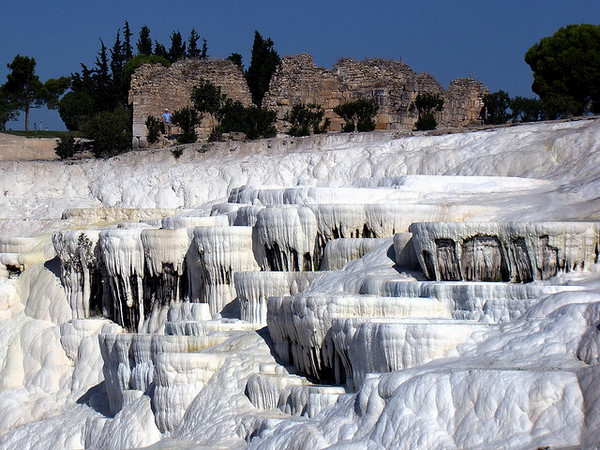
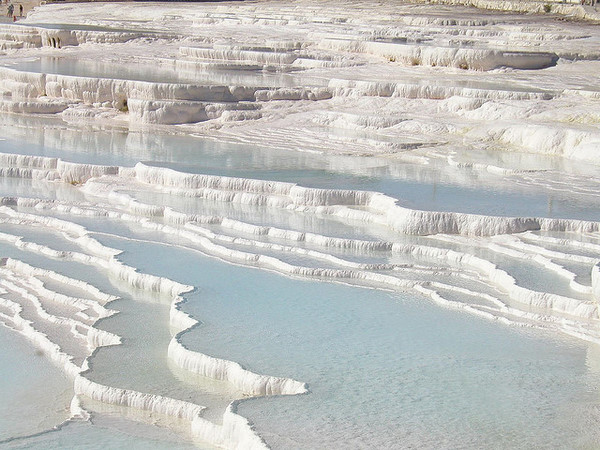
Pamukkale is the prominent historic site in Turkey that literally means “cotton castle” is situated beneath the ancient city of Hierapolis. The cotton castle contained many old tombs in their structure but the landscape and excretion of hot springs as well as terrace-tines demolish the appearance of tombs. The terrace-tines are a layer of chemicals that is generated because of the calcium carbonates left by the flowing water.
Tourists are attracted by its splendid appearance of organic structure and take bath in it. Moreover, the water stream contains the hot spring (calcium carbonate form) that comes from different seventeen paths to change the temperature of water from lukewarm to boiling hot. This surprising reality of the castle busted in front of world which increase its popularity that magnetize various hotel owners to play their role to promote the heritage and to make profit from it.
But to preserve the world heritage wonder the related institutions have banned the usage of vehicles to visit it; moreover the hotels are shifted far away too. Now, visitors are only allowed to visit the phenomenal ancient castle without shoes to protect the natural marvel.


The Largest Swimming Pool on Earth


The history of swimming pools date back to Greeks and Romans but later on the concept was adopted by the British. The swimming pool situated beside the sea in Chile is the biggest in the world, having a capacity to store 66 million gallons of water and has a depth of 115 feet. The length of the pool is 1000 yards and the total area it occupies is 20 acres. The pool has already won the Guinness Book of Record of the largest pool of World. The pool, which took $1 billion for construction, has an annual maintenance cost of $2 million.


pool1
pool2
pool4


largest-pool
best-swiming-pool

Beauty of Pakistan [Places to Visit]


Some beautiful pictures from Pakistan, 


Bolan Baluchistan - Image: http://www.flickr.com/photos/commoner/2653657824/
Rawalakot-Azad Kashmir
Mull-Pur Village (District Islamabad)
Murree-Kalabagh Road
Loh-e-Dandi - Bari-Imam (District Islamabad)
Godwin Austen, Baltistan District Northern Areas Pakistan. Image: http://www.flickr.com/photos/tree_elf/331222000/
PAF Base (Kalabagh)
PAF Base (Kalabagh)
Rawal Dam Back View (Restaurant)
Neelam Valley (Muzaffarabad-Azad Kashmir)
Lahore, Pakistan - Image: http://www.flickr.com/photos/asadk/219763199/
Simly Dam (Lake View)
Derawar Fort - Image: http://dildilpakistan.wordpress.com
Chitral
Chitral
karakoram
karakoram
Grand Hotel (Muzaffarabad-Azad Kashmir)
Satpara Lake, Pakistan - Image: http://www.flickr.com/photos/tree_elf/311057780/in/set-1175068/
Rawal Dam Back View
Rawal Dam Back View
Rawal Dam (Lake View)
Ansu Lake - Image: http://www.opf.org.pk/home/photos/1.html
Simly Dam (CDA Guest House)
Badshahi mosque, Lahore, Pakistan - Image: http://www.flickr.com/photos/98122895@N00/1364876659
Saiful Malook - Image: http://outdoors.webshots.com/photo/1176524632057254194fLtDtF
Simly Dam
Simly Dam
Swat Valley
Swat Valley
Kutwal Lake,The Karakorams - Image: http://www.flickr.com/photos/tree_elf/326542050/in/set-72157611500691940/
Nanga Parbat valley, Pakistan
Somewhere in Northen Areas - Image: http://dildilpakistan.wordpress.com
Neelam Valley - Image: http://images.muxlim.com/eddiednn/354874767-9140462674-o/

Related Posts Plugin for WordPress, Blogger...

Search

Custom Search

 
Design by Wordpress Theme | Bloggerized by Free Blogger Templates | coupon codes