Environment-Clean-Generations

Environment-Clean-Generations
THE DEFINITIVE BLOG FOR EVERYTHING YOU NEED TO KNOW ABOUT THE ENVIRONMENT YOU LIVE IN, WITH REFERENCE TO LIFE, EARTH AND COSMIC SPACE SCIENCES, PRESENTED BY ENVIRONMENTAL ENGINEER DORU INDREI, ENVIRONMENTAL QUALITY AND ENERGY SPACIALIST
"Life is not about what we know, but what we don't know, craving the unthinkable makes it so amazing, that is worth dying for." Doru Indrei
Custom Search
Showing posts with label space. Show all posts

Hubble Telescope Spots Exoplanet Made of Water


GJ 1214b, a planet some 40 light-years from Earth, is a water world. It's almost entirely made of liquid, has an estimated temperature of 230C and is enshrouded by a steamy atmosphere.

"The high temperatures and high pressures would form exotic materials like hot ice or superfluid water: substances that are completely alien to our everyday experience," explains Zachory Berta of the Harvard-Smithsonian Center for Astrophysics.


It's classified as a super-Earth, as the planet is about 2.7 times Earth's diameter and weighs almost seven times as much. It orbits its star every 38 hours at a distance of just two million kilometres, resulting in those super-hot temperatures.


The planet was first discovered in 2009, by the ground-based MEarth Project. The next year, astronomers from the Harvard-Smithsonian Center for Astrophysics (CfA) measured the exoplanet's atmosphere, and found that it could be composed mainly of water.

But those observations could also be explained if the planet just had a thick, hazy atmosphere. So, the team waited for GJ 1214b to cross in front of its host star (a red dwarf). When that happens, the star's light is filtered through the planet's atmosphere, giving hints to the mix of gases it contains.

.........................................................................................................................................................
..........................................................................................................................................................

"We're using Hubble to measure the infrared colour of sunset on this world," explained the CfA team leader.
The team used Hubble's Wide Field Camera 3 (WFC3) to watch the planet's transit, and found the spectrum of GJ 1214b to be featureless over a wide range of wavelengths. That's consistent with a dense atmosphere of water vapour, suggesting the planet is covered by steam -- not haze.

Because the team knows the planet's mass and size, they can calculate the density. It comes out at about about two grams per cubic centimetre -- seeing as water has a density of one gram per cubic centimetre, and the Earth's average density is 5.5 grams per cubic centimetre, GJ 1214b has much more water and much less rock than our so-called "Blue Marble".

The liquid planet has been flagged as a "prime candidate" for study by Hubble's successor: the James Webb Space Telescope, when it launches around 2018.

Solid Buckyballs in Space Found by Spitzer Telescope


After finding gaseous clouds of buckyballs in space last year, astronomers have now discovered the carbon balls in a solid form, around a pair of stars some 6,500 light-years from Earth.

Buckyballs are microscopic spheres, where 60 carbon atoms are arranged -- with alternating patterns of hexagons and pentagons -- into a football-like pattern. The unusual structure makes them incredibly strong, and ideal candidates for things like superconducting materials, medicines, water purification and armour.


They got their name because of their resemblance to the geodesic domes of the architect Buckminster Fuller.


So far, they've only been found in gas form in space. In 2010, astronomers using the Spitzer space telescope found the balls in a planetary nebula called Tc 1.
But with this latest discovery, again using data from Nasa's Spitzer space telescope, astronomers found particles consisting of stacked buckyballs. They had stacked together like oranges in a crate to form a solid shape.

.........................................................................................................................................................
..........................................................................................................................................................

"The particles we detected are minuscule, far smaller than the width of a hair, but each one would contain stacks of millions of buckyballs," said the paper's lead author Nye Evans of Keele University in England.
The research team was able to identify the solid form of buckyballs in the Spitzer data because they emit light in a unique way that differs from the gaseous form. In all, the team detected enough solid buckyballs to fill the equivalent in volume to 10,000 Mount Everests.

"This exciting result suggests that buckyballs are even more widespread in space than the earlier Spitzer results showed," said Mike Werner, project scientist for Spitzer at Nasa's Jet Propulsion Laboratory. "They may be an important form of carbon, an essential building block for life, throughout the cosmos."

Huge Avalanche near Mars's North Pole


A Nasa spacecraft has captured an avalanche of fine ice and dust thundering over a cliff near Mars's north pole. 

It's not the first avalanche captured by the HiRISE camera aboard the Mars Reconnaissance Orbiter - Nasa first detected the phenomenon in 2008, believed to be caused by a thin 'crust' of frozen carbon dioxide (dry ice) which forms during the Martian winter. 

 Ice and dust cascade over a Martian cliff: The camera on the Mars Reconnaissance Orbiter captured the avalanche near Mars's north pole

The HiRISE high resolution camera took the amazing photograph at 85 degrees north on the planet.
The HiRISE camera is one of several hi-tech instruments on board Mars Reconnaissance Orbiter. It's the largest camera ever carried into deep space.
Nasa's ground team says that the events are detectable by a cloud of fine material that erupts when avalanches collapse down slopes on the planet.


Some avalanches on Mars are caused by meteorite impacts, but others are thought to be the result of 'seasons' on the planet, which has winters, just like Earth.
Planetary scientist Ingrid Daubar Spitale of the University of Arizona, who first noticed the avalanches in photos taken by the Mars Reconnaissance Orbiter said, 'It's great to see something so dynamic on Mars. A lot of what we see there hasn't changed for millions of years.'


.........................................................................................................................................................
..........................................................................................................................................................


Fine ice and dust cascades over a martian polar cliff in March 2010 in another picture captured by the Mars Reconnaissance Orbiter's HiRISE camera.

Ancient Ocean on Mars


The European Space Agency's Mars Express has returned compelling evidence that the red planet once hosted an enormous ocean in its northern plains. The probe's radar detected sediments reminiscent of an ocean floor, within areas that have been suspected to be shorelines.
Jérémie Mouginot from the Institut de Planétologie et d'Astrophysique de Grenoble (IPAG), the University of California in Irvine, and colleagues analysed more than two years of data from Mars Express' Marsis (Mars Advanced Radar for Subsurface and Ionosphere Sounding) radar.

The radar can penetrate deep into the planet's ground, and reveal the first 60 to 80 metres of the planet's subsurface. At these depths, the team found that the northern plains are covered in low-density material.
"We interpret these as sedimentary deposits, maybe ice-rich," says Mouginot. "It is a strong new indication that there was once an ocean here."


The notion of water on Mars and big ideas of oceans in the planet's ancient history are nothing new. But this research provides some of the best evidence yet that there were once large bodies of liquid water on Mars, and it is further proof that water played a role in martian geological history.
"Previous Mars Express results about water on Mars came from the study of images and mineralogical data, as well as atmospheric measurements," said Olivier Witasse, a Mars Express project scientist at the European Space Agency.


This data supports a proposed theory where Mars has had two oceans in its lifetime. One four billion years ago when warmer conditions prevailed, and another three billion years go when subsurface ice melted following a large impact.

This later ocean would have been very temporary. It would only have lasted about a million years or less, Mouginot estimates, and then the water would have either frozen back in place or turned into vapour and lifted gradually into the planet's weak atmosphere.

.........................................................................................................................................................
..........................................................................................................................................................

"I don't think it could have stayed as an ocean long enough for life to form," Mouginot says.
A recent study from Imperial College London doesn't offer much good news for martian life-hunters, either. Soil analysis at the site of Nasa's Phoenix mission suggest that surface of Mars has dry as a bone for hundreds of millions of years, making it too hostile for any life to survive on the planet's surface

Future Astronauts Will be Able to Perform Surgery on Each Other


Astronauts traveling to Mars or other distant destinations will face all kinds of medical problems, but rocket science isn’t surgery. And vice versa. A new augmented reality system could help astronauts take care of each other, overlaying computer graphics over a real patient to guide diagnoses or even surgery. It could even improve telemedicine in developing countries or remote spots.

..........................................................................................................................................................
..........................................................................................................................................................

For now, the Computer Assisted Medical Diagnosis and Surgery System, CAMDASS, only works with ultrasound, which is already available on the International Space Station. But the goal is to use it for any biomedical procedures future astronauts might need, according to the European Space Agency.


CAMDASS users don a 3-D display headcam, which includes an infrared camera to track the ultrasound device. Markers placed on a patient’s body denote sites of interest, and the system recognizes the patient and calibrates the display according to the CAMDASS wearer’s vision, an ESA news release explains. The headset displays little floating cue cards in the wearer’s field of vision, which match up with the markers on the real patient. Aligning the markers helps the user position the ultrasound probe, or whatever other device is needed. Then reference images show what the CAMDASS wearer should be seeing.

The ESA tested a prototype of this device with medical and nursing students, paramedics and Belgian Red Cross workers at Saint-Pierre University Hospital in Brussels. The CAMDASS testers could perform a “reasonably difficult” ultrasound procedure without any other help, the space agency said.
Augmented reality can be pretty fun to play with, but the practical applications of a real-life informational overlay are limitless. This is one reason why DARPA wants AR contact lenses that would require no bulky headgear. We've even seen an AR concept in which a would-be home mechanic can learn how to repair a car.

Similarly, this ESA device could be useful long before anyone takes it to Mars. It could help improve diagnostics in developing countries, for instance, or in remote locations like Antarctic research stations. Workers there have had to complete their fair share of self-diagnostics. The ESA now wants to conduct further tests.

The 51st State Should be The Moon


At the sunset of Newt Gingrich’s putative presidency, the moon would be the 51st state, colonized by permanent American settlers. Tourists would honeymoon in low-Earth orbit, space factories would manufacture goods in microgravity, and America would have a rocket powerful enough to send us to Mars.

This is all according to a discussion Gingrich hosted Wednesday in Florida, which holds its presidential primary next Tuesday and which lost thousands of jobs as the space shuttle program drew to a close last year. But this is Gingrich talking, so it’s safe to say this isn’t all politics. A self-professed space nut and fan of science, Gingrich has dreamt of a lunar colony for decades. Even if this dream is inherently irrational:

“The reason you have to have a bold and large vision is you don't arouse the American nation with trivial, bureaucratically rational objectives,” Gingrich said.

It's odd for a politician to trump his own ideas as grandiose and not rational. But hey, going back to the moon sure fires up the patriots! So America's space goals are once again a political football — one, incidentally, that seems to rev up Republicans more than it does Democrats. Gingrich has a long list of space dreams, which we'll get to in a minute. But this debate brings to light an interesting volley since the Reagan administration, between Democratic presidents who seem not to really dwell on America’s space ambitions and Republican presidents (and would-be presidents) who just love the idea of Americans on the moon.


Dubbing himself a “visionary” for his space plans, the former House speaker and GOP presidential hopeful compared himself to John F. Kennedy, Abraham Lincoln and the Wright brothers. But he didn’t compare himself to another conservative Republican, George W. Bush, who also wanted the U.S. to go back to the moon as a launch pad for Mars. His new vision was gestated in the wake of the Columbia disaster, and centered on the retirement of the aging shuttles, but it also sought a more ambitious future for the space agency. The Constellation program never really got off the ground, however, and critics found plenty of faults.


But contrast this with Bill Clinton's presidency. While he was in the Oval Office, the U.S. partnered with Russia to build the International Space Station — certainly a major achievement, but it was arguably more impressive for its geopolitics than its science scope. Both countries already had space stations before, and the ISS took way more time and money to build than anyone had anticipated. Otherwise, Clinton apparently didn’t have much to say about the space program, even in his autobiography “My Life.”

Then, a while after taking office and organizing a blue-ribbon NASA review commission, President Obama harrumphed at the idea of returning to the moon — “we’ve been there before,” he famously said — and charted a bumpy course for a future NASA that will eventually visit an asteroid and someday Mars.
Now Gingrich has set his sights back on our natural satellite, with a much tighter timeline. But there is one catch — he favors private development, not necessarily NASA leadership.

..........................................................................................................................................................

More...

...........................................................................................................................................................

As Charles Houmans notes in Foreign Policy, the space program presents a conundrum for dedicated conservatives. It’s the most unassailably awesome achievement in American history, and as such it’s fertile ground for jingoists. But it’s also plagued by huge federal spending overruns, a risk-averse bureaucracy and — let us not forget — scientists, whose findings do not always comport with the conservative worldview. Gingrich seems able to toe this boundary carefully, coupling his love of science and space with his free-market beliefs. 


In a debate earlier this week, he said privately funded prizes spurred Charles Lindbergh and Burt Rutan to reach new milestones, and private incentives could do the same for lunar settlement and Mars exploration.

For his part, his rival Mitt Romney has been a little more vague and a little more NASA-centric, discussing a space agency with more partnerships with universities and commercial enterprises.


Wednesday’s talk is just the latest in a long list of Gingrich’s space ideas, some of which are wackier than others. In 1981 he sponsored an unsuccessful bill called the National Space and Aeronautics Policy Act, which set forth “provisions for the government of space territories, including constitutional protections, the right to self-government and admission to statehood,” the New York Times reported in 1995. He proposed a lunar mirror network that would illuminate highways and dark alleyways. He envisions space factories creating new opportunities for the unemployed. 


“If we’d spent as much on space as we’ve spent on farm programs, we could have taken all the extra farmers and put them on space stations working for a living ... in orbiting factories,” he told a science fiction convention in 1986.

But other predictions and desires have borne out. A quarter-century ago he said “space tourism is coming,” predicting Hiltons and Marriotts of the solar system. There are no space hotels yet, but space tourism is likely just around the corner.


So does anyone really think a president Gingrich would set up a successful moon base? Not really, especially given this country's economic situation and (depending on whose hyperbole you believe) debt crisis. Gingrich has given no indications of how he'd pay for it, incentives or otherwise, and the details are sparse. And most of the reaction from space observers has been tepid at best.


Space policy expert John Logsdon, professor emeritus at George Washington University, called it a "fantasy," according to Space.com. "It would be much better to set realistic goals, but that is not Mr. Gingrich's strong suit," he said.


But you can hand Gingrich one thing: At least he's talking about American leadership in space, something that's been sorely lacking of late. Maybe his grandiose visions will start a real conversation.

A Low-Cost Mission to Europa


  • The 7-day mission would send two landers to Europa.
  • Spacecraft would be designed to compete their studies in a week, though they may be able to work longer.
  • Europa has a liquid ocean beneath its icy shell and is a prime candidate for life beyond Earth. 
In the search for life beyond Earth, few places beckon as strongly as Europa, an ocean-bearing, ice-covered moon circling Jupiter.
But how to pull off the mission, given today's tight science budgets and competing missions, such as a sample return from Mars?

A team of scientists may have the answer: Send a pair of landers directly to Europa and design the mission to last just seven days.
"When you're trying to design a mission to deal with the radiation environment (around Jupiter) one way to get around it is to have a lot of shielding and the other way is to not live very long," said Kevin Hand, an astrobiologist and planetary scientist at NASA's Jet Propulsion Laboratory in Pasadena, Calif.


Radiation shielding adds to a spacecraft's size and cost. The National Research Council's recently released study to prioritize planetary science for the next decade estimated a mission to Europa at $4.7 billion.
An alternative mission, unveiled at the American Geophysical Union (AGU) conference in San Francisco this month, would cut mission costs down to less than $1 billion.

It features a pair of landers that would launch in 2020 and fly directly to Europa to assess the moon's suitability for life. They would be designed to complete their missions within seven days -- enough time to measure the ocean, look for organics and photograph the surface features.


.........................................................................................................................................................

More...

..........................................................................................................................................................

Europa is believed to have a global liquid ocean beneath its icy shell. New research shows Europa's ice and water might regularly mix, raising the prospect that traces of any ocean life could be found on the moon's surface.

"The best think you could probably do from the surface in a short time is to really nail down the composition of the non-ice material, particularly the organics," planetary scientist Paul Schenk, with the Lunar and Planetary Institute in Houston, told Discovery News.

"Selecting the right landing site is critical because you want material that's been recently exposed or been brought up from as far down as possible," Schenk said.
"I think you can go just about anywhere on the surface of Europa and do revolutionary science." Hand told.

"Europa really does give us the opportunity to look for living life in the ocean that is there today and has been for much of the history of the solar system," he said.
The "Low-Radiation Europa Lander Mission Concept" is under review at NASA Headquarters.

It Seems that Every Star Has at Least One Planet


Each star in the Milky Way shines its light upon at least one companion planet, according to a new analysis that suddenly renders exoplanets commonplace, the rule rather than the exception. This means there are billions of worlds just in our corner of the cosmos. This is a major shift from just a few years ago, when many scientists thought planets were tricky to make, and therefore special things. Now we know they’re more common than stars themselves.

“Planets are like bunnies; you don’t just get one, you get a bunch,” said Seth Shostak, a senior astronomer at the SETI Institute who was not involved in this research. “So really, the number of planets in the Milky Way is probably like five or 10 times the number of stars. That’s something like a trillion planets.”

Of course there’s no way to know, at least not yet, how many of these worlds could be hospitable to forms of life as we know it. But the odds alone are tantalizing, Shostak said.


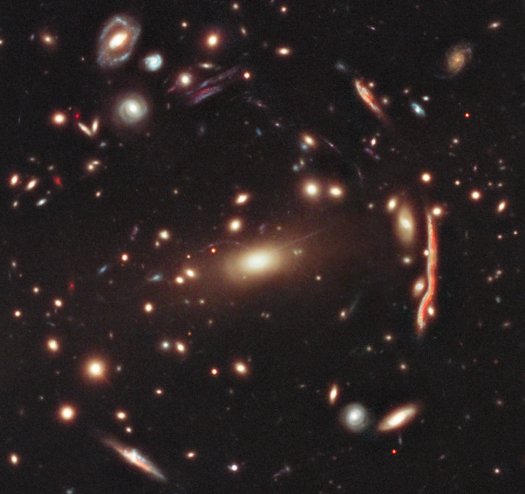
Gravitational Lensing This image of galaxy cluster MACS J1206.2-0847 shows the gravitational lensing effect of dark matter on distant galaxies. In a new exoplanet population paper, astronomers used microlensing to sense the presence of planets around other stars. The lensing was not as extreme as this, but works somewhat like a magnifying glass, brightening the light of a star lined up behind the planetary system. Space Telescope Science Institute
“It’s not unreasonable at this point to say there are literally billions of habitable worlds in our galaxy, probably as a lower limit,” he said. “Maybe they’re all sterile as an autoclave, but it doesn’t seem very likely, does it? That would make us very odd.”
Other astronomers maintain that we are odd indeed, and that increasing the known planet population does not increase the odds of finding intelligent life on any of them.
“The numbers are huge by any human standard, but we are still looking at only a tiny bit of our galaxy,” said John Gribbin, an astronomer and science writer who just published a book called “Alone in the Universe.” “[This research] does further our understanding of how things like planets form and how stars form, but there is a long way to go before we can say there is life on any of these planets, and further to go before we get to civilization.”

The new planetary plenitude is derived from a six-year survey of millions of stars studied with an international network of southern hemisphere telescopes. Astronomers used a delicate detection method called gravitational microlensing, which is one of three trusty ways to find extrasolar planets. Kepler uses the transit method, detecting blips in star brightness as planets cross in front of them.

Other observatories use the radial velocity method, measuring the wobble caused by the gravitational tug of a planet on its star. Both of these are helpful for finding planets that are either huge or hug tightly to their stars. But the gravitational microlensing method can be used to find planets over a wider mass range and a wider orbital distance.

.........................................................................................................................................................

More...

..........................................................................................................................................................

La Silla Observatory: The Milky Way seen above the dome of the Danish 1.54-metre telescope at ESO's La Silla Observatory in Chile, used to search for exoplanets using the microlensing technique. The central part of the Milky Way is visible behind the dome of the ESO 3.6-metre telescope; on the right, the Magellanic Clouds.  ESO/Z. Bardon
 
It works by using the host star and its putative planets as a lens. The gravitational field of the host solar system magnifies the light of a star in the background. If the host star does have a planet, the planet essentially widens the lens, and this is an effect that can be measured. 
 
Such an alignment is incredibly rare, so an international team of researchers examined 100 million stars every night and noted ones with promising light curve amplifications, examining them in higher resolution. From 2002 to 2007, the team observed 500 such stars. In 10 cases, they could directly see the lensing effect of a planet.
 
A statistical analysis showed one in six of the stars studied hosts a planet of similar mass to Jupiter, half have Neptune-mass planets and two thirds have super-Earths. Combining the results suggests that the average number of planets around a star is greater than one, the astronomers say in a new Nature paper.
 
“Together, the three methods are, for the first time, able to say something about how common our own solar system is, as well as how many stars appear to have Earth-size planets in the orbital area where liquid what could in principle exist as lakes, rivers and oceans — that is to say, where life as we know it from Earth could exist,” said Uffe GrÃ¥e Jørgensen, head of the Astrophysics and Planetary Science group at the Niels Bohr Institute at the University of Copenhagen and an author of the paper.

With so many planets, it could be easy to assume the odds have just gotten much better for alien life hunters, but it’s not necessarily the case because scientists still don’t know what’s necessary for life to form, said Paul Davies, a cosmologist and astrobiologist at Arizona State University.

“How much real estate is out there doesn’t matter,” he said. “My guess is there would be some hundreds of millions of Earth-like planets in the Milky Way, but that is no good to you if the probability of life forming on one of them is one in a trillion.”

The lack of knowledge hasn’t stopped scientists from making educated guesses, however — take the Drake equation, devised by astronomer Frank Drake in 1961, which seeks to estimate the number of intelligent civilizations based on an equation of assumptions.


“All of the work that has been done since 1961 when this equation was concocted has gone in the same direction, namely, that our situation here is not so weird, not so strange, not so bizarre, not so special,” Shostak said. “We’re not unique, at least astronomically.”
We’re just one in millions.


A Plethora of Planets: This artist’s impression shows how common planets are around the stars in the Milky Way. The planets, their orbits and their host stars are all vastly magnified compared to their real separations. A six-year search that surveyed millions of stars using a technique called microlensing concluded that every star has at least one planet orbiting around it.  ESO/M. Kornmesser

A Portion of Mars could be Friendly to Life


Sunrise at Gale Crater Gale Crater, future home of the Mars Science Laboratory, looms in the distance, distinguished from adjacent craters by its central mountain. Gale Crater straddles the dichotomy boundary of Mars, which separates the broad, flat, and young northern plains from the much older and rougher southern highlands. Water may have flowed across this topographic boundary, from highland to lowland. Last week, the Opportunity rover team found slam-dunk evidence of liquid water on the surface of Mars, an intriguing find for astrobiology. NASA/JPL-Caltech

..........................................................................................................................................................
..........................................................................................................................................................
Now that we have slam-dunk evidence that Mars was once a wet and likely temperate place, astrobiologists are pondering the implications for ancient Martian life. One new study says the Red Planet has even more habitable space than Earth — albeit underground.

Led by Charley Lineweaver at the Australian National University, researchers compared models of temperature and pressure conditions on Earth with those on Mars, extrapolating how much of Mars might be amenable to hosting Earth-like organisms. Life occupies just one percent of Earth, if you consider the entire planet’s volume from the core to the stratosphere. But apparently three percent of Mars could be habitable, Lineweaver said. Most of this comfortable space is underground, where there would be sufficient pressure and warmth to hold liquid water and perhaps some toasty microbes.


Although the Phoenix lander found ice at the north pole, modern Mars’ surface is too low-pressure to hold on to liquid water, and it’s too cold (average about -81 °F) for water or life as we know it. But nestled underneath the planet’s crust, the habitat could be much more friendly, Lineweaver told AFP.
Lineweaver said his study uses decades of data from a host of Mars missions and compiles information about several sites, rather than just one or two areas. “There are large regions of Mars that are compatible with terrestrial life,” he said.

The Mars Science Laboratory, en route to the planet for an August arrival, is designed to help answer some of these questions. It has several instruments for examining the chemical composition of rocks inside Gale Crater, a region believed to once host flowing water. The Curiosity rover also has some instruments designed to look for the chemical ingredients of life.
The Australian study was published in the journal Astrobiology.

Omega Nebula in Exquisite Detail


Looking more like a painting than an astronomy photograph, the Omega nebula glows with vivid colours in this new image from the European Southern Observatory's Very Large Telescope. This is one of the sharpest and most detailed images of this object ever taken from a ground-based telescope.


..........................................................................................................................................................
..........................................................................................................................................................

The nebula -- located around 6,500 light-years from Earth in the constellation Sagittarius -- is thought to be a hotbed of recent star formation. The cloud of gas and dust spans approximately 15 light-years and is estimated to contain enough material to produce 800 sun-like stars.
The heart of the Omega nebula contains roughly 35 stars, the hottest of which spew out ultraviolet radiation that causes the surrounding hydrogen gas to glow red and pink.


The nebula also seems to collect names the way some people collect butterflies, sometimes being known as the Swan, Horseshoe, Checkmark, or Lobster nebula, depending on who observed it and when.

It is believed to be a close neighbor to the Eagle nebula, another star-forming gas-and-dust cloud located a similar distance from Earth in the same spiral arm of the Milky Way. In 1995, Nasa's Hubble Space Telescope photographed the heart of the Eagle nebula, producing one of the most iconic astronomical pictures of all time, the Pillars of Creation.

Quasicrystals Appear to Have Come From Space


Quasicrystals Within this chunk of mineral unearthed in Russia's Koryak mountains are crystalline structures that likely originated in space and were delivered to Earth via meteorite, a new study claims.

First they were thought to be impossible on Earth, then when they were grown in the lab they were thought to be so novel that they earned their discoverer a Nobel Prize in Chemistry. Now, it turns out the quasicrystals--unusually structured crystals that break several rules of crystalline symmetry and exhibit strange physical properties--unearthed in Russia’s Koryak mountains a couple of years ago are probably from outer space.


..........................................................................................................................................................
..........................................................................................................................................................


Quasicrystals were first introduced to the chemical conversation by Israeli researcher Daniel Schechtman back in the 1980s, and they immediately were met with a good deal of skepticism by researchers who thought such structures impossible. Schechtman won that round, eventually receiving the Nobel for his efforts. But up until two years ago, quasicrystals were still thought to be impossible in nature--up to that point they had only been created under laboratory conditions.

Then in 2009 a team of Italian researchers found quasicrystals in mineral samples found in the mountains of eastern Russia. This mineral provided proof that quasicrystals could form naturally, but exactly how they formed remained a mystery.

Now, with tests on the quasicrystals completed, researchers are saying that the evidence suggests these crystals are not of Earthly origin, but rather were deposited in Russia via meteorite. Firstly, mass spectrometry shows a pattern of oxygen isotopes in the quasicrystal that is unlike that in any mineral known to originate on Earth (but it did resemble a pattern found in a certain type of meteorite). It also contained the tell-tale signs of a high-pressure past in certain silicas that only form under extreme conditions, like those inside the Earth’s mantle or in a high-speed impact like the kind that occurs when meteors slam into a planetary body.

Another Soyuz Rocket Launch Fails


Russia's recent poor launch record has continued with yet another Soyuz rocket failure.
This time, a Soyuz-2 vehicle failed to put a communications satellite into orbit after lifting away from the country's Plesetsk spaceport.

Debris is said to have re-entered the Earth's atmosphere and crashed to the ground.
In August, a Soyuz failure on a mission to resupply the space station led to a six-week suspension of flights.
Friday's rocket was carrying a Meridian-5 satellite, designed to provide communication between ships, planes and coastal stations on the ground, according to RIA Novosti.

t was a Soyuz-2.1b, the most modern version of the rocket that has been in service in various forms since the 1960s.
The failure is said to have occurred seven minutes into the flight. Sources being quoted by the Russian media talk of an anomaly in the rocket's third stage.


"The satellite failed to go into its orbit. A state commission will investigate the causes of the accident," the spokesman of Russia's space forces, Alexei Zolotukhin, was quoted as saying by the Interfax news agency.
August's botched launch involved a Soyuz-U. An inquiry into that incident eventually traced the problem to a blocked fuel line, again in the third stage of the vehicle.

But the U and 2.1b Soyuz variants use different engines in this segment of the rocket, so no immediate parallels between the two incidents can be drawn.
Friday's failure now puts a major question mark against the next Soyuz launch, scheduled for 28 December from the Baikonur Cosmodrome. This flight is intended to put in orbit six satellites for the Globalstar satellite phone company.

..........................................................................................................................................................
..........................................................................................................................................................

And it will raise concern again among the partners on the International Space Station (ISS) that there may be systemic problems in the Russian launch sector.
Following the retirement of the American space shuttle in July, the Soyuz rocket is the only means of getting astronauts and cosmonauts to the ISS. August's failure saw manned flights stand down even longer than the six weeks for unmanned Soyuz rockets, and the hiatus put a severe strain on the operation of the space station.


Russia has experienced a number of launch mishaps in the past 13 months.
On 18 August, the week before the loss of the space station mission, a Proton vehicle failed to put a communications satellite in its proper orbit.

Back on 1 February, a Rokot launch also underperformed with a similar outcome.
And on 5 December last year, a Proton carrying three navigation spacecraft fell into the Pacific Ocean. This particular failure is widely believed to have contributed to the decision of the Russian government to replace the then space agency chief, Anatoly Perminov.

Vladimir Popovkin took over as the head of Roscosmos in April.
The rocket failures come on top of the loss of Phobos-Grunt, Russia's most ambitious planetary mission in decades. It became stuck in Earth orbit after its launch in November and will probably fall back to Earth next month.
Environment Clean Generations

Jupiter's Core Dissolving


Think climate change is bad? Things are rather worse in the outer solar system. Jupiter's rocky central core may well be dissolving into liquid.
The gas giant, which is twice as massive as all of the other planets orbiting the Sun put together, has a central core comprised of iron, rock and ice. It sits in the centre of the planet, submerged in a fluid of hydrogen and helium under intense pressures about 40 million times greater than atmospheric pressure on Earth, and temperatures around 16,000 degrees kelvin -- hotter than the surface of the Sun.


As such, we can't recreate those conditions experimentally on Earth. But that hasn't stopped planetary scientists Hugh Wilson and Burkhard Militzer of the University of California, Berkeley, giving it a go. They've performed quantum mechanical calculations to try and work out how one of the key ingredients of the core -- magnesium oxide -- responds in such an extreme situation.

..........................................................................................................................................................
..........................................................................................................................................................


They found that under these intense pressures and temperatures, the magnesium oxide has very high solubility, meaning that it's likely to be dissolving into liquid. The exact rate of the erosion isn't known, but the pair had earlier predicted that the ice in the core is also dissolving. That means that Jupiter's core is likely to be smaller now than it was when the planet formed.


The research has been detailed in a paper submitted to Physical Review Letters, in which Wilson and Militzer say that the work has substantial implications for working out how to simulate these types of planets. "For large exoplanets exceeding Jupiter's mass, higher interior temperatures promote both solubility and redistribution, implying that the cores of sufficiently large super-Jupiters are likely to be completely redistributed," it reads.
We'll be able to find out more in 2016, when Nasa's Juno spacecraft arrives at the gas giant and begins to measure its gravitational field.
Environment Clean Generations

Massive Gas Cloud Tumbling into Nearby Black-Hole


The supermassive black hole at the heart of the Milky Way galaxy is about to have lunch. An enormous gaseous cloud, with almost three times the mass of planet Earth, is fast approaching the black hole's event horizon, and it will be ripped, shredded and gobbled down in 2013.
"It is not going to survive the experience," Stefan Gillessen, of the Max Planck Institute for Extraterrestrial Physics in Germany, confirms in no uncertain terms.
This unique event will give astronomers a front row seat to something that's never been observed up close, before: how a black hole gulps down gas, dust and stars as it grows ever bigger. All other black holes are too far away to see first hand, while our closest one is just 27,000 light years from Earth.


"When we look at the black holes in the centres of other galaxies, we see them get bright and then fade, but we never know what is actually happening," said Eliot Quataert, a theoretical astrophysicist at University of California.
"This is an unprecedented opportunity to obtain unique observations and insight into the processes that go on as gas falls into a black hole, heats up and emits light. It's a neat window onto a black hole that's actually capturing gas as it spirals in."

Gillessen, Quataert and physicist Reinhard Genzel have been tracking the cloud since 2008, using the European Southern Observatory's Very Large Telescope in Chile. They have seen the gaseous entity speed up to a velocity of 8 million kilometres an hour, and are now starting to see its edges fray as it tumbles deeper into the black hole's gravitational whirlpool.

..........................................................................................................................................................
...........................................................................................................................................................


This cloud is mostly helium and hydrogen, and it's particularly cold -- just 280 degrees celsius. It likely formed when plumes of gas from two nearby stars were shoved together by stellar winds, and it is now glowing under the ultraviolet radiation from surrounding hot stars.

The cloud will soon come within about 40 billion kilometres of the event horizon. That's the limit beyond which nothing, not even light, can escape from a black hole. By 2013 the team should see violent outbursts of X-rays and radio waves as the cloud gets hotter and is torn to shreds. The light emitted around the black hole could increase by a hundredfold to a thousandfold, Quataert has calculated.
The Chandra X-ray satellite has already scheduled its largest single chunk of observation time in 2012 near the Milky Way's central black hole.
Environment Clean Generations

Lovejoy Comet Lives after Solar Encounter


You would have been very optimistic if, before Comet Lovejoy's apparent suicidal near-miss of the sun's surface, you'd placed a bet on the icy interloper's survival. But if you did, you'd be laughing all the way to the bank.


This is why I don't gamble -- I was anything but optimistic of the chances the Kreutz Sungrazing comet -- officially designated as C/2011 W3 (Lovejoy) -- would live through the hellish temperatures it endured as it made the death-defying solar dive.

..........................................................................................................................................................
...........................................................................................................................................................


But as NASA's Solar Dynamics Observatory (SDO) watched the comet emerge from the other side of the sun Thursday evening, Comet Lovejoy proved the doubters wrong and continued its orbit after passing only 87,000 miles above the sun's photosphere. In doing so, it had endured temperatures of over a million degrees Celsius.
Watch the video of the lucky comet zooming away from the limb of the sun:

Kepler Team Confirms First Earth-like Planet in a Habitable Zone, And Finds 1,094 More Worlds


Nestled in the Goldilocks zone of a small, sun-like star is a room-temperature world a little more than twice the size of Earth. Scientists do not yet know if it is rocky or gaseous and whether it has water or clouds, but they do know that it’s the right size, and in the right place, for liquid water to exist. If it does exist, it may be one of the best places to look for life outside of our solar system.

The new planet, Kepler-22, is about 600 light-years away and the smallest planet confirmed to exist smack in the middle of the habitable zone of a sun-like star. It’s one of the most stunning announcements from the Kepler Space Telescope, which stares at a field of stars in the constellations Cygnus and Lyra and looks for blips in brightness to find other planets. While Kepler has (as of today) found more than 2,000 possible planets, finding an Earth-like world in a sun-like environment has proved elusive — until now.


“This is a major milestone on the road to finding Earth's twin,” said Douglas Hudgins, Kepler program scientist at NASA Headquarters in Washington.
On top of this announcement today, the Kepler science team is sharing 1,094 more planet candidates, many of which are also potentially Earth-like and in habitable zones. Now there are 2,326 planet candidates in the sun-orbiting space telescope’s field of view, in a small sliver of the sky.

Kepler-22b’s discovery was first announced last February, when the Kepler team shared its initial treasure trove of planet candidates. Among 1,235 candidate worlds, there were 54 habitable zone candidates, Kepler-22b among them. Now it’s the first of these to be confirmed.
It takes 290 days to orbit around its star, Kepler-22, a G-class star a lot like the one we know best. “It’s almost a solar twin; it is very similar to our sun,” Natalie Batalha, Kepler deputy science team lead at San Jose State University, said in a press conference.

 ...........................................................................................................................................................
...........................................................................................................................................................


The planet is about 15 percent nearer to its star than Earth is to the sun. But this is OK because the star is cooler (by about 220 degrees), a bit dimmer, and a little smaller than our star. So the planet is in a really analogous Earth-like orbit. The planet’s temperature is even pretty close to Earth’s, said William Borucki, the Kepler mission’s principal investigator at NASA’s Ames Research Center. “If greenhouse warming on this planet was similar (to atmospheric warming on Earth), its surface temperature would be something like 72° F,” he said.


Kepler-22 System: This diagram compares our own solar system to Kepler-22, a star system containing the first "habitable zone" planet discovered by NASA's Kepler telescope. The habitable zone is the sweet spot around a star where temperatures are right for water to exist in its liquid form. Kepler-22's star is a bit smaller than our sun, so its habitable zone is slightly closer in. The diagram shows an artist's rendering of the planet comfortably orbiting within the habitable zone, similar to where Earth circles the sun.  NASA/Ames/JPL-Caltech
 
It will be a mighty nice place to look for signs of life, he added. Jill Tarter, director of the Center for SETI Research at the SETI Institute, said astrobiologists are taking that to heart. “We will give a higher priority to worlds that our colleagues tell us are not too warm, not too cold, but just right,” she said.
With so many exoplanets, astronomers will need to start making some catalog decisions, ranking planets by their habitability potential. Along with the Earth Similarity Index we covered last month, the Kepler team has their own proposed planetary directory to make this easier. The Habitable Exoplanets Catalog ranks planets by their surface temperature, similarity to Earth, and capacity to sustain organisms at the bottom of the food chain.

Monday’s announcement came during the inaugural Kepler Science Conference in Mountain View, Calif. With the addition of 1,094 new candidate worlds, the number of planet candidates has increased by 89 percent and now totals 2,326. Of these, 207 are approximately Earth-size, 680 are super Earth-size, 1,181 are Neptune-size, 203 are Jupiter-size and 55 are larger than Jupiter. So since February, the number of Earth-size and super Earth-size candidates has increased by more than 200 and 140 percent, respectively.
That’s a lot of numbers, and here’s another good one: 10. That’s the number of these new candidates that are near-Earth-sized and in the habitable zones of their host stars. Kepler-22b is not among that list, so that makes at least 11 places elsewhere in the galaxy that might look very, very familiar.

There’s still a bit of work to do to quantify just what Kepler-22b looks like. Now that astronomers are convinced it’s a planet and they know where it is, confirming their findings with the Spitzer Space Telescope, they want to find out what it's made of. Ground-based telescopes like the Keck Observatory will start making some measurements next summer, when the field of sky that Kepler studies is visible from Earth.

And there is still much more to come, according to NASA scientists. Some software improvements have made it a little simpler to sift through Kepler light-curve data and hunt for planet candidates, so there will be at least one more big batch, according to Batalha. Among those, there may be many more Earth-like candidates to join the ranks.
“We are really zeroing in on the true Earth-sized habitable planets,” she said.
NASA
Environment Clean Generations

Related Posts Plugin for WordPress, Blogger...

Search

Custom Search

 
Design by Wordpress Theme | Bloggerized by Free Blogger Templates | coupon codes