


The secrets of why the leaves of trees change yellow or red in the autumn are slowly being revealed. Those eye-seducing hues, it appears, are a lot more than pretty. They're the result of trees doing their utmost to survive. They're the shades of evolutionary success.
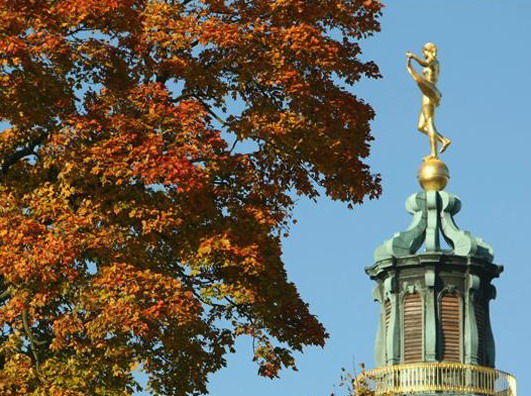
Let's start with the green leaf: We all learned in school that it's the result of the most abundant pigment in the leaf being the green chlorophyll. When the cool air and shorter days of autumn arrive, leaves change to red or yellow not because the leaves are dying, but because of a series of clever processes underway.

Not so surprisingly, yellow leaves undergo one sort of color changing process and red leaves another. As the chlorophyll is being turned off, most leaves turn yellow, which is just a color that's already in the leaves but is usually flooded by green the rest of the growing season.

But over the last decade or so, researchers have discovered something very different goes on in red leaves. As their chlorophyll drops, they would also turn yellow if not for the sudden rapid production of a brand new red pigment call anthocyanin, which was not previously present in the leaves.
This surprising revelation has led to a surge of interest by scientists who are trying to explain why a leaf with only a week or so to live would bother producing an entirely new pigment.
This surprising revelation has led to a surge of interest by scientists who are trying to explain why a leaf with only a week or so to live would bother producing an entirely new pigment.

One theory for explaining red leaves is that they are the result of 35 million years of trees battling insects looking for places to get a last meal and lay their eggs in the fall. Red leaves are harder for insects like aphids to see, for instance, so they tend to go for the yellow leaves.
Some evidence for this theory can be found in the differences of fall colors between North America and Europe. There are few native European trees that turn red in fall, but they are mostly yellow. In North America, however, there are ample red-turning trees, as well as yellow.
Some evidence for this theory can be found in the differences of fall colors between North America and Europe. There are few native European trees that turn red in fall, but they are mostly yellow. In North America, however, there are ample red-turning trees, as well as yellow.

The reason for this may be that in North America, as well as in East Asia, North-South running mountain ranges allowed forests to shift their ranges North and South with climate changes, carrying their insects -- and their long-standing battles -- along the way.
In Europe, however, the major mountain ranges run east-west. So as climate warms or cools, trees have nowhere to go and simply die out -- along with the insects that live off of them. So in Europe, the insect-tree battles have a much shorter history, and so less time to evolve strategies like anthocyanins to fend them off.
In Europe, however, the major mountain ranges run east-west. So as climate warms or cools, trees have nowhere to go and simply die out -- along with the insects that live off of them. So in Europe, the insect-tree battles have a much shorter history, and so less time to evolve strategies like anthocyanins to fend them off.
This theory was put forward by Simcha Lev-Yadun of the Department of Science Education- Biology at the University of Haifa-Oranim and Jarmo Holopainen of the University of Kuopio in Finland, and published in the journal New Phytologist.

Another theory suggests that the variation of red anthocyanin in leaves of trees that live in the same area might have more to do with the richness or poverty of the soil in which a tree grows and so it reflects the lengths trees must go to hang onto the nutrients they have invested in their leaves.
In a preliminary study by a student in Charlotte, N.C., it was found that fall leaf colors and the soils under sweet gum and red maple trees show a significant nutrient difference that matches autumn tree color patterns. The richer lowland soils corresponded to more yellow leaves and poorer highland soils correlated to redder leaves.
In a preliminary study by a student in Charlotte, N.C., it was found that fall leaf colors and the soils under sweet gum and red maple trees show a significant nutrient difference that matches autumn tree color patterns. The richer lowland soils corresponded to more yellow leaves and poorer highland soils correlated to redder leaves.

"It's very clear that there's a correlation," said plant physiologist Bill Hoch of Montana State University in Bozeman. What's more, it matches what he has discovered about the function of that stunning red anthocyanin.
Experiments make a pretty strong case for anthocyanin serving as a protective pigment that helps trees in nutrient-poor or stressed places to maximize the nutrients they can draw from the leaves before they are dropped to the ground, Hoch told Discovery News in an October 2007 article.
"They pull as many of the nutrients back into the plants as possible," said Hoch.

The red pigment protects any remaining green, food-making chloroplasts in the leaves from damage. This is especially valuable for trees in nutrient-poor soils or stressful situations because this "photo-protection" allows the leaves to keep making sugars in their leaves longer.
This, in turn, is vital for pulling nutrients out of the leaves because the only way the nutrients can be extracted from leaf to trunk is by hitching a ride on the trunk-bound sugars.
The bottom line, Hoch explained, is that the longer photosynthesis can continue on an autumnal, coloring leaf, the more nutrients can be drawn out of it for re-use in the spring. So where every drop of nutrient counts the most -- like perhaps on some nutrient-poor hillsides of North Carolina -- red is the color of autumn.

by "environment clean generations"
 Posted in: autumn,earth,europe,leaves,mountain,nutrient,photosynthesis,Seriously,Why Do Leaves Change Color No,yellow


