Environment-Clean-Generations

Environment-Clean-Generations
THE DEFINITIVE BLOG FOR EVERYTHING YOU NEED TO KNOW ABOUT THE ENVIRONMENT YOU LIVE IN, WITH REFERENCE TO LIFE, EARTH AND COSMIC SPACE SCIENCES, PRESENTED BY ENVIRONMENTAL ENGINEER DORU INDREI, ENVIRONMENTAL QUALITY AND ENERGY SPACIALIST
"Life is not about what we know, but what we don't know, craving the unthinkable makes it so amazing, that is worth dying for." Doru Indrei
Custom Search
Showing posts with label planet. Show all posts

It Seems that Every Star Has at Least One Planet


Each star in the Milky Way shines its light upon at least one companion planet, according to a new analysis that suddenly renders exoplanets commonplace, the rule rather than the exception. This means there are billions of worlds just in our corner of the cosmos. This is a major shift from just a few years ago, when many scientists thought planets were tricky to make, and therefore special things. Now we know they’re more common than stars themselves.

“Planets are like bunnies; you don’t just get one, you get a bunch,” said Seth Shostak, a senior astronomer at the SETI Institute who was not involved in this research. “So really, the number of planets in the Milky Way is probably like five or 10 times the number of stars. That’s something like a trillion planets.”

Of course there’s no way to know, at least not yet, how many of these worlds could be hospitable to forms of life as we know it. But the odds alone are tantalizing, Shostak said.
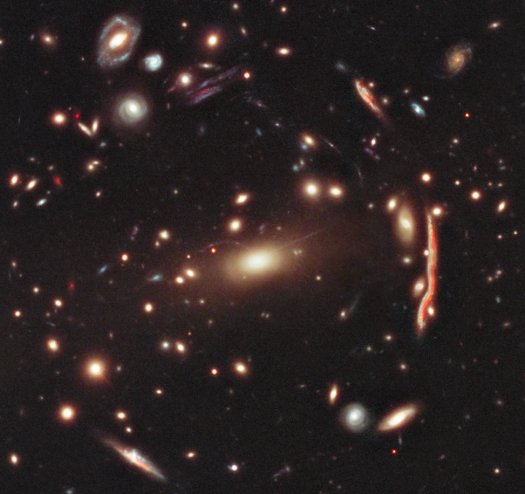

Gravitational Lensing This image of galaxy cluster MACS J1206.2-0847 shows the gravitational lensing effect of dark matter on distant galaxies. In a new exoplanet population paper, astronomers used microlensing to sense the presence of planets around other stars. The lensing was not as extreme as this, but works somewhat like a magnifying glass, brightening the light of a star lined up behind the planetary system. Space Telescope Science Institute
“It’s not unreasonable at this point to say there are literally billions of habitable worlds in our galaxy, probably as a lower limit,” he said. “Maybe they’re all sterile as an autoclave, but it doesn’t seem very likely, does it? That would make us very odd.”
Other astronomers maintain that we are odd indeed, and that increasing the known planet population does not increase the odds of finding intelligent life on any of them.
“The numbers are huge by any human standard, but we are still looking at only a tiny bit of our galaxy,” said John Gribbin, an astronomer and science writer who just published a book called “Alone in the Universe.” “[This research] does further our understanding of how things like planets form and how stars form, but there is a long way to go before we can say there is life on any of these planets, and further to go before we get to civilization.”

The new planetary plenitude is derived from a six-year survey of millions of stars studied with an international network of southern hemisphere telescopes. Astronomers used a delicate detection method called gravitational microlensing, which is one of three trusty ways to find extrasolar planets. Kepler uses the transit method, detecting blips in star brightness as planets cross in front of them.

Other observatories use the radial velocity method, measuring the wobble caused by the gravitational tug of a planet on its star. Both of these are helpful for finding planets that are either huge or hug tightly to their stars. But the gravitational microlensing method can be used to find planets over a wider mass range and a wider orbital distance.

.........................................................................................................................................................

More...

..........................................................................................................................................................

La Silla Observatory: The Milky Way seen above the dome of the Danish 1.54-metre telescope at ESO's La Silla Observatory in Chile, used to search for exoplanets using the microlensing technique. The central part of the Milky Way is visible behind the dome of the ESO 3.6-metre telescope; on the right, the Magellanic Clouds.  ESO/Z. Bardon
 
It works by using the host star and its putative planets as a lens. The gravitational field of the host solar system magnifies the light of a star in the background. If the host star does have a planet, the planet essentially widens the lens, and this is an effect that can be measured. 
 
Such an alignment is incredibly rare, so an international team of researchers examined 100 million stars every night and noted ones with promising light curve amplifications, examining them in higher resolution. From 2002 to 2007, the team observed 500 such stars. In 10 cases, they could directly see the lensing effect of a planet.
 
A statistical analysis showed one in six of the stars studied hosts a planet of similar mass to Jupiter, half have Neptune-mass planets and two thirds have super-Earths. Combining the results suggests that the average number of planets around a star is greater than one, the astronomers say in a new Nature paper.
 
“Together, the three methods are, for the first time, able to say something about how common our own solar system is, as well as how many stars appear to have Earth-size planets in the orbital area where liquid what could in principle exist as lakes, rivers and oceans — that is to say, where life as we know it from Earth could exist,” said Uffe GrÃ¥e Jørgensen, head of the Astrophysics and Planetary Science group at the Niels Bohr Institute at the University of Copenhagen and an author of the paper.

With so many planets, it could be easy to assume the odds have just gotten much better for alien life hunters, but it’s not necessarily the case because scientists still don’t know what’s necessary for life to form, said Paul Davies, a cosmologist and astrobiologist at Arizona State University.

“How much real estate is out there doesn’t matter,” he said. “My guess is there would be some hundreds of millions of Earth-like planets in the Milky Way, but that is no good to you if the probability of life forming on one of them is one in a trillion.”

The lack of knowledge hasn’t stopped scientists from making educated guesses, however — take the Drake equation, devised by astronomer Frank Drake in 1961, which seeks to estimate the number of intelligent civilizations based on an equation of assumptions.


“All of the work that has been done since 1961 when this equation was concocted has gone in the same direction, namely, that our situation here is not so weird, not so strange, not so bizarre, not so special,” Shostak said. “We’re not unique, at least astronomically.”
We’re just one in millions.


A Plethora of Planets: This artist’s impression shows how common planets are around the stars in the Milky Way. The planets, their orbits and their host stars are all vastly magnified compared to their real separations. A six-year search that surveyed millions of stars using a technique called microlensing concluded that every star has at least one planet orbiting around it.  ESO/M. Kornmesser

Kepler Team Confirms First Earth-like Planet in a Habitable Zone, And Finds 1,094 More Worlds


Nestled in the Goldilocks zone of a small, sun-like star is a room-temperature world a little more than twice the size of Earth. Scientists do not yet know if it is rocky or gaseous and whether it has water or clouds, but they do know that it’s the right size, and in the right place, for liquid water to exist. If it does exist, it may be one of the best places to look for life outside of our solar system.

The new planet, Kepler-22, is about 600 light-years away and the smallest planet confirmed to exist smack in the middle of the habitable zone of a sun-like star. It’s one of the most stunning announcements from the Kepler Space Telescope, which stares at a field of stars in the constellations Cygnus and Lyra and looks for blips in brightness to find other planets. While Kepler has (as of today) found more than 2,000 possible planets, finding an Earth-like world in a sun-like environment has proved elusive — until now.


“This is a major milestone on the road to finding Earth's twin,” said Douglas Hudgins, Kepler program scientist at NASA Headquarters in Washington.
On top of this announcement today, the Kepler science team is sharing 1,094 more planet candidates, many of which are also potentially Earth-like and in habitable zones. Now there are 2,326 planet candidates in the sun-orbiting space telescope’s field of view, in a small sliver of the sky.

Kepler-22b’s discovery was first announced last February, when the Kepler team shared its initial treasure trove of planet candidates. Among 1,235 candidate worlds, there were 54 habitable zone candidates, Kepler-22b among them. Now it’s the first of these to be confirmed.
It takes 290 days to orbit around its star, Kepler-22, a G-class star a lot like the one we know best. “It’s almost a solar twin; it is very similar to our sun,” Natalie Batalha, Kepler deputy science team lead at San Jose State University, said in a press conference.

 ...........................................................................................................................................................
...........................................................................................................................................................


The planet is about 15 percent nearer to its star than Earth is to the sun. But this is OK because the star is cooler (by about 220 degrees), a bit dimmer, and a little smaller than our star. So the planet is in a really analogous Earth-like orbit. The planet’s temperature is even pretty close to Earth’s, said William Borucki, the Kepler mission’s principal investigator at NASA’s Ames Research Center. “If greenhouse warming on this planet was similar (to atmospheric warming on Earth), its surface temperature would be something like 72° F,” he said.


Kepler-22 System: This diagram compares our own solar system to Kepler-22, a star system containing the first "habitable zone" planet discovered by NASA's Kepler telescope. The habitable zone is the sweet spot around a star where temperatures are right for water to exist in its liquid form. Kepler-22's star is a bit smaller than our sun, so its habitable zone is slightly closer in. The diagram shows an artist's rendering of the planet comfortably orbiting within the habitable zone, similar to where Earth circles the sun.  NASA/Ames/JPL-Caltech
 
It will be a mighty nice place to look for signs of life, he added. Jill Tarter, director of the Center for SETI Research at the SETI Institute, said astrobiologists are taking that to heart. “We will give a higher priority to worlds that our colleagues tell us are not too warm, not too cold, but just right,” she said.
With so many exoplanets, astronomers will need to start making some catalog decisions, ranking planets by their habitability potential. Along with the Earth Similarity Index we covered last month, the Kepler team has their own proposed planetary directory to make this easier. The Habitable Exoplanets Catalog ranks planets by their surface temperature, similarity to Earth, and capacity to sustain organisms at the bottom of the food chain.

Monday’s announcement came during the inaugural Kepler Science Conference in Mountain View, Calif. With the addition of 1,094 new candidate worlds, the number of planet candidates has increased by 89 percent and now totals 2,326. Of these, 207 are approximately Earth-size, 680 are super Earth-size, 1,181 are Neptune-size, 203 are Jupiter-size and 55 are larger than Jupiter. So since February, the number of Earth-size and super Earth-size candidates has increased by more than 200 and 140 percent, respectively.
That’s a lot of numbers, and here’s another good one: 10. That’s the number of these new candidates that are near-Earth-sized and in the habitable zones of their host stars. Kepler-22b is not among that list, so that makes at least 11 places elsewhere in the galaxy that might look very, very familiar.

There’s still a bit of work to do to quantify just what Kepler-22b looks like. Now that astronomers are convinced it’s a planet and they know where it is, confirming their findings with the Spitzer Space Telescope, they want to find out what it's made of. Ground-based telescopes like the Keck Observatory will start making some measurements next summer, when the field of sky that Kepler studies is visible from Earth.

And there is still much more to come, according to NASA scientists. Some software improvements have made it a little simpler to sift through Kepler light-curve data and hunt for planet candidates, so there will be at least one more big batch, according to Batalha. Among those, there may be many more Earth-like candidates to join the ranks.
“We are really zeroing in on the true Earth-sized habitable planets,” she said.
NASA
Environment Clean Generations

Extreme Sunsets: On Earth and From Out Space


You might have witnessed sunset at beach or from a hillside and imagined that this is the most beautiful scene on the planet. Well, we have compiled a list of best sunset scenes from all over the world and from outer space to match with your best ever sunset experience.

1. Sunset From the International Space Station

2. Sunset on Mars

3. Sunset along with Moon at the North Pole

4. Sunset During an Eclipse


5. Sunset in Manhattan Along the Center-line of Every Street

6. Sunset with Clouds, Trees and Water in Indonesia


Ocean Floor Can Predict the Planet's Future, Study Finds


ScienceDaily (Oct. 27, 2011) — New research from the University of Missouri indicates that Atlantic Ocean temperatures during the greenhouse climate of the Late Cretaceous Epoch were influenced by circulation in the deep ocean. These changes in circulation patterns 70 million years ago could help scientists understand the consequences of modern increases in greenhouse gases.Environment Clean Generations

"We are examining ocean conditions from several past greenhouse climate intervals so that we can understand better the interactions among the atmosphere, the oceans, the biosphere, and climate," said Kenneth MacLeod, professor of geological sciences in the College of Arts and Science. "The Late Cretaceous Epoch is a textbook example of a greenhouse climate on earth, and we have evidence that a northern water mass expanded southwards while the climate was cooling. At the same time, a warm, salty water mass that had been present throughout the greenhouse interval disappeared from the tropical Atlantic."Environment Clean Generations

read more
The study found that at the end of the Late Cretaceous greenhouse interval, water sinking around Greenland was replaced by surface water flowing north from the South Atlantic. This change caused the North Atlantic to warm while the rest of the globe cooled. The change started about five million years before the asteroid impact that ended the Cretaceous Period.Environment Clean Generations
To track circulation patterns, the researchers focused on "neodymium," an element that is taken up by fish teeth and bones when a fish dies and falls to the ocean floor. MacLeod said the ratio of two isotopes of neodymium acts as a natural tracking system for water masses. In the area where a water mass forms, the water takes on a neodymium ratio like that in rocks on nearby land. As the water moves through the ocean, though, that ratio changes little. Because the fish take up the neodymium from water at the seafloor, the ratio in the fish fossils reflects the values in the area where the water sank into the deep ocean. Looking at changes through time and at many sites allowed the scientists to track water mass movements.
by"environment clean generations"

MIT's Artificial Leaf is Better


Speaking at the National Meeting of the American Chemical Society in California, MIT professor Daniel Nocera claims to have created an artificial leaf, made from stable and inexpensive materials, which mimics nature's photosynthesis process.

The device is an advanced solar cell, no bigger than a typical playing card, which is left floating in a pool of water. Then, much like a natural leaf, it uses sunlight to split the water into its two core components, oxygen and hydrogen, which are stored in a fuel cell to be used when producing electricity.


Nocera's leaf is stable -- operating continuously for at least 45 hours without a drop in activity in preliminary tests -- and made of widely available, inexpensive materials -- like  silicon, electronics and chemical catalysts. It's also powerful, as much as ten times more efficient at carrying out photosynthesis than a natural leaf.

With a single gallon of water, Nocera says, the chip could produce enough electricity to power a house in a developing country for an entire day. Provide every house on the planet with an artificial leaf and we could satisfy our 14 terrawatt need with just one gallon of water a day.
Those are impressive claims, but they're also not just pie-in-the-sky, conceptual thoughts. Nocera has already signed a contract with a global megafirm to commercialise his groundbreaking idea. The mammoth Indian conglomerate, Tata Group has forged a deal with the MIT professor to build a small power plant, the size of a refrigerator, in about a year and a half.

This isn't the first ever artificial leaf, of course. The concept of emulating nature's energy-generating process has been around for decades and many scientists have tried to create leaves in that time. The first, built more than ten years ago by John Turner of the US National Renewable Energy Laboratory, was efficient at faking photosynthesis but was made of rare and hugely expensive materials. It was also highly unstable, and had a lifespan of barely one day.

For now, Nocera is setting his sights on developing countries. "Our goal is to make each home its own power station," he said. "One can envision villages in India and Africa not long from now purchasing an affordable basic power system based on this technology."
by "environment clean generations"

What Is Frozen Fuel?


All by itself, methane isn't very exciting. It's a colorless, odorless gas and the simplest member of the alkane series of hydrocarbons. Its biggest claim to fame is that, as the main constituent of natural gas, it's useful as a source of energy.

Recently, however, geologists have discovered a type of methane that has piqued their curiosity. Part of its unusual character is how it exists in its natural state -- trapped inside a cage of ice. Even more intriguing is how much of this frozen methane seems to be locked away in the Earth's crust. Some estimates indicate that as much as 700 quadrillion (700 × 1015) cubic feet (20 quadrillion cubic meters) of methane are encased in ice and trapped in seafloor sediments all over the world [source: Tarbuck]. That's twice as much carbon as Earth's other fossil fuels combined.

That's not just mud (pictured). It's mud containing methane hydrate, icelike crystals that form at low temperatures and high pressure. And it could be a future energy source. See more alternative fuel pictures.

The discovery of this new type of methane, what scientists call methane hydrate, has led to two important questions. The first is pragmatic: Will it burn like ordinary methane? It turns out it will. If you take a piece of methane hydrate -- it looks like hard-packed snow -- and touch a lighted match to it, the sample will burn with a reddish flame. And if that's the case, it could be used to heat homes, fuel cars and generally power energy-hungry nations such as Japan, the United States, India and China. Recent data suggest that just 1 percent of Earth's methane hydrate deposits could yield enough natural gas to meet America's energy needs for 170,000 years [source: Stone].

The second question is partly an ethical consideration: Should we, as a global community trying fervently to develop clean, renewable energy, embrace one of the fossil fuels that got us into trouble in the first place? Science can't answer that question. It can, however, reveal the challenges and risks that face countries hoping to take advantage of methane hydrate. One of the most significant challenges is finding efficient ways to extract the frozen fuel. More troubling are potential catastrophes -- ranging from massive underwater landslides to a runaway greenhouse effect -- related to methane mining.

In this article, we'll explore all the positives and negatives of methane hydrate. We'll look at its relatively brief history, as well as how it fits in some possible future scenarios. And, of course, we'll examine the basic science behind this so-called "flammable ice."


 Fire and Ice: The Chemistry of Methane Hydrate

Frozen fuel is the catchy name for a family of substances known as gas hydrates. The gas in question is natural gas, a mixture of hydrocarbons, such as methane, propane, butane and pentane. Of these, methane is by far the most common component and one of the most-studied compounds in chemistry.

Like all hydrocarbons, methane contains only two elements -- carbon and hydrogen. It is an example of a saturated hydrocarbon, or a molecule composed entirely of single bonds and therefore the maximum number of hydrogen atoms allowed. The general formula for saturated hydrocarbons is CnH2n+2. Methane only has one carbon atom, so its chemical formula is CH4. Chemists describe this shape as a tetrahedron.

Methane is a colorless, odorless, combustible gas produced by bacterial decomposition of plant and animal matter. It forms in a process shared by all fossil fuels. First, marine plants and animals die and fall to the seafloor. Next, mud and other seafloor sediments cover the decomposing organisms. The sediments put a great deal of pressure on the organic matter and begin to compress it. This compression, combined with high temperatures, breaks down the carbon bonds in the organic matter, transforming it into oil and natural gas.

Generally, this methane -- what geologists describe as "conventional" methane -- is located beneath the Earth's surface. To get to it, workers must drill through rock and sediment and tap into the methane deposits to release the gas. Then they pump it to the surface, where it's transported through pipes across the country.
Methane can also form unconventionally if the sediments producing it are located about 1,640 feet (500 meters) below the ocean surface.

The near-freezing temperatures and high pressure of these conditions causes the methane to become encased in ice. The methane doesn't bond chemically with the water. Instead, each tetrahedral methane molecule sits inside a crystalline shell made of ice. This unique substance is known as methane hydrate, and as soon as it reaches warmer temperatures and lower pressures, the ice melts away, leaving behind pure methane.
Geologists discovered naturally occurring methane hydrate only recently, but chemists have known about it for years.

A Brief History of Methane Hydrate

The history of gas hydrates can be traced back to Humphrey Davy, a chemist from Cornwall, England, who identified chlorine as an element in 1810.

Davy and his assistant, Michael Faraday, continued to work with chlorine throughout the early 1800s, mixing the green gas with water and cooling the mixture to low temperatures.

It's very likely that Davy observed the strange solid that resulted as chlorine atoms became encased in ice crystals, but Faraday gets official credit for the discovery. In 1823, Faraday issued a report describing the strange substance and called it chlorine clathrate hydrate. Other types of clathrates, each involving a guest compound locked inside the lattice structure of a host, were soon discovered, but they remained a laboratory curiosity.

Then, in the 1930s, natural-gas miners began to complain of an icelike material clogging pipelines exposed to cold temperatures. Scientists determined that this material was not pure ice, but ice wrapped around methane. They wasted no time trying to find ways to prevent hydrates from forming and turned primarily to chemicals, such as methanol or monoethylene glycol. Since then, mining companies have added these materials to their natural-gas pipelines to inhibit hydrate formation.

In the 1960s, scientists discovered that methane hydrate, or "solid natural gas," existed in the Messoyakha gas field in western Siberia. This was significant because naturally occurring gas hydrates had never been found before. Geologists and chemists arrived in the vast basin and began to study the conditions in which the hydrates were forming. They found that sub-permafrost sediments were rich in hydrates and began to look for similar deposits in other high-latitude regions. Soon, another team of researchers found methane hydrate in sediments buried deep below the North Slope of Alaska.

Based on these early findings, the U.S. Geological Survey (USGS) and the Department of Energy National Energy Technology Laboratory conducted extensive research between 1982 and 1992, revealing that methane hydrate deposits could be found in offshore sediments as well. Suddenly, what had once been a curiosity and an industrial nuisance looked like it might be a significant resource. In the mid-1990s, Japan and India took the lead in methane hydrate research, with the goal of finding more deposits and developing ways to extract the trapped methane economically. Scientists have since discovered methane hydrate deposits in numerous locations, including the Mackenzie River delta in Canada and the Nankai Trough off the coast of Japan.
Up next, we'll consider the impact methane hydrate could have on the world's energy supply.

 The Potential of Frozen Fuel

Once scientists began looking for methane hydrate deposits, they weren't disappointed. They found them beneath Arctic permafrost and  beneath the seafloor, especially in areas where one tectonic plate slides over another. These regions are known as subduction zones because the edge of one plate moves beneath another.

For example, off the coast of Washington and Oregon, the Juan de Fuca plate is sliding underneath the North American plate. Like a piece of wood being drawn across the blade of a plane, the sediments, including hydrates, of the Juan de Fuca plate are removed by the rocky crust of the North American plate. This creates a ridge of hydrates that runs parallel to the coast.

Hydrate deposits have also been found in regions where large ocean currents meet. Blake Ridge is a formation located off the coast of South Carolina, in water ranging from 6,562 to 15,748 feet (2,000 to 4,800 meters) deep. Geologists believe the ridge formed during the Oligocene epoch, about 33.7 to 23.8 million years ago.

The Greenland Sea opened up during this time, allowing huge amounts of cold, dense water to flow south along the Atlantic coast. As this cold water ran headlong into warm water being carried northward on the Gulf Stream, the currents slowed down and dropped large amounts of sediment. Organic material buried in these sediments eventually gave rise to a large amount of methane hydrate.

How much of this frozen fuel exists at Blake Ridge and other sites around the world? Some estimates put the amount of methane locked away in hydrates at anywhere from 100,000 trillion to 300,000,000 trillion cubic feet (2,832 trillion to 8,495,054 trillion cubic meters). Compare that to the 13,000 trillion cubic feet (368 trillion cubic meters) of conventional natural gas reserves remaining on the planet, and you can understand why jaws in the scientific community have dropped [source: Collett].
Of course, finding the hydrate deposits is one thing. As we'll see in the next section, getting them out -- and doing it safely -- is another thing entirely.

 The Risky Business of Mining Methane Hydrate

The potential rewards of releasing methane from gas hydrate fields must be balanced with the risks. And the risks are significant. Let's start first with challenges facing mining companies and their workers. Most methane hydrate deposits are located in seafloor sediments. That means drilling rigs must be able to reach down through more than 1,600 feet (500 meters) of water and then, because hydrates are generally located far underground, another several thousand feet before they can begin extraction. Hydrates also tend to form along the lower margins of continental slopes, where the seabed falls away from the relatively shallow shelf toward the abyss. The roughly sloping seafloor makes it difficult to run pipeline.

Even if you can situate a rig safely, methane hydrate is unstable once it's removed from the high pressures and low temperatures of the deep sea. Methane begins to escape even as it's being transported to the surface. Unless there's a way to prevent this leakage of natural gas, extraction won't be efficient. It will be a bit like hauling up well water using a pail riddled with holes.

Believe it or not, this leakage may be the least of the worries. Many geologists suspect that gas hydrates play an important role in stabilizing the seafloor. Drilling in these oceanic deposits could destabilize the seabed, causing vast swaths of sediment to slide for miles down the continental slope. Evidence suggests that such underwater landslides have occurred in the past (see sidebar), with devastating consequences. The movement of so much sediment would certainly trigger massive tsunamis similar to those seen in the Indian Ocean tsunami of December 2004.

But perhaps the biggest concern is how methane hydrate mining could affect global warming. Scientists already know that hydrate deposits naturally release small amounts of methane. The gas works itself skyward -- either bubbling up through permafrost or ocean water -- until it's released into the atmosphere. Once methane is in the atmosphere, it becomes a greenhouse gas even more efficient than carbon dioxide at trapping solar radiation. Some experts fear that drilling in hydrate deposits could cause catastrophic releases of methane that would greatly accelerate global warming.
Does that make methane from hydrate fields off-limits? This is the question scientists from all over the world are trying to answer.

The Future of Frozen Fuel

In 1997, the U.S. Department of Energy (DOE) initiated a research program that would ultimately allow commercial production of methane from gas hydrate deposits by 2015. Three years later, Congress authorized funding through the Methane Hydrate Research and Development Act of 2000. The Interagency Coordination Committee (ICC), a coalition of six government agencies, has been advancing research on several fronts. Much of what we know about the basic science of methane hydrate -- how it forms, where it forms and what role it plays, both in seafloor stabilization and global warming -- has come from the ICC's research.

Interesting ideas about how to extract the methane from hydrates efficiently are also emerging. Some experts propose a technique in which miners pump hot water down a drill hole to melt the hydrate and release the trapped methane. As the methane escapes, it is pumped to the seafloor through a companion drill hole.

From there, submarine pipelines carry the natural gas ashore. Unfortunately, such pipelines would need to travel over difficult underwater terrain. One solution is to build a production facility on the seafloor so it is situated near the hydrate deposits. As methane escapes from the heated sediments, workers in the plant would refreeze the gas to form "clean" methane hydrate. Submarines would then tow the frozen fuel in huge storage tanks to shallower waters, where the methane could be extracted and transported safely and efficiently.

Is all of this necessary? Won't renewable energy sources make it a waste of time to pursue another nonrenewable fossil fuel so vigorously? Realistically, fossil fuels will still be an important component of the world's overall energy mix for decades to come. According to the Energy Information Administration (EIA), total U.S. natural gas consumption is expected to increase from about 22 trillion cubic feet (0.622 trillion cubic meters) today to about 27 trillion cubic feet (0.76 trillion cubic meters) in 2030. Global natural gas consumption is expected to increase to 182 trillion cubic feet (5.15 trillion cubic meters) over the same period [source: EIA]. Tapping into the methane locked away in hydrates will obviously play a key role in meeting that demand.

That means the frozen fuel from methane hydrate can buy more time as scientists search for alternatives to power our planet. Think of it as an important stepping-stone in our transition to cleaner, greener energy sources.

 by "environment clean generations"

Myths About Renewable Energy


Residents of the early 21st century live in quite an exciting time. We have a thriving Internet culture, an unprecedented understanding of the natural world and we can even watch episodes of "America's Next Top Model" on our mobile phones.

But of course, the world is ever in transition, and we currently find ourselves suspended between two ages: a time dependent on fossil fuels such as oil and coal, and a future dominated by renewable energy sources. Yet not everyone is sold on this vision. Options vary on just how dependable some of these renewable energy sources are, as well as how well they'll be able to sustain us in a post-fossil fuel era.

Indeed, it's a lot like leaving the leaky, polluting and ultimately doomed tugboat we know for the sleek, green, carbon neutral sloop that we don't. Sure, the ideas behind the new boat are encouraging, but we still want to stay above water -- and we'd like to bring all our things with us too.

Out of all this uncertainty, a number of myths, misconceptions and outright lies have risen to the surface. In this article, we'll forgo the loonier notions out there concerning new world orders and Area 51 battery packs. Instead, we'll look at five of the bigger renewable energy myths currently making the rounds. 

5. Clean Coal Is the Answer

As it turns out, coal is exceedingly dirty. Just consider the facts: Coal-fired power plants spit out 59 percent of the United States' total sulfur dioxide pollution, 50 percent of its particle pollution and 40 percent of its total carbon dioxide (CO2) emissions [source: Sierra Club]. Factor in smog, ozone and health concerns and you have quite an environmental villain on your hands -- and that's not counting all the toil, danger and upheaval involved in mining it.

Yet coal, for all its ills, continues to play a vital role in global energy production, and you simply can't reasonably ask everyone to stop burning it -- not when renewable alternatives aren't ready to pick up all the slack. That's where clean coal enters the picture, theoretically to mitigate the impact of coal pollution until such time as it can be abandoned altogether. For more information on the various refining processes involved, read "What is clean coal technology?"

Problem solved, right? Wrong. A great deal of clean coal technology centers around capturing and storing pollutants that would otherwise be released in the burning process. With CO2, this involves either pumping the gas down wells to depleted oil fields or into deep-sea depths. 

Not only can the later option potentially endanger marine ecosystems, but also they both require care and monitoring to prevent polluting the environment anyway. Critics charge that all this amounts to a redirecting of pollution, not a true reduction of it. 

Plus, environmentalists also point out that coal mining still entails a great deal of geologic upheaval, riddling the Earth with tunnels and sometimes requiring mountaintop-removal mining. They've also leveled greenwashing accusations at the very oxymoronic name "clean coal." For their campaign, the American Coalition for Clean Coal Electricity used the same marketing company that came up with the ever-popular slogan "What happens in Vegas, stays in Vegas."

Therefore, the myths surrounding clean coal tend to paint it as more of a solution than it is, as well as a cleaner energy source than it could ever possibly be. 

4. Solar Energy Doesn't Provide Enough Juice

When was the last time you saw a sun-powered race car? How about a jet fighter decked out with solar panels? Chances are, the fastest and most powerful examples of technology in the world around you are powered by something other than the brilliant rays of the sun. None of this exactly helps solar power's reputation as a wimpy, low-voltage way for tree huggers to power their decorative, iridescent yard squirrels.

First, even if solar electricity -- also known as photovoltaics (PV) -- was only capable of energizing our low-power vanity gadgets and amazing, fuzzy green undergarments, many commentators identify the statement "little steps can't make a difference" as a major myth surrounding the green movement. Just consider Triumph's Photovoltaic-Powered Bra (seen in the nearby photo). 

While such gadgetry hardly makes a dent in global energy consumption, it's a small change that forces others to think about the ecological matters at hand and possibly make both small and substantial changes in their own lives.

Second, PV power may not be in a position to solve all our energy problems right now, but its potential for the future is great. Remember, we're talking about leaching energy from a titanic, star -- one that steers an entire system of planets, our atmosphere and life as we know it.

The United States Department of Energy (DOE) estimates that the solar energy resource in a 100-square-mile (259-square-kilometer) area of Nevada could supply the United States with all its electricity. We're talking 800 gigawatts of power, and that's using modestly efficient commercial PV modules. 

Break all that down and each state would only need to devote 17 x 17 miles (27 x 27 kilometers) of solar cells (not all states are quite as sunny as Nevada). Where would all that land come from in each state? The DOE points to the country's estimated 5 million acres (2.02 million hectares) of abandoned industrial sites as a potential candidate that could contribute a whopping 90 percent of U.S. electrical consumption.

In the meantime, PV technology continues to develop and the U.S. industry alone is expected to reach the $10-$15 billion level by 2025. At this rate, solar electricity in the United States will offset 11.02 million tons (10 million metric tons) of carbon dioxide per year by 2027. Just try to imagine how big that solar-powered squirrel could be. 

3. Wind Turbines Are Noisy, Costly Bird Killers

Solar electricity isn't the only renewable energy whipping boy out there. Wind power has also taken more than its share of lumps, frequently saddled with a reputation for excessive noise and energy inefficiency. Plus, if some of the rumors are true, wind harvesters of the world have steadily been turning the planet's bird population into an airborne puree of blood and feathers.

To be fair, wind turbines do kill birds -- but so do vehicles, skyscrapers, pollution and the introduction of invasive species into their habitats. Humans have had bird blood on their hands for ages, and as daunting as a field of wind turbines may look, they're responsible for statistically few bird deaths -- less than 1 in every 30,000 [source: U.S. Department of Energy].

But even without the death cries of a thousand birds, aren't wind turbines a noise nuisance? Actually, modern turbine technology renders them relatively silent -- essentially no more than the soft, steady whine of wind through the blades. According to the U.S. Department of Energy, if you stand 750 feet (229 meters) away from a wind farm of multiple turbines, the noise would be no more than that of a working kitchen refrigerator. 

These aren't helicopter blades, after all. The Ontario Ministry of Environment breaks it down like this: If 0 decibels is the threshold of hearing and 140 is the threshold of pain, then a typical wind farm scores between 35 and 45, sandwiched between a quiet bedroom (35) and a 40-mile-per-hour (64-kilometer-per-hour) car (55).

Finally, there's the issue of cost. Like any energy production facility, there are plenty of upfront costs to harvesting wind energy, but research indicates that the average wind farm pays back the energy used in its manufacture within three to five months of operation [source: BWEA]. 

Since wind farms depend on variable weather patterns, day-to-day operating costs tend to run higher. Simply put, the wind isn't going to blow at top speed year-round. If it did, a wind turbine would produce its maximum theoretical power. In reality, a turbine only produces 30 percent of this amount, though it produces different levels of electricity 70 to 85 percent of the time [source: BWEA]. 

This means that wind power requires back-up power from an alternative source, but this is common in energy production. Wind power demonstrates tremendous promise for the future -- and not just for the environment, but for the pocketbook as well. In 2005, the state of New York determined that a 10 percent addition of wind generation would reduce customer payments by $305 million in one year. 

2. Renewable Energy Is Worthless Without Government Incentives

Think back to the ridiculous solar-paneled bra on page three of this article. How likely are you to fill your lingerie drawer with these renewable energy undergarments? But wait, before you refuse to drop top dollar on a space-age brassiere, think about what you'd do if you could get one at a discount -- or even free. Then would you consider augmenting your under attire with some renewable energy?
 
To some critics, investing in solar and wind energy is no less silly. Of course it makes sense to invest in renewable technology if a government program is going to pay for most of it through incentives and tax breaks. But this, they argue, artificially backs an unsustainable energy model.

While it's true that renewable energy benefits heavily from government incentive programs, it's important to realize that this is true of most energy sources. This includes everything from gasoline and nuclear power to ethanol production and solar power. The United States government, for instance, provides significant subsidies to every major fuel source in one way or another, keeping the costs for consumers down to predetermined levels. 

For instance, in 2007, the United States provided $724 million in subsidies for wind power, $174 million for solar and $14 million for geothermal. Yet, in that same year, they also provided $854 million in subsidies to coal production and $1.267 billion to nuclear power [source: Energy Information Administration].
Simply put, a government-subsidized technology is not one that necessarily exists in a bubble or is unsustainable in the long run. 

1. Renewable Sources Can't Replace Fossil Fuels

So here we are, one foot on the bow of the sinking ship Fossil Fuel, the other on the bow of the U.S.S. Renewable Energy. We've spent centuries dependent on the black blood of the Earth, on mountains of coal and warrens of tunnels sunk deep into the buried remnants of a prehistoric past. Science and technology have blossomed under the glow of its burning brilliance. Can this momentum -- and the civilization it supports -- really continue by relying solely on renewable power sources such as sunshine and wind?

Indeed, it's one thing to supplement energy production with renewable sources, quite another to replace fossil fuels entirely. In 2007, fossil fuels accounted for nearly 72 percent of the United States' electric power production, while hydroelectric power supplied only 5.8 percent and other renewables supplied a mere 2.5 percent [source: Manhattan Institute]. Those are daunting numbers, especially when you factor in Energy Information Administration estimations that fossil fuels and uranium will still provide 85 percent of the nation's electricity in 2030.

But just as it would be unreasonable to think renewable sources could take the reins now, it's equally unreasonable to think they can't eventually facilitate an end to fossil fuel dependency. There's only so much oil and coal in the Earth, after all, and global warming concerns only punctuate the need for a new direction.
No one is arguing that a solar-powered bra will save the planet, but again, it's one small step in an effort to spread a message and promote an emerging technology. Likewise, any given renewable energy source, be it based on the sun, wind, tides or biomass, is essentially just one part of a larger effort to curb fossil fuel dependency. When possible, cleaner methods of harvesting and using fossil fuels should play a role in the effort, along with better power management and reduced consumption.

The transition from the sinking ship to the vessel of the future may take longer than we'd like. We might have to live with both for a while, no matter how much we'd like to see the oil age vanish beneath the waves. Even more challenging, we may have to let some of our cherished possessions and ways sink with it.
Explore the links on the next page to learn even more about renewable energy and the possibilities for a sustainable future.

 by "environment clean generations"

Gold From Heaven


When our planet was still forming, collisions with other planetesimals — and a Mars-sized object that sheared away the moon — turned the embryonic Earth into a roiling ball of molten rock. Iron and other heavy elements sank toward the core, and other iron-loving elements did, too. As a result, there’s plenty of gold at our planet’s center. So why, then, is there also gold in the hills? A new study supports the theory that it was all a gift from above.


Meteorites seeded the Earth with a fresh, crust-level supply of noble metals half a billion years after the planet coalesced, British scientists say. And given how the Earth’s crust has been mixed since then, the researchers speculate that meteorites may have even given us plate tectonics.


The Late Heavy Bombardment was a cataclysmic era between 3.8 and 4.1 billion years ago in which waves of meteorites rained billions of tons of material onto the Earth, moon and the other terrestrial planets. These meteorites brought gold, tungsten and other precious elements, explain Matthias Willbold and Tim Elliott of the University of Bristol.

To test this theory, the team studied 3.8 billion-year-old rocks from Isua, Greenland, some of the oldest rocks on the planet. The rocks formed after the bombardment era, but they contain isotopic information that can tell scientists about earlier Earth conditions. 

Willbold and Elliott zeroed in on an isotope of tungsten, 182W, of which there’s an elevated ratio in the Earth’s mantle. This is because the tungsten isotope is a daughter product of another radioactive element present amid crustal silicates. Which is to say, an added veneer of metals from meteorites would have a relatively lower ratio.


Using incredibly precise analysis — this tungsten ratio is measured in units of parts-per-10,000 — the researchers were able to tell that Greenland rocks do have a higher tungsten-182 ratio than modern-day rocks. The small difference is in agreement with how a bombardment would have added material to the Earth’s crust. This bombardment explains the otherwise surprisingly high abundance of precious metals in the crust, the researchers say. 

“Our work shows that most of the precious metals on which our economies and many key industrial processes are based have been added to our planet by lucky coincidence,” Willbold said in a statement.

There’s one other cool aspect of this study. Willbold and Elliott discussed that the ratio in modern rocks means plate tectonics must have stirred in the new, meteorite-delivered rocks relatively quickly. Thus the Late Heavy Bombardment, in addition to giving us precious metals, may have initiated mantle dynamics that still exist, they write. 


by "environment clean generations"

YU55 Asteroid Flyby On 8-9 November


The third near-earth asteroid of 2011 will pass between the moon and earth later this year, NASA has confirmed.

The 1300-foot-wide  (400 metres) asteroid, which is more than one and a half times the length of a soccer pitch, will pass within 0.85 lunar distances of the Earth on November 8, 2011.

Discovered on December 28, 2005 by Robert McMillan of the Spacewatch Program near Tucson, Arizona, 2005 YU55 is believed to be a very dark, nearly spherical object.

According to NASA’s Near Earth Object Program: “Although classified as a potentially hazardous object, 2005 YU55 poses no threat of an Earth collision over at least the next 100 years. However, this will be the closest approach to date by an object this large that we know about in advance and an event of this type will not happen again until 2028 when asteroid (153814) 2001 WN5 will pass to within 0.6 lunar distances.”
While neither the European Space Agency (ESA) nor NASA has suggested that YU55 poses a threat to Earth, plans to develop a mission to counteract a potential asteroid collision in the future are already underway.

The Daily Mail reported on Tuesday that the ESA is planning to fire an ‘impactor’ satellite into a ‘test’ asteroid in 2015 to see if the object’s trajectory can be altered.  The Agency is conducting the test mission in light of the minimal threat posed by the 700-1100-foot-wide 99942 Apophis asteroid, which has a one in 250,000 chance of impacting Earth in 2036.
Other Recent Asteroid Encounters

In late June 2011, earth experienced one of its closest encounters with an asteroid in recent years. But as NASA indicated in the days ahead of the ‘cosmic close call’, the encounter was so close that Earth’s gravity sharply altered the asteroid’s trajectory and prevented the space rock from impacting the planet.

2011MD, a newly discovered asteroid passed within 12,000 kilometres (7,500 miles) of Earth. The asteroid was only sighted for the first time on 22 June by a robotic telescope in New Mexico, USA. The International Astronomical Union’s Minor Planet Center in Massachusetts, USA, put out an alert Thursday.
It was daylight in the UK and Ireland (12.30 GMT) when the asteroid passed over the southern Atlantic Ocean, near the coast of Antarctica. The event was observable from South Africa and parts of Antarctica. It also was visible in the hours leading up to the closest approach across Australia, New Zealand, southern and eastern Asia, and the western Pacific.
Some media outlets proclaimed the asteroid to be as big as New York’s Empire State Building’. In fact, 2011 MD measured about 16 feet to 35 feet.
According to Minor Planet Center’s ranking charts 2011 MD’s trip was the fifth-closest recorded Asteroid event. The last asteroid to impact earth was ‘2008 TC3’ which was detected on 7 October 2008, just 19 hours before it burned up in the atmosphere over northern Sudan.
On 2 June, a 10-metre wide asteroid passed between the earth and moon.
Asteroid 2009 BD, which was first observed on 16 January 2009 passed approximately within 0.9 lunar distances (the distance between Earth and the Moon) of earth. Astronomers believe the rock is a rare “co-orbital asteroid” which follows the orbit of the Earth, not receding more than 0.1 AU (15 million km) away.
Two asteroids, several meters in diameter and in unrelated orbits, passed within the moon’s distance of Earth on September 8 2010. In April 2010 an asteroid roughly as long as a tennis court zoomed past Earth at about the distance of the moon. The space rock to pass at or within lunar distance previous to this was 2009 JL2, an asteroid about 17 to 37 metres across, in May 2009.
There is a roughly 50 percent chance of a 30-metre-wide plus asteroid striking Earth each century, according to Clark Chapman, a space scientist at the Southwest Research Institute in Boulder, Colorado, USA.
by "environment clean generations"

Reflective Crops Could Cool the Planet


  • Planting more reflective versions of crops could cool off the regional climate.
  • Changing a plant's wax, hairiness or leaf arrangement can change it's reflectivity.
  • About 11 percent of the global land surface is devoted to crops. 
Planting more reflective versions of crops could cool regional temperatures in summertime, reducing the impact of increasing global temperatures in these areas, according to ongoing research.
Increasing the reflectivity of crop plants by 20 percent could decrease temperatures in a given area by about one degree Celsius (1.8 degrees Fahrenheit), said Joy Singarayer of the University of Bristol, United Kingdom.

"It's quite immediate and it's quite safe because crops get planted every year," she said. "The idea is not to think about changing what crops you plant but rather to look within the variety of crops you might plant." This might mean choosing a more reflective variety of wheat, for example.

About 11 percent of the global land surface is devoted to crops, Singarayer said. Even planting all of the world's crops with more reflective varieties would not be enough to reduce climate change worldwide, but it could take the edge off of regional temperature increases as the climate warms.

"That's one degree you don't have to turn up the air conditioning," said John Shepherd of the University of Southampton who was not involved in the study. "You'd be clipping the extreme temperatures."
So far, the team has seen differences in reflectivity of up to 20 to 40 percent in some plant varieties.

Several things change the reflectivity of a crop, including the amount and composition of the wax on the leaf surface, and even how hairy the leaves are. The arrangement of the leaves in the canopy can also change how much sun is reflected.

Changing the wax can also change the plant's water retention, which could change crop yields, probably for the better, especially in arid regions, Singarayer said. Models suggest these changes could have a positive affect on regional water cycles, she added.

Genetic engineering could be used to improve reflectivity, but the team's intention is to start with conventional crop breeding to create more reflective crops.

"It's a very interesting idea and it's a very nice idea in many ways," Shepherd said. "It's using something that's there already."

The idea is similar to the proposal to reduce urban temperatures by making roofs white to reflect more sunlight.

"The disadvantage with white roofs is that there simply isn't enough area of them to make a difference," he said. "We have a much larger area of crops available. It's a question of what can be achieved, and if you can do that without damaging the productivity and water retention and all the other things that are important for crops."

"It's not going to make a big dent, but it could be a really affordable and non-threatening option," he added.


by"environment clean generations"

Related Posts Plugin for WordPress, Blogger...

Search

Custom Search

 
Design by Wordpress Theme | Bloggerized by Free Blogger Templates | coupon codes