Environment-Clean-Generations

Environment-Clean-Generations
THE DEFINITIVE BLOG FOR EVERYTHING YOU NEED TO KNOW ABOUT THE ENVIRONMENT YOU LIVE IN, WITH REFERENCE TO LIFE, EARTH AND COSMIC SPACE SCIENCES, PRESENTED BY ENVIRONMENTAL ENGINEER DORU INDREI, ENVIRONMENTAL QUALITY AND ENERGY SPACIALIST
"Life is not about what we know, but what we don't know, craving the unthinkable makes it so amazing, that is worth dying for." Doru Indrei
Custom Search
Showing posts with label dead sea. Show all posts

How Low Can Life Go?


  • The byproducts of rock-eating microbes have been found pouring out of a hole in the sea floor
  • The unidentified microbe that live in the rocks could be widespread in the oceans.
  • How much these subterranean, submarine microbes contribute to the global carbon budget is still unknown. 
There is a thriving realm of mysterious microbes of potential importance to the global carbon budget hidden beneath the sea floor near where the Earth's crust is being pulled apart, according to new evidence from deep-sea explorers.

In the frigid depths of the Juan de Fuca tectonic plate off the coast of the Pacific Northwest, warm water moving through the sea floor near the plate edges has been found loaded with dissolved organic matter with a telltale carbon signature that could have only come from microbes in the rocks.

The warm waters were captured as they poured from an old bore-hole and into the freezing waters, and were double-checked for contamination by comparing them to waters obtained from sterile, specially made samplers that were driven into the sea floor.

"It looks like a massive fire hose," said Matthew McCarthy of the University of California at Santa Cruz, referring to the pressurized, 80-degree Fahrenheit groundwater spewing from the old hole in the sea bottom. McCarthy is one of the authors of a paper about the secrets of that groundwater, being published in the January issue of the journal Nature Geoscience.

The goal of the work, McCarthy explained, was to irrefutably show that the waters from the hole were representative of what lies much deeper, rather than just contaminated by the human activities that drilled the hole.

"If there was ever any contamination, it was long gone," McCarthy said of he and his colleagues conclusions.
Indeed, now the researchers have evidence of what is probably a vast volume of lava rocks going down to unknown depths which are loaded with microbes. Those microbes make their living by using reactions on the surface of basalt rocks that have been erupted over the millennia on the seafloor.

The microbes belong to a group called called chemo-litho-autotrophs that live without any connection to the more common Earth ecosystems which are dependent on sunlight.
Such microbial ecosystems could be widespread in the oceans. If they are, they could play an important and unknown role in the cycling of carbon in the deep seas, said McCarthy.

"If these kinds of reactions are happening at Juan de Fuca, chances they are happening at other places are very high," agreed researcher Katrina Edwards of the University of Southern California. "The potential is pretty widespread."

So far the actual identities of the microbes is unknown, said McCarthy. "Our data don't tell you about the microbes that made it," he said.
Although some microbes have been found, it's not clear they are the source of the dissolved organic carbon in the water.

As for how it fits into the Earth's carbon budget, that's still unknown, says Edwards. She likes to visualize the carbon budget as being made of many carbon cycles that are like gears of different sizes and turning at different speeds.
 
"This one is moving slowly and we don't know how big it is," she said of the deep sea, chemo-litho-autotroph carbon cycle.
One thing that will help to begin defining its size will be more work on other seafloor spreading centers. Edwards and her team are planning just that, with a new observatory slated to be installed on the Mid-Atlantic Ridge in late 2011.

Arctic Sea Ice Could Make Comeback Tour


The Arctic's summer ice coverage could hold its ground or even bounce back slightly, even as global average temperatures rise. But like a Guns 'n' Roses tour, the comeback will be short lived and eventually doomed to disappear. A computer climate model created by the National Center for Atmospheric Research (NCAR) found that in some of the runs of the simulation, Arctic summer sea ice actually halted its retreat or even expanded for a decade or so. But in the long run, climate change won out and most of the summer ice melted away completely within 50 to 60 years.

“One of the results that surprised us all was the number of computer simulations that indicated a temporary halt to the loss of the ice,” said NCAR scientist Jennifer Kay, the lead author of the research, which was recently published in Geophysical Research Letters. The National Science Foundation funded the study.

“The computer simulations suggest that we could see a 10-year period of stable ice or even an increase in the extent of the ice. Even though the observed ice loss has accelerated over the last decade, the fate of sea ice over the next decade depends not only on human activity but also on climate variability that cannot be predicted,” said Kay.

The Earth's climate has always been a complex system influenced by many factors. The effects of human activities make the system even more complex and harder to predict. That is part of the reason why no computer simulation ever returns the same results for every run of the program.

“The changing Arctic climate is complicating matters,” Kay said. “We can’t measure natural variability now, because when temperatures warm and the ice thins, the ice variability changes and is not entirely natural.”
To look at the short and long term trends, the scientists used the recent version of the most powerful climate modeling software in the world, the Community Climate System Model.

Accuracy of future predictions was checked by running simulations of the late 20th century. The Model replicated the events of the past well enough to suggest that its forecasts of possible futures are realistic.
The simulations may say a comeback is possible, but reality shows it won't be this year. July 2011 set a monthly record for minimum sea ice extent, according to the National Snow and Ice Data Center.
“When you start looking at longer-term trends, 50 or 60 years, there’s no escaping the loss of ice in the summer,” Kay said.


IMAGE 1: Melt water collecting in ponds on the surface of Arctic ice. The darker coloration absorbs more heat and causes further melting. (NASA, July 12, 2011)

IMAGE 2: This map and graph show that Artic ice is melting for longer periods of time each year. (NASA, Wikimedia Commons)


 by "environment clean generations"

Beautiful Seas On Titan


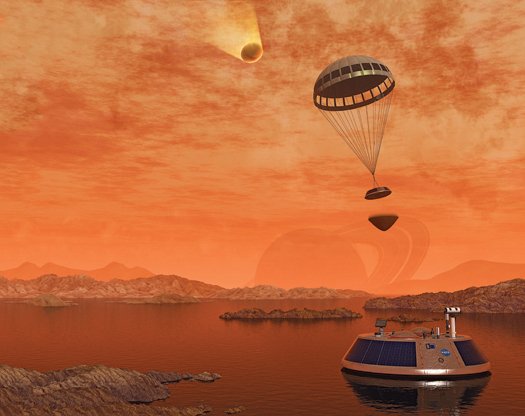
TiME This capsule designed to explore Titan's seas is one of three projects being considered to receive NASA funding next year.

In 2006, while flying by Saturn’s moon Titan, the radar on NASA’s Cassini orbiter discovered seas of liquid ethane and methane on the moon’s –300ºF surface, the only bodies of liquid we know of that exist anywhere but on Earth. Some of the oily seas appeared on Cassini’s radar to be larger than Lake Superior, but visibility was poor because Titan’s atmosphere is thick and hazy.

Now NASA is considering sending a probe called the Titan Mare Explorer (TiME) to splash down on one of Titan’s seas for a closer look. The mission would be humankind’s first extraterrestrial nautical expedition.

In May, the TiME project received a $3-million development contract from NASA. If the space agency green-lights the mission, the capsule will lift off in 2016. By 2023, TiME will be about 800 million miles away in Titan’s north-polar region, home to its biggest lakes and seas. The capsule will take photographs, collect meteorological data, measure depth, and analyze samples. TiME will have no means of propulsion once it is on Titan, so it will float, carried by breezes across the sea’s surface.

Then, by the mid-2020s, it will enter a decade-long winter of darkness as the moon’s orbit takes it to the dark side of Saturn, away from the sun and communication. It won’t have a line of sight to Earth to beam back more data until 2035.

Methane clouds drift in Titan’s smoggy orange skies, sometimes releasing hydrocarbon raindrops, which replenish the seas and sculpt the landscape the way water does on Earth. But Titan’s seas probably don’t contain life. “Life as we know it requires liquid water, and Titan’s surface is far too cold for this,” says Ralph Lorenz, a physicist at Johns Hopkins University who is working on TiME.

“Its seas can tell us about how molecules organize and evolve, and how life may arise more generally.” TiME’s principal investigator, planetary geologist Ellen Stofan, wonders about the waves: “Are there hazes, sea spray? Is the liquid clear or cloudy? Is there scum floating on the surface? With Titan’s seas, there are endless questions.”


DROP IN


After a seven-year journey, including gravitational slingshots around Earth and Jupiter, the Titan Mare Explorer (TiME) passes through Titan’s thick nitrogen and methane atmosphere, protected by its heat shield.

DRIFT DOWN


At an altitude of about 100 miles, TiME deploys its parachute. During the remainder of its roughly two-hour descent, the probe’s camera snaps pictures while a thermometer and barometer record meteorological data.

FLOAT AROUND


After landing in the ethane and methane sea Ligeia Mare, TiME’s mass spectrometer collects a sample to analyze its chemical composition, while its sonar measures the sea’s depth. Without its own means of propulsion, the capsule will bob along in the gentle wind and currents. It might even experience alien rains or wash up on an extraterrestrial beach.

Cosmic Contenders


Next year, NASA will give full funding to one of three missions: a Mars probe to study how the planet formed, a “comet hopper” that will repeatedly land on a near-Earth comet, or a capsule to float on a sea on Titan, one of Saturn’s 53 known moons. The Jet Propulsion Laboratory’s Geophysical Monitoring Station would study Mars’s interior structure and composition to better understand its geological history. The Comet Hopper, conceived at NASA’s Goddard Space Flight Center, would land several times on a comet, studying how the icy body evolves as it warms up while approaching the sun.


by "environment clean generations"

Bring To Life Dead Sea


    Scientists are studying a proposal to pump water into the Dead Sea from the Red Sea more than 110 miles away. The plan could save the Dead Sea, which is disappearing at an alarming rate. The project is sure to have unpredictable economic, political and especially environmental consequences. 

            The Dead Sea has been drying up at a dramatic rate in recent decades as a result mostly of human demands for water. But instead of letting the historic body of water continue to disappear, some scientists are getting increasingly serious about trying to save it.

            In the most ambitious and detailed proposal yet, officials are considering a massive engineering project that would pump water into the Dead Sea from the Red Sea more than 110 miles to the south. Water pipes would follow the border between Israel and Jordan, earning the project a conciliatory nickname, "The Peace Conduit," for its potential to ease tensions between two extremely thirsty nations.

            An international consortium of researchers has been weighing environmental and financial impacts of the multi-billion-dollar plan for a recent series of reports to the World Bank. As the conversation continues, its consequences stretch beyond the Middle East.

            Water woes plague regions around the world. And water-related infrastructure projects span the globe, from the massive Three Gorges Dam in China, to a multitude of dams and irrigation diversions along the Colorado River.

            In hindsight, the history of water projects offers a number of cautionary tales, said Peter Gleick, president of the Pacific Institute, an independent environmental research organization in Oakland, Calif.

           "I would argue that every single project that has been built has had unforeseen consequences, from the littlest to the biggest," Gleick said. "The big engineering water projects of the 20th century were typically built with consideration given only to technological questions, not to environmental, political, social and economic questions."

            "The Red Sea-Dead Sea project is an example of the extremes we're willing to consider when water resources are seriously constrained," he added. "In the Middle East, water is really short. Jordan, Israel and the Palestinians desperately need water. I completely understand how they got into this fix."

            At more than 1,300 feet below sea level, the Dead Sea's shores are the lowest spots of dry land on Earth. Hot, dry and surrounded by dramatic rock structures, the area attracts visitors for its Biblical history, stunning archeological sites, and extremely buoyant waters. Some ascribe healing powers to the muddy shores and mineral-rich salts.

            The Dead Sea has also proven attractive to the potash industry. Two major companies, Dead Sea Works, Ltd., on the Israeli side and the Arab Potash Company on the Jordanian side, intentionally evaporate water from the Sea to extract millions of tons of mineral-filled salts for use as fertilizer and for other industrial applications.

          Pressure on the Dead Sea also comes from two nations full of thirsty people, who remove large amounts of water from the Jordan River and other inflows to use for drinking and agriculture.
For thousands of years, the surface of Dead Sea fluctuated around a generally stable level of about 400 meters (1,300 feet) below sea level.
       
         By 1950, though, human activities had started to make an impact. Then, the water level began to drop at a rate of 30 centimeters (about a foot) each year.

                Since 2000, that rate has accelerated to about a meter (more than three feet) a year.
Overall, the level of the Dead Sea has dropped by more than 30 meters (nearly 100 feet) since the early 1930s.

                 "There is no doubt that human intervention in the water balance has caused the disruption," said geologist Jiwchar Ganor, an environmental geochemist at Ben-Gurion University of the Negev in Israel. "There's no question. It's our fault."

                  Meanwhile, the region gets just 75 millimeters (three inches) of rain each year. That essentially means that the only way to replace the water that people take from the Dead Sea would be to manually put water back in. "We need new interventions," Ganor added. "But we need to make sure they will not induce new and undesired processes."

                    It's far from clear what the perfect solution will be for saving the Dead Sea, or whether there is a good solution at all. Doing nothing has already had profound impacts. As the sea shrinks, underground layers of salt have dissolved, leading to the sudden formation of sinkholes, which damage roads and bridges and threaten lives.

  
         More than 2,500 sinkholes now line the shores of the Dead Sea. Most have appeared since 2000.
Scientists are also concerned about losing recently discovered and yet-to-be discovered microorganisms with unique metabolisms and unexplored genetics.

         Microscopic residents of such a specialized and sensitive ecosystem could harbor insights that might lead researchers to new ways of helping crops grow better in stressful situations. That could eventually help improve food security for the millions of people that live in dry and salty places around the world. 

                While the idea for pumping water into the Dead Sea is not new, the discussion has taken on a new urgency recently as global water shortages rapidly become crises. And while it's a discussion worth having, Gleick said, conversations will need to dig more deeply to truly solve any of the world's water issues.

                "In the 21st century, we have to look beyond purely engineering solutions toward more comprehensive and sustainable answers," he said, such as finding ways to use water more efficiently in the first place. "We have a leaky bucket," he added, "and before we can put more expensive water in, it may make sense to plug the leaks."


by "environment clean generations"

Related Posts Plugin for WordPress, Blogger...

Search

Custom Search

 
Design by Wordpress Theme | Bloggerized by Free Blogger Templates | coupon codes