Environment-Clean-Generations

Environment-Clean-Generations
THE DEFINITIVE BLOG FOR EVERYTHING YOU NEED TO KNOW ABOUT THE ENVIRONMENT YOU LIVE IN, WITH REFERENCE TO LIFE, EARTH AND COSMIC SPACE SCIENCES, PRESENTED BY ENVIRONMENTAL ENGINEER DORU INDREI, ENVIRONMENTAL QUALITY AND ENERGY SPACIALIST
"Life is not about what we know, but what we don't know, craving the unthinkable makes it so amazing, that is worth dying for." Doru Indrei
Custom Search
Showing posts with label internet. Show all posts

Faster Chips, Faster Internet, Everything Faster


We’ve constructed a world out of fiber optic cable and silicon, but Arizona State University researchers think their new material can do better. They have synthesized a new kind of single-crystal nanowire from a compound of erbium--a material generally used to dope fiber optic cables to amplify their signals--and they claim it could increase the speed of the Internet, spawn a new generation of computers, and improve photovoltaic solar cells, sensor technologies, and solid-state lighting.
That’s a tall order, but the ASU team says their erbium material is up to it. In fact, erbium is already augmenting these things. Erbium atoms are generally used to dope fiber optic cable, boosting its optical properties and amplifying signals. But because of the particular properties of erbium, cramming enough atoms onto a cable to make it an effective amplifier requires a fairly long cable.
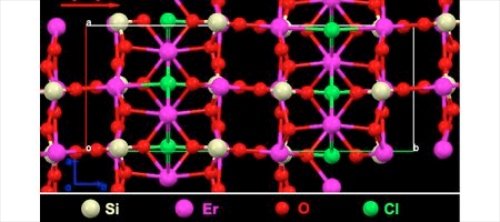


So how do you cram more erbium atoms into a cable? You make the cable itself out of erbium. That’s easier said than done, and the breakthrough here is the erbium compound that can be produced in high quality, single-crystal form. Using the compound, the researchers can create objects with 1,000 times more erbium atoms in them than they could when they were simply doping other materials with erbium. And while that doesn’t translate directly into cables or silicon chips that are 1,000-times faster, it does translate into remarkable improvements in speed and efficiency, the researchers say.

It also enables erbium atoms to be packed into small architectures where they couldn’t be packed in significant numbers previously. That means they can be integrated into silicon chips to speed the performance of computers and other devices even as the fiber optic cables that feed those devices data are also improved by the erbium compound. And all of that could be powered with vastly more efficient PV solar cells made of the erbium compound.
The researchers are testing the material for a range of applications, including those mentioned above. There’s no word yet as to when it might be commercially available. But we imagine it will be fast.

Internet Weights as Much as a Strawberry


A mathematician recently calculated that eBook readers 'gain weight' when you add new books to your library - due to the energy 'gained' by electrons when they store information, and the weight of that energy.Environment Clean Generations
Filling a Kindle with books causes it to gain an infinitesimally small amount of mass - so small that it gains 100,000,000 times more when you recharge the battery.
Now a YouTube science channel has used the same mathematics to calculate the mass of the entire internet.

Surprisingly, the whole thing weighs just 50g - around the weight of a single (large) strawberry.Environment Clean Generations


 But the actual information in it weighs less than a speck of dust.
Vsauce says that the 50g figure is the weight of all the electrons in the electricity required to make the internet work - assuming 75-100 million servers supporting the internet, and not including the home PCs running it.
The whole lot equates to around 40billion watts - which weighs in around the same as a plump strawberry.
If you include all the home PCs using the net, the figure is roughly three strawberries.
The weight if you're just counting the data stored in the internet is much less.
It's difficult to quantify how much data there is in the internet - Vsauce used a (dated) estimate by Google's Eric Schmidt.Environment Clean Generations
Schmidt guessed that there were 5,000,000 terabytes of information in the internet - of which Google indexed 0.04 per cent.
The entire weight of that information would work out, Vsauce estimates, to 0.02 millionths of an ounce.
by "environment clean generations"

GLORIA the Telescope that can be operated from your home


European project will make 17 networks robotic telescopes available to everyone. The idea is to benefit from the eyes and minds of amateurs, star lovers community by giving them access to data they can process. 

GLORIA stands for "GLObal Robotic-telescopes Intelligent Array". GLORIA will be the first free and open- access network of robotic  telescopes of the world.

What it means is that a worldwide network of 17 robotic telescopes crossing 4 continents, ran by 13 partner groups from Russia, Chile, Ireland, the United Kingdom, Italy, the Czech Republic, Poland and Spain will be available online to everyone.


    Locations of the Telescopes (photo)
 
The main purpose of the project is to make astronomic research benefit from all the eyes of amateurs . As the GLORIA website puts it: “Research in astronomy can only benefit from attracting many eyes to the sky - to detect something in the sky requires looking in the right place at the right moment. Our robotic telescopes can search the sky, but the vast quantities of data they produce are far greater than astronomers have time to analyze. GLORIA will provide a way of putting thousands of eyes and minds on the problem.”

But hands will have a play too. The community is open to “to anyone with an interest in astronomy” and, more important, “The community will not only generate content, as in most Web 2.0, but will control telescopes around the world, both directly and via scheduled observations.”

The European project draws on the experience of the Montegancedo Observatory, located at the Facultad de Informática. The Montegancedo Observatory is the first free open access astronomical observatory in the world. The observatory is remote controlled using Ciclope Astro software, maintained by the UPM's Ciclope group. This software will be used by the world robotic telescope network.

Gloria will also organize educational activities, such as broadcasting astronomical events, to attract new users. For this purpose, it will sponsor the next four Sky Live Internet television missions.

If well designed, this project could be one of the most interesting crowdsourcing experiment of the Internet. It will in any case please any star lover around the world.
by environment clean generations"

Related Posts Plugin for WordPress, Blogger...

Search

Custom Search

 
Design by Wordpress Theme | Bloggerized by Free Blogger Templates | coupon codes