Environment-Clean-Generations

Environment-Clean-Generations
THE DEFINITIVE BLOG FOR EVERYTHING YOU NEED TO KNOW ABOUT THE ENVIRONMENT YOU LIVE IN, WITH REFERENCE TO LIFE, EARTH AND COSMIC SPACE SCIENCES, PRESENTED BY ENVIRONMENTAL ENGINEER DORU INDREI, ENVIRONMENTAL QUALITY AND ENERGY SPACIALIST
"Life is not about what we know, but what we don't know, craving the unthinkable makes it so amazing, that is worth dying for." Doru Indrei
Custom Search
Showing posts with label mission. Show all posts

Twin GRAIL Spacecraft to Mapping Moon's Gravity


Circling the Earth at a distance of only 240,000 miles, the moon has captivated humanity's collective imagination since ancient times. Humans have studied the moon for hundreds of years -- first with telescopes, then with robotic probes, even sending twelve American astronauts to the lunar surface. But many mysteries remain. 

The Gravity Recovery and Interior Laboratory mission, or GRAIL, features twin spacecraft embarking on a challenging mission to map the moon's gravity.

"Trying to understand how the moon formed, and how it evolved over its history, is one of the things we're trying to address with the GRAIL mission," says Maria Zuber, principal investigator for GRAIL from the Massachusetts Institute of Technology. "But also, (we're) trying to understand how the moon is an example of how terrestrial planets in general have formed."  

"GRAIL is a mission that will study the inside of the moon from crust to core," Zuber says.

The mission's two spacecraft will fly in formation above the lunar surface to measure the variations in gravity. The mission seeks to reveal clues about our moon's thermal history, and how the inner solar system's rocky planets developed.
 
GRAIL is set to depart from Space Launch Complex 17B at Cape Canaveral Air Force Station in Florida on Sept. 8 at 8:37 a.m. Prelaunch processing -- and the final countdown -- are managed by NASA's Launch Services Program (LSP) at nearby Kennedy Space Center.

"Our team, especially, gets excited whenever we leave Earth orbit, and going to the moon excites us and excites the public," says LSP's Tim Dunn, the NASA Launch Manager for GRAIL.

The two spacecraft -- called GRAIL-A and GRAIL-B -- are riding into space side-by-side aboard a powerful Delta II Heavy rocket built by United Launch Alliance. It's a rocket with an impressive reliability record.

"NASA has a terrific history with the Delta family of rockets," Dunn says. "If we just look at the Delta II rocket, which is the version of the vehicle that we fly today, NASA has a perfect launch record, 48 for 48."

The payload for NASA's most recent lunar mission, called LRO-LCROSS, weighed in at 6,600 pounds and was the size of a minivan. It launched in 2009 aboard a massive Atlas V rocket. Compare that to the GRAIL spacecraft, which together weigh only about 1,600 pounds. Each unit is about the size of a washing machine, designed to be compact and rugged.

"Whenever you have two spacecraft, it does increase the amount of work you have to do," explains Bruce Reid, the GRAIL mission manager for LSP.

"Both spacecraft have to go through environmental testing. And then, for instance, on launch day, we have two dedicated teams -- one to GRAIL-A and one to GRAIL-B. And they'll have to individually power up each spacecraft, and go through their health checks, and put the spacecraft in the proper configuration for launch."

After the climb to orbit, the GRAIL spacecraft will be released from the launch vehicle one at a time. Although most launches conclude with a single "spacecraft separation" -- the moment when launch and mission personnel cheer a successful deployment -- there will have to be two good separations for the GRAIL mission to begin. 

"So we will definitely wait to celebrate until both spacecraft are safe and are on their translunar cruise to the moon," Reid says.

GRAIL's journey to the moon will take three-and-a-half months, a mission plan offering plenty of time for controllers to make sure the spacecraft are ready to get to work. The 42-day launch window opens Sept. 8, but the probes' arrival at the moon will remain fixed, regardless of the liftoff date. GRAIL-A will reach the moon on New Year's Eve of 2011; GRAIL-B will follow on New Year's Day of 2012.

Each spacecraft will have to execute a 38-minute lunar orbit insertion burn -- enough to slow the forward speed by 427 miles per hour. Once the spacecraft have slipped into lunar orbit, they'll spend the next five weeks reducing their orbit period. Then, the twin orbiters will be maneuvered into formation, kicking off the mission's three-month science phase.

During the next 82 days, the moon will rotate three times beneath the two GRAIL spacecraft as they calculate the gravity they encounter. Each 27-day rotation is called a "mapping cycle."

"The lead spacecraft will accelerate, speed up, in response to a mass and cause the distance between the two to increase," Zuber explains. "Then, as the second spacecraft comes over this greater mass, it will speed up and get closer to the first spacecraft. So we're essentially taking the distance between two points, and watching how that distance changes."

The GRAIL mission also marks the first time students have a dedicated camera on board a planetary spacecraft. The digital video imaging system, called MoonKAM, will offer middle-school students the chance to request photography of lunar targets for classroom study. The project is headed by Dr. Sally Ride, the first American woman to fly in space.

The path from the Earth to the moon has been well traveled in recent decades by pioneers like Surveyor, the Apollo astronauts, Clementine, Lunar Prospector and many more. Today, GRAIL is ready to take its place in this long line of lunar explorers. 

"I'm going to be passing Complex 17 about 3:30 a.m. on my way to console," Dunn says about launch day. "And that hour of the morning, looking off to the east, seeing the rocket bathed in spotlights... It's an emotional time for all of us on the launch team."  


by "environment clean generations"


NASA Moon Mission Preparations for September Launch


CAPE CANAVERAL, Fla. -- NASA's Gravity Recovery And Interior Laboratory (GRAIL) mission to study the moon is in final launch preparations for a scheduled Sept. 8 launch from Cape Canaveral Air Force Station in Florida.

GRAIL's twin spacecraft are tasked for a nine-month mission to explore Earth's nearest neighbor in unprecedented detail. They will determine the structure of the lunar interior from crust to core and advance our understanding of the thermal evolution of the moon.

"Yesterday's final encapsulation of the spacecraft is an important mission milestone," said David Lehman, GRAIL project manager for NASA's Jet Propulsion Laboratory in Pasadena, Calif. "Our two spacecraft are now sitting comfortably inside the payload fairing which will protect them during ascent. Next time the GRAIL twins will see the light of day, they will be about 95 miles up and accelerating."

The spacecraft twins, GRAIL-A and GRAIL-B, will fly aboard a Delta II rocket launched from Florida. The twins' circuitous route to lunar orbit will take 3.5 months and cover approximately 2.6 million miles (4.2 million kilometers) for GRAIL-A, and 2.7 million miles (4.3 million kilometers) for GRAIL-B.

In lunar orbit, the spacecraft will transmit radio signals precisely defining the distance between them. Regional gravitational differences on the moon are expected to expand and contract that distance.

GRAIL scientists will use these accurate measurements to define the moon's gravity field. The data will allow mission scientists to understand what goes on below the surface of our natural satellite.

"GRAIL will unlock lunar mysteries and help us understand how the moon, Earth and other rocky planets evolved as well," said Maria Zuber, GRAIL principal investigator from the Massachusetts Institute of Technology in Cambridge.

GRAIL's launch period opens Sept. 8 and extends through Oct. 19. On each day, there are two separate launch opportunities separated by approximately 39 minutes. On Sept. 8, the first launch opportunity is 8:37 a.m. EDT (5:37 a.m. PDT); the second is 9:16 a.m. EDT (6:16 a.m. PDT).

NASA's Jet Propulsion Laboratory, Pasadena, Calif., manages the GRAIL mission. The Massachusetts Institute of Technology, Cambridge, is home to the mission's principal investigator, Maria Zuber. The GRAIL mission is part of the Discovery Program managed at NASA's Marshall Space Flight Center in Huntsville, Ala. Lockheed Martin Space Systems, Denver, built the spacecraft. Launch management for the mission is the responsibility of NASA's Launch Services Program at the Kennedy Space Center in Florida. JPL is a division of the California Institute of Technology in Pasadena.


by "environment clean generations"

The Next Human Spaceflight


Human spaceflight is one of mankind's noblest efforts. Despite this, it's also the most difficult human endeavor to justify. This apparent contradiction is something that plagues each baby-step we make beyond the safety of our atmosphere.


With all the problems in the world considered "more worthy" of the billions of dollars spent on sending a few astronauts and cosmonauts (and taikonauts, sporadically) into space, where's the incentive to "boldly go"? 


50 years ago, when Yuri Gagarin blasted into the unknown, space was considered essential to the future of mankind. Indeed, inside the Cold War pressure cooker, the Space Race was a matter of life and death.

Soviet Russia had beaten the USA into space; a horrendous political predicament for the US government and a massive strategic advantage for the Soviets. 


Three weeks after Gagarin successfully orbited Earth, the US responded by putting Alan Shepard into space. Gagarin and Shepard spearheaded a Cold War tit-for-tat culminating in NASA's Apollo moon landings from 1969 to 1972.


The Cold War clamor for the stars was going on despite rising fears of a nuclear Armageddon, in fact, it was the threat of World War 3 that fueled the Space Race.


50 years on, why are we still restricted to sending humans into low-Earth orbit (LEO)? Why are space programs being cut? Why is there no replacement for the Shuttle Program? Why has mankind become so... introverted? 

Space Race 2?


Two things motivate mankind to do great things in space: power and money. During the Cold War, the world's two superpowers were at loggerheads and one way to beat the opposition was to find the highest ground. This was all about power.


Through incredible ingenuity and bravery, scientists and engineers built rockets to launch men into the ultimate "high ground": space. Granted, the rocket technology was stimulated by the want to hurl nuclear warheads to the other side of the planet, but to control LEO was to win the hearts and minds of entire nations.

Today, although there has been much hype about the supposed "Space Race 2" between the US and China, there is little incentive to send humans beyond Earth orbit. Actually, if it wasn't for the International Space Station, there would be few human spaceflight programs.


Although the motivation for strategic control for space has diminished, that's not to say space technology has remained stagnant. Satellite technology and robotics have become mankind's "eyes and ears" in space. Our robotic explorers are "low-risk" in that they can prevent humans coming into harm's way. Why send a man to Mars when an expendable robot can do it on the cheap?

Job Losses, Canceled Missions


Stymied by the global financial meltdown and political mismanagement, expensive manned space programs (even expensive robotic missions) are becoming difficult for governments to justify. Despite all the positive government spin on "streamlining" space agencies, the fact remains that the world's premier government-run space agency, NASA, is suffering
.

There is no replacement for the retiring shuttle. Missions are being postponed, or outright canceled. Highly skilled workers are facing unemployment; many will likely look for employment abroad.


 In Russia, the birthplace of the first man in space, the financial situation isn't much better. That said, the dependable Russian Soyuz space vehicle will soon be the only ride for NASA astronauts to the space station -- with a per seat round-trip ticket price of $55.8 million -- an uneasy situation where US politicians have accused policy makers of keeping Russian space workers in jobs while sacrificing thousands of jobs at home.

Other nations and space agencies have human spaceflight desires, such as the European Space Agency, China, Japan, and India, but more time is needed to see if any mature and all suffer from the inevitable changing tides of political ideals.
ncentivizing Space Exploration
 
And yet, tonight is a night of celebration. Yuri's Night is in full swing and there are over 500 events being held around the planet. There appears to be a genuine global excitement about the exploration of space, but enthusiasm alone can't push us to the stars.


So, as the Cold War is long gone, and there doesn't seem to be much in the way of a Space Race with China, what could possibly incentivize the exploration of space with robots or humans? If knowledge and curiosity were the only driving factors, we would have pushed well beyond LEO years ago. 


If power isn't in the driving seat, then perhaps the burgeoning private spaceflight industry will be able to turn a profit. Money -- not power -- could be the new motivation for manned spaceflight, but could it be enough to expand the reach of mankind? Will it go beyond space tourism and NASA-funded contracts to resupply the space station? Will orbital space hotels/private microgravity laboratories really "take off"?

The commercial interests in space are far-ranging, but it's too early to tell if commercialized spaceflight is the answer to pushing us beyond LEO.


Lots of Eggs, One Basket


So far you may have noticed that I haven't discussed the benefits of human spaceflight, I've only briefly mentioned a few of the factors preventing us from getting off the ground. There are many advantages to human spaceflight that can be measured immediately, others are more long term. But for me personally, I have a similar philosophy to Stephen Hawking (no, not the philosophy that we are going to get slaughtered by aliens): we shouldn't keep all our eggs in one basket.


All we need is one asteroid to be spotted in the not-so-distant future, and suddenly Planet Earth will be in the cross-hairs. Should this asteroid be big enough -- not necessarily an "extinction level" event, just something that could cripple a continent -- we're going to wish we had an in-space infrastructure to deal with the threat before the threat was detected! 


Additionally, it would be prudent to have self-sufficient colonies elsewhere in the solar system, just in case the worst happens and Earth bumps into some cosmic buckshot.
We live in a violent universe, and although the inner solar system is enjoying a long period of quiescence, there's a lot of space rocks out there. 

Remembering Yuri


We are a technologically advanced civilization, we've sent man to the moon and fired probes into deep space; we've collected samples from asteroids and comets, sent satellites to orbit Mars, Venus, Jupiter, Saturn and now Mercury; we've sent landers and rovers on planetary excursions and now we have a near-complete space station. Isn't it about time we push deeper into space, not only to address potential asteroid deflection techniques, but send man to the next great destination?


As Yuri Gagarin proved 50 years ago, humans have evolved with a desire to explore. We are an inquisitive race and we have the technology to live in space. The only things stopping us are politics and myopic goals.


In 50 years time, when we look back on the early 21st century, will we remember a crossroads in human history when a surge of commercial spaceflight interests stimulated a new era for human spaceflight?

Or will we see a time when we were too busy with politics, conflict and greed to be bothered to invest in the "luxury" of space exploration?


I'm hoping it's not the latter.


 by "environment clean generations"

Beautiful Seas On Titan


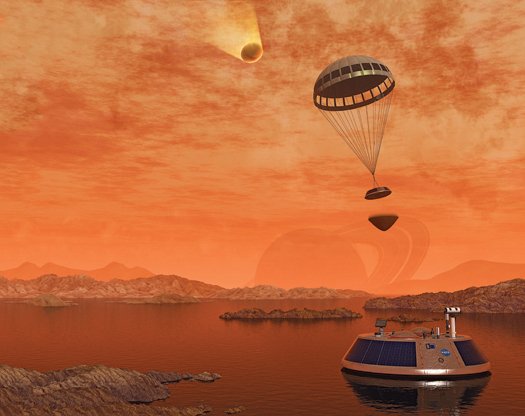
TiME This capsule designed to explore Titan's seas is one of three projects being considered to receive NASA funding next year.

In 2006, while flying by Saturn’s moon Titan, the radar on NASA’s Cassini orbiter discovered seas of liquid ethane and methane on the moon’s –300ºF surface, the only bodies of liquid we know of that exist anywhere but on Earth. Some of the oily seas appeared on Cassini’s radar to be larger than Lake Superior, but visibility was poor because Titan’s atmosphere is thick and hazy.

Now NASA is considering sending a probe called the Titan Mare Explorer (TiME) to splash down on one of Titan’s seas for a closer look. The mission would be humankind’s first extraterrestrial nautical expedition.

In May, the TiME project received a $3-million development contract from NASA. If the space agency green-lights the mission, the capsule will lift off in 2016. By 2023, TiME will be about 800 million miles away in Titan’s north-polar region, home to its biggest lakes and seas. The capsule will take photographs, collect meteorological data, measure depth, and analyze samples. TiME will have no means of propulsion once it is on Titan, so it will float, carried by breezes across the sea’s surface.

Then, by the mid-2020s, it will enter a decade-long winter of darkness as the moon’s orbit takes it to the dark side of Saturn, away from the sun and communication. It won’t have a line of sight to Earth to beam back more data until 2035.

Methane clouds drift in Titan’s smoggy orange skies, sometimes releasing hydrocarbon raindrops, which replenish the seas and sculpt the landscape the way water does on Earth. But Titan’s seas probably don’t contain life. “Life as we know it requires liquid water, and Titan’s surface is far too cold for this,” says Ralph Lorenz, a physicist at Johns Hopkins University who is working on TiME.

“Its seas can tell us about how molecules organize and evolve, and how life may arise more generally.” TiME’s principal investigator, planetary geologist Ellen Stofan, wonders about the waves: “Are there hazes, sea spray? Is the liquid clear or cloudy? Is there scum floating on the surface? With Titan’s seas, there are endless questions.”


DROP IN


After a seven-year journey, including gravitational slingshots around Earth and Jupiter, the Titan Mare Explorer (TiME) passes through Titan’s thick nitrogen and methane atmosphere, protected by its heat shield.

DRIFT DOWN


At an altitude of about 100 miles, TiME deploys its parachute. During the remainder of its roughly two-hour descent, the probe’s camera snaps pictures while a thermometer and barometer record meteorological data.

FLOAT AROUND


After landing in the ethane and methane sea Ligeia Mare, TiME’s mass spectrometer collects a sample to analyze its chemical composition, while its sonar measures the sea’s depth. Without its own means of propulsion, the capsule will bob along in the gentle wind and currents. It might even experience alien rains or wash up on an extraterrestrial beach.

Cosmic Contenders


Next year, NASA will give full funding to one of three missions: a Mars probe to study how the planet formed, a “comet hopper” that will repeatedly land on a near-Earth comet, or a capsule to float on a sea on Titan, one of Saturn’s 53 known moons. The Jet Propulsion Laboratory’s Geophysical Monitoring Station would study Mars’s interior structure and composition to better understand its geological history. The Comet Hopper, conceived at NASA’s Goddard Space Flight Center, would land several times on a comet, studying how the icy body evolves as it warms up while approaching the sun.


by "environment clean generations"

Related Posts Plugin for WordPress, Blogger...

Search

Custom Search

 
Design by Wordpress Theme | Bloggerized by Free Blogger Templates | coupon codes