Environment-Clean-Generations

Environment-Clean-Generations
THE DEFINITIVE BLOG FOR EVERYTHING YOU NEED TO KNOW ABOUT THE ENVIRONMENT YOU LIVE IN, WITH REFERENCE TO LIFE, EARTH AND COSMIC SPACE SCIENCES, PRESENTED BY ENVIRONMENTAL ENGINEER DORU INDREI, ENVIRONMENTAL QUALITY AND ENERGY SPACIALIST
"Life is not about what we know, but what we don't know, craving the unthinkable makes it so amazing, that is worth dying for." Doru Indrei
Custom Search
Showing posts with label photosynthesis. Show all posts

MIT's Artificial Leaf is Better


Speaking at the National Meeting of the American Chemical Society in California, MIT professor Daniel Nocera claims to have created an artificial leaf, made from stable and inexpensive materials, which mimics nature's photosynthesis process.

The device is an advanced solar cell, no bigger than a typical playing card, which is left floating in a pool of water. Then, much like a natural leaf, it uses sunlight to split the water into its two core components, oxygen and hydrogen, which are stored in a fuel cell to be used when producing electricity.


Nocera's leaf is stable -- operating continuously for at least 45 hours without a drop in activity in preliminary tests -- and made of widely available, inexpensive materials -- like  silicon, electronics and chemical catalysts. It's also powerful, as much as ten times more efficient at carrying out photosynthesis than a natural leaf.

With a single gallon of water, Nocera says, the chip could produce enough electricity to power a house in a developing country for an entire day. Provide every house on the planet with an artificial leaf and we could satisfy our 14 terrawatt need with just one gallon of water a day.
Those are impressive claims, but they're also not just pie-in-the-sky, conceptual thoughts. Nocera has already signed a contract with a global megafirm to commercialise his groundbreaking idea. The mammoth Indian conglomerate, Tata Group has forged a deal with the MIT professor to build a small power plant, the size of a refrigerator, in about a year and a half.

This isn't the first ever artificial leaf, of course. The concept of emulating nature's energy-generating process has been around for decades and many scientists have tried to create leaves in that time. The first, built more than ten years ago by John Turner of the US National Renewable Energy Laboratory, was efficient at faking photosynthesis but was made of rare and hugely expensive materials. It was also highly unstable, and had a lifespan of barely one day.

For now, Nocera is setting his sights on developing countries. "Our goal is to make each home its own power station," he said. "One can envision villages in India and Africa not long from now purchasing an affordable basic power system based on this technology."
by "environment clean generations"

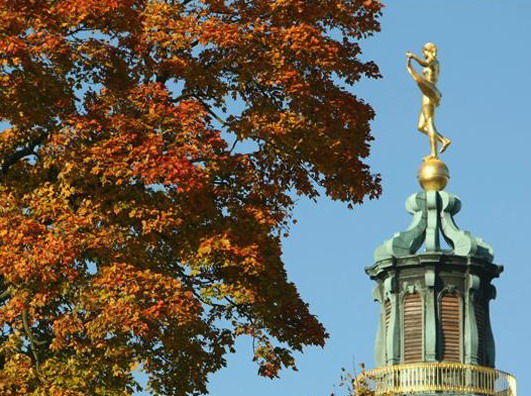
Why Do Leaves Change Color? No, Seriously!


The secrets of why the leaves of trees change yellow or red in the autumn are slowly being revealed. Those eye-seducing hues, it appears, are a lot more than pretty. They're the result of trees doing their utmost to survive. They're the shades of evolutionary success. 

Let's start with the green leaf: We all learned in school that it's the result of the most abundant pigment in the leaf being the green chlorophyll. When the cool air and shorter days of autumn arrive, leaves change to red or yellow not because the leaves are dying, but because of a series of clever processes underway.


Not so surprisingly, yellow leaves undergo one sort of color changing process and red leaves another. As the chlorophyll is being turned off, most leaves turn yellow, which is just a color that's already in the leaves but is usually flooded by green the rest of the growing season. 


But over the last decade or so, researchers have discovered something very different goes on in red leaves. As their chlorophyll drops, they would also turn yellow if not for the sudden rapid production of a brand new red pigment call anthocyanin, which was not previously present in the leaves.

This surprising revelation has led to a surge of interest by scientists who are trying to explain why a leaf with only a week or so to live would bother producing an entirely new pigment.


One theory for explaining red leaves is that they are the result of 35 million years of trees battling insects looking for places to get a last meal and lay their eggs in the fall. Red leaves are harder for insects like aphids to see, for instance, so they tend to go for the yellow leaves.

Some evidence for this theory can be found in the differences of fall colors between North America and Europe. There are few native European trees that turn red in fall, but they are mostly yellow. In North America, however, there are ample red-turning trees, as well as yellow. 

The reason for this may be that in North America, as well as in East Asia, North-South running mountain ranges allowed forests to shift their ranges North and South with climate changes, carrying their insects -- and their long-standing battles -- along the way.

In Europe, however, the major mountain ranges run east-west. So as climate warms or cools, trees have nowhere to go and simply die out -- along with the insects that live off of them. So in Europe, the insect-tree battles have a much shorter history, and so less time to evolve strategies like anthocyanins to fend them off. 
This theory was put forward by Simcha Lev-Yadun of the Department of Science Education- Biology at the University of Haifa-Oranim and Jarmo Holopainen of the University of Kuopio in Finland, and published in the journal New Phytologist.


Another theory suggests that the variation of red anthocyanin in leaves of trees that live in the same area might have more to do with the richness or poverty of the soil in which a tree grows and so it reflects the lengths trees must go to hang onto the nutrients they have invested in their leaves.

In a preliminary study by a student in Charlotte, N.C., it was found that fall leaf colors and the soils under sweet gum and red maple trees show a significant nutrient difference that matches autumn tree color patterns. The richer lowland soils corresponded to more yellow leaves and poorer highland soils correlated to redder leaves.


"It's very clear that there's a correlation," said plant physiologist Bill Hoch of Montana State University in Bozeman. What's more, it matches what he has discovered about the function of that stunning red anthocyanin.

Experiments make a pretty strong case for anthocyanin serving as a protective pigment that helps trees in nutrient-poor or stressed places to maximize the nutrients they can draw from the leaves before they are dropped to the ground, Hoch told Discovery News in an October 2007 article.

"They pull as many of the nutrients back into the plants as possible," said Hoch.


The red pigment protects any remaining green, food-making chloroplasts in the leaves from damage. This is especially valuable for trees in nutrient-poor soils or stressful situations because this "photo-protection" allows the leaves to keep making sugars in their leaves longer.

This, in turn, is vital for pulling nutrients out of the leaves because the only way the nutrients can be extracted from leaf to trunk is by hitching a ride on the trunk-bound sugars.


The bottom line, Hoch explained, is that the longer photosynthesis can continue on an autumnal, coloring leaf, the more nutrients can be drawn out of it for re-use in the spring. So where every drop of nutrient counts the most -- like perhaps on some nutrient-poor hillsides of North Carolina -- red is the color of autumn.


by "environment clean generations"

Related Posts Plugin for WordPress, Blogger...

Search

Custom Search

 
Design by Wordpress Theme | Bloggerized by Free Blogger Templates | coupon codes