THE DEFINITIVE BLOG FOR EVERYTHING YOU NEED TO KNOW ABOUT THE ENVIRONMENT YOU LIVE IN, WITH REFERENCE TO LIFE, EARTH AND COSMIC SPACE SCIENCES, PRESENTED BY ENVIRONMENTAL ENGINEER DORU INDREI, ENVIRONMENTAL QUALITY AND ENERGY SPACIALIST
"Life is not about what we know, but what we don't know, craving the unthinkable makes it so amazing, that is worth dying for."Doru Indrei
Ever want to cancel out a laser beam? Now you can.
There are aspects of science that lend the subject its reputation, at least among schoolchildren, for being “boring” (Punnett squares come to mind).
Then there are things like lasers that are completely awesome, regardless of whether you’re eight years old or 80. Which is why it’s mind-blowing that in what must be the least fun science lab in all the universe, researchers have developed an anti-laser. That’s right, Yale scientists are undoing perfectly good laser beams.
But the development of a device that can absorb an incoming laser beam entirely does have some decidedly interesting implications, not least in optical computing systems.
The researchers were looking into theories to explain which materials might be used to create lasers, and their theory predicted that it should also be possible to create a medium capable of absorbing incoming light.
The device they ended up with turns to lasers tuned to a specific frequency into a silicon optical cavity. The cavity traps the light, forcing it to bounce around until all of its energy is dissipated as heat.
Their demo device can absorb 99.4 percent of incoming light at a specific wavelength, a property that could be used as an optical switch in future computing schemes that use light rather than electrons to carry out operations.
Such a computer could potentially turn certain wavelengths of light off without affecting others, allowing for high degree of control within a computing system. It also might be useful in medical applications, like imaging through opaque biological tissues.
Making Electron Movies with an Attosecond Laser After splitting and then recombining two laser beams from the same origin, the resulting beam would be passed through a gas medium that further intensifies the beam's frequency.
An international team of researchers spanning Australia, North America, and Europe has created a model for a new kind of attosecond laser that should be able to film individual electrons as they participate in chemical reactions. Such high-res, high-speed data gathering has never been achieved before, and if successful the new laser system could have implications for everything from basic chemistry to complex pharmaceutical research and chemical engineering.
Capturing electrons on “film” isn’t easy--imagine the shutter speed you would need to capture something moving so fast that it can rotate a central hub in 151 billionths of a billionth of a second. That’s how fast the electron orbiting a hydrogen nucleus is moving, so in order to capture it in the act you need something with attosecond resolution. In other words, you need a laser capable of pulsing at the attosecond scale.
Attosecond laser pulses have been demonstrated before, but they were too weak to actually measure electron dynamics. For that, you need something both fast and intense. This new laser system satisfies both requirements, and does so with a relatively simple setup.
To get super-short bursts of laser light, you need to combine light waves of different frequencies in a very precise way such that they reinforce each other. This is easier said then done, particularly because it’s hard to get two different laser beams synchronized precisely. To overcome this, the researchers constructed a setup that runs a single laser beam through a beam splitter, producing two beams of different frequencies that are nonetheless the same beam. And because they share the same origin, they remain in sync.
But they’re still not at the attosecond level yet. Several other things have to happen to reach the proper intensities and durations necessary for attosecond-scale measurements. But a paper the team recently published in Nature Photonics outlines the road to attosecond resolutions in such a way that other researchers think its only a matter of time (and, more specifically, a matter of amplification) before we’re looking at individual electrons in a way in which we’ve never seen them before.
Not justolder peoplebutyoung people as well havethe feelingthat everythinghas accelerated. Yesterday wasthe Carnival,Holy Weekin a short timeanda little later Christmas. This feelingisillusoryor hasa real basis?
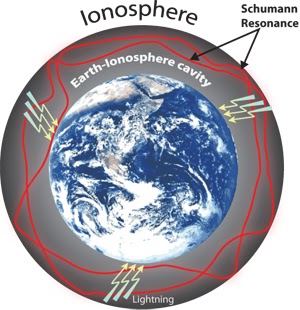
Schumannresonancecangivean explanation.GermanphysicistW.O.Schumannfoundin 1952that the Earthissurroundedby astrongelectromagnetic field,which formsthe bottom of theionosphere, about100 kmabove us.This fieldhas aresonance(theSchumannresonance),approximatelyequal to7.83pulsesper second.
It's like amemoryresponsible for thebalanceof the biosphere,naturalenvironmentupon whichall life depend.All vertebratesandour brainshavethe same frequencyof7.83hertz.Empiricallyit seemedthat we can notbehealthyapart from thisnaturalbiologicalfrequency.Whenastronautswenttospace travel,wentfromSchumannresonance,andgot sick.
If they were subjected to a Schumann simulator, they would recover their balance and health. For thousands of years,Earth'sheartbeathadthis frequencyof7.83pulsesanddevelopedalife ofrelativeecological balance.It seemsthatsincethe 80s,andslightlyincreasedinthe 90s,theratewent from7,83 to 11 and 13 hertz.
The heart of the planetwasdisturbed.As a result,ecologicalimbalanceshave emerged:climatedisruptions,increasedvolcanicactivity, largetensionsescalated into aworld conflict,the overall increase indeviant behaviorin humans,etc..
Because of thisgeneralacceleration,24 hoursa dayis perceivedas havingonly 16.Therefore, the perceptionthatall goestoo fastis notillusory.ItwasrealbasicchangeintheSchumannresonance.
Itmay advance a recurrent theory, between cosmologistsandbiologists, where the Earthisactuallyalivingsuperorganism,weand the planetform asingle entity.
Thatwehuman beings are''earth''who feels,thinks,lovesandworships. Why? Because we havethe same bioelectric nature and we are surrounded bythe same waves of the SchumannResonance.
Gaia,thelivingsuperorganismisMotherEarth,it needs tofindnaturalbalance...like anyliving organism,butit is not knownwhat pricewillbepaid by thebiosphereand humans.
The Schumann resonances (SR) are a set of spectrum peaks in the extremely low frequency (ELF) portion of the Earth's electromagnetic field spectrum. Schumann resonances are global electromagnetic resonances, excited by lightning discharges in the cavity formed by the Earth surface and the ionosphere.
In general, the African peak is the strongest, reflecting the major contribution of the African 'chimney' to the global lightning activity. The ranking of the two other peaks - Asian and American - is the subject of a vigorous dispute among Schumann resonance scientists. Schumann resonance observations made from Europe show a greater contribution from Asia than from South America.
This contradicts optical satellite and climatological lightning data that show the South American thunderstorm center stronger than the Asian center although observations made from North America indicate the dominant contribution comes from South America. The reason for such disparity remains unclear, but may have something to do with the 60hz cycling of electricity used in North America (60hz being a mode of Schumann Resonance).
Williams and Satori suggest that in order to obtain correct Asia-America chimney ranking, it is necessary to remove the influence of the day/night variations in the ionospheric conductivity (day-night asymmetry influence) from the Schumann resonance records. On the other hand, such corrected records presented in the work by Satori et al. show that even after the removal of the day-night asymmetry influence from Schumann resonance records, the Asian contribution remains greater than American.
Similar results were obtained by Pechony et al. who calculated Schumann resonance fields from satellite lightning data. It was assumed that the distribution of lightning in the satellite maps was a good proxy for Schumann excitations sources, even though satellite observations predominantly measure in-cloud lightning rather than the cloud-to-ground lightning that are the primary exciters of the resonances.
Both simulations those neglecting the day-night asymmetry, and those taking this asymmetry into account, showed same Asia-America chimney ranking. As for today, the reason for the invert ranking of Asia and America chimneys in Schumann resonance records remains unclear and the subject requires further, targeted research.
Modeling Schumann resonances on the planets and moons of the Solar System is complicated by the lack of knowledge of the waveguide parameters. No in situ capability exists today to validate the results, but in the case of Mars there have been terrestrial observations of radio emission spectra that suggest the presence of Schumann resonances and there is the possibility that future lander missions could carry in situ instrumentation to perform the necessary measurements. Theoretical studies are primarily directed to parameterizing the problem for future planetary explorers.
The existence of Schumann-like resonances is conditioned primarily by two factors: (1) a closed, planetary-sized spherical cavity, consisting of conducting lower and upper boundaries separated by an insulating medium. For the earth the conducting lower boundary is its surface, and the upper boundary is the ionosphere. Other planets may have similar electrical conductivity geometry, so it is speculated that they should possess similar resonant behavior. (2) source of electrical excitation of electromagnetic waves in the ELF range. Within the Solar System there are five candidates for Schumann resonance detection besides the Earth: Venus, Mars, Jupiter, Saturn and its moon Titan.


 Posted in: