Environment-Clean-Generations

Environment-Clean-Generations
THE DEFINITIVE BLOG FOR EVERYTHING YOU NEED TO KNOW ABOUT THE ENVIRONMENT YOU LIVE IN, WITH REFERENCE TO LIFE, EARTH AND COSMIC SPACE SCIENCES, PRESENTED BY ENVIRONMENTAL ENGINEER DORU INDREI, ENVIRONMENTAL QUALITY AND ENERGY SPACIALIST
"Life is not about what we know, but what we don't know, craving the unthinkable makes it so amazing, that is worth dying for." Doru Indrei
Custom Search
Showing posts with label Aircraft. Show all posts

The Virgin Space Ship


Virgin Galactic just keeps on ticking off the milestones on its way to becoming the first commercial company to take tourists on high-altitude flights to suborbital space and return them safely through the atmosphere to Earth. In the video below, we actually get to see Virgin’s SpaceShipTwo (aka VSS Enterprise) making its first “feathered” flight.

 “Feathering,” as it is known, is probably the biggest innovation integrated into SpaceShipTwo’s design. In the feathered position, the entire tail section of the plane rotates upward about 65 degrees, creating a different aerodynamic shape that is highly stable yet creates tremendous drag to slow the aircraft down during re-entry. Though that drag is pretty significant, the light weight of the aircraft keeps the skin temperature from rising too high, circumventing the need for heat shields and other thermal protection. 

Moreover, when feathered correctly the aircraft is so stable that the pilot can more or less take his hands off the sticks and let the aircraft work its way through the atmosphere naturally, based purely on its aerodynamic shape. That’s a huge safety feature, as the pilot doesn’t have to maintain a specific degree of entry or rely on a sophisticated fly-by-wire computer.


The test shown below took place May 4 and did not actually include a trip to space. But this first feathering test, which began when SpaceShipTwo was dropped from the carrier aircraft WhiteKnightTwo at 51,500 feet, proves that Burt Rutan’s feathering design actually works as well in the air as it did on paper. Where you see the aircraft feather, keep in mind that it is basically falling straight down at 15,500 feet per minute, a rate that is slowed significantly by the aerodynamic drag generated by the feathering configuration.


by "environment clean generations"

The Future of Air Travel


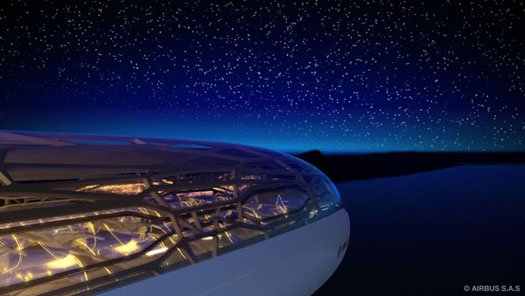
Airbus has seen the future, and it's spacious, sunlit and full of interactive screens. Oh, and cocktails will be served in the virtual bar, assuming someone isn’t playing 18 holes in there.

After revealing its larger vision of what aviation hardware will offer us in 2050 at last year’s Paris Air Show--reduced emissions, lower fuel consumption, reductions in noise and increases in speed--the company has turned its attention toward the passenger experience, offering a sneak peak of the future via the video below.

What does the future have in store? Well, assuming populations begin growing less obese and the economics of packing as many people on a flight as possible are discarded (in the future, air travel--like society--will know no class), the future is much more comfortable.
When flights are at less than full capacity, unneeded seats at the rear of the plane will collapse and all seats will redistribute themselves to offer everyone an equitable boost in legroom. These seats will also morph to fit passengers’ bodies.


Those who need something more than a spacious, morphing seat in steerage will be free to join others in the interaction area, which can be anything from an interactive map room to a virtual golf course to a conference room or bar/lounge, depending on what passengers require. And a “revitalizing zone” in the nose of the aircraft offers panoramic views of the Earth below while re-energizing travelers with “vitamin and antioxidant enriched air, mood lighting, aromatherapy and acupressure treatments.” Right.

But perhaps the most easily digestible part of this vision is the structure of the aircraft itself, which taps a largely-hollow, lightweight bionic structure that mimics the bones in birds and could allow for the kind of transparent canopy pictured above. Airbus isn’t sure what it would be made of yet, but it could be 3-D printed--a technology that we know Airbus’s parent firm EADS is investing heavily in.

by "environment clean generations"

NASA Awards the Largest Prize in Aviation History


NASA has awarded the single largest prize handed down in aviation history to Team Pipistrel-USA.com for designing and demonstrating its Taurus G4 electric aircraft. Per the rules of the NASA- and Google-sponsored CAFE Green Flight Challenge, Pipistrel’s Taurus G4 covered 200 miles in less than 2 hours and did so on the electricity equivalent of less than one gallon of fuel per passenger, scoring $1.35 million for the effort.

But the cash, substantial though it may be, is only part of the story here. The CAFE (that’s Comparative Aircraft Flight Efficiency) Challenge was created to push aircraft engineers toward new, more efficient airplane designs that would perhaps usher in a new era of ultra-efficient flight, based on either electric engines or extremely efficient fuel-burning engines.


So while you can argue the day belongs to Pipistrel--and we certainly don’t mean to diminish that achievement--the CAFE Foundation and NASA are the real winners here. Consider: The challenge asked teams to average 100 miles per hour over two hours, and to do so on the equivalent of one gallon of gas. Not only did Pipistrel manage this, but so did California-based e-Genius with its electric-powered plane (for which it netted a second place prize of $120,000).

The kicker: both teams did so on just a little more than a half-gallon of fuel equivalent. That means both Pipistrel and e-Genius did twice as well as NASA and CAFE asked them to do (and Pipistrel slightly better than e-Genius, hence the distribution of prizes).

That’s pretty amazing, considering that just a few years ago engineers were still trying to figure out how to get an all-electric powered plane into the air for any considerable length of time, much less at sustained triple-digit speeds and while using very little energy.

Our jetliners aren’t going green just yet of course. But the winning teams in the CAFE Green FLight Challenge collectively spent just two years and $4 million on two aircraft that have pushed the electric airplane field forward by a considerable step. Imagine what ten years and some serious investment might do for the electric aircraft space.


by "environment clean generations"

The New Boeing 787 Dreamliner Carbon-Fibre


Aluminium has been the standard material used in aircraft for more than a century - even the Wright brothers' famous first flight in 1903 used an aircraft made partially from the metal. But the 'aluminium age' could be about to end - with the delivery of the first large-scale commercial aircraft made using 50 per cent 'composite materials' including plastics and carbon fibre.

The much-delayed Boeing Dreamliner 787 has a range of 10,000 miles, is far quieter than ordinary jets, and is constructed using a 'moulding' process that has eliminated 1,500 aluminum sheets and 50,000 fasteners. It's also three years late - and has cost a reported $32billion.
Scott Fancher, vice president and general manager of the 787 programme, said: 'It took a lot of hard work to get to this day.'


The first Boeing 787s - delivered to All Nippon Airways - are 20 per cent more fuel-efficient than rivals, but also offer in-flight luxuries such as electrically dimmed windows.


All Nippon Airways is the first airline to take delivery of the hi-tech new plane - the first large-scale commercial jetliner to be built from composite materials, not aluminium.
 The hi-tech new aircraft seats 250-290 and offers increased comfort - the air inside is less dry than comparable jets, and First Class passengers will enjoy entertainment on 17-inch touchscreens.

The aircraft has been much delayed - its maiden flight was delayed for more than two years - and will cost up to $200 million. The delays are reported to have cost maker Boeing more than $32 billion. 


It offers hi-tech entertainment with Android touchscreens built into every seat - even in Economy. The 'composite' design - using mixed materials such as titanium and carbon fibre - is believed to have been a spur for rival Airbus to incorporate carbon fibre in future aircraft.

 Workers inspect the first production models of the 787 Dreamliner - with fuselage assembled from composite sections rather than huge numbers of aluminium sheets.

The blue and white-painted long-range aircraft, which boasts a graceful new design with raked wingtips, will leave for Japan on Tuesday and enter service domestically on Oct 26.


One of the components that gives the 787 Dreamliner its extraordinary range and fuel economy - 20 per cent less than other equivalent aircraft - are its engines, hi-tech new models made by Rolls Royce. 

'It is simpler than today's aeroplanes and offers increased functionality and efficiency,' says Boeing's official description of the plane. 'The team has incorporated airplane health-monitoring systems that allow the airplane to self-monitor and report systems maintenance requirements to ground-based computer systems by itself.'

'You can tell the Dreamliner is special the moment you see it coming in to land,' says Jonathan Margolis, a technology specialist who saw one of its first test flights, 'The near silence is almost spooky.  But the thing which struck me most when I saw it at the Farnborough Air Show was the obvious suppleness of the composite structure. You can clearly see the wings flexing. It almost looks like an Airfix kit.'
'Speaking to the pilot later, he confirmed that as a result of its ultra-light airframe, the 787 is exceptionally manoeuvrable and easy to fly precisely.'


All passengers will enjoy hi-tech entertainment courtesy of an iPad-like Android tablet built into the back of every seat.

Boeing abandoned plans for a sound barrier-chasing 'Sonic Cruiser' a decade ago and worked on lighter long-range jets as cash-starved airlines valued efficiency over speed. Boeing expects this to become the standard for future passenger planes.

Mike Sinnett, the 787 program's chief project engineer, said: 'Technology will only get more efficient and lighter.
The plane's lighter weight allows airlines to operate routes even when the demand is insufficient for larger aircraft like the Boeing 777 or 747, or the Airbus 380 superjumbo.
Fancher added: 'For aviation we believe this is as important as the 707 was with the introduction of the jet age.

He moved to head off any fears over the new materials, stressing the tough moulded composites used to create the aircraft were nothing like ordinary plastic.
'Plastic is what you have on the dashboard of your car. This is not plastic,' he told reporters.

The 787 development program has been delayed seven times due to challenges with engineering, supply chain glitches and a 58-day labor strike in 2008.
'We have been waiting for the 787 for over 3 years as we expected it in the summer of 2008,' said senior vice president Satoru Fujiki who took part in negotiations to buy the 787.


The techniques used to create the 787 Dreamliner have eliminated the need for multiple aluminium sheets and up to 50,000 fasteners.
'I can't say the delayed delivery didn't have any impact but ANA and Boeing worked closely to mitigate it,' he said, adding Boeing had provided alternative jets to meet the shortfall.
ANA has ordered a total of 55 Dreamliners worth $11billion at current list prices, including 40 of the 260-passenger 787-8 variant being delivered this week.

 Some of the aircraft's 20 per cent fuel efficiency gains are thanks to extensive wind-tunnel testing at facilities including Britain's Farnborough air base.

ANA plans to take delivery of four planes in 2011 and an additional eight next year.
The Seattle Times reported on Sunday that 787 program costs had topped $32 billion due to delays. That estimate raised questions, the newspaper said, over whether the new jet would make money for Boeing before 'well into the 2020s, if ever.' Boeing declined comment on the claims.
Analysts say new jets typically cost closer to $15billion.


Analysts have speculated that the huge delays in delivering the hi-tech new jet could mean Boeing will not turn a profit until 2020.

Boeing also faces Wall Street concerns over its ability to reach its target of lifting output to 10 planes a month by 2013.

Aerospace analyst Scott Hamilton said: 'Boeing still has to achieve a smooth production ramp-up and still has to do rework on some 40 airplanes that it says will take years to complete.'


A makeshift sign shows a ramp leading to the first 787 has been hastily converted from '777' - an earlier, less efficient Boeing model.
Asked how confident he was that Boeing would stick to its latest output goals, ANA's Fujiki said: 'We are quite confident in Boeing's ability to deliver on schedule this time.'
Also uncertain is how many planes Boeing must sell to break even, something the company is not yet saying.

'If it is 1,200, they should make money; if it is larger than that it could be challenging,' Hamilton said.
The delivery comes as Boeing remains locked in a dispute with one ofits top labor unions in Washington state, where it has traditionally built its aircraft.

The International Association of Machinists and the National Labor Relations Board accuse Boeing of building a non-union 787 plant in South Carolina to punish the IAM for past strikes.
Boeing denies that claim, saying the jobs in South Carolina represent new employment, not the relocation of existing work.

by "environment clean generations"

Voyager 1 leaves the solar system


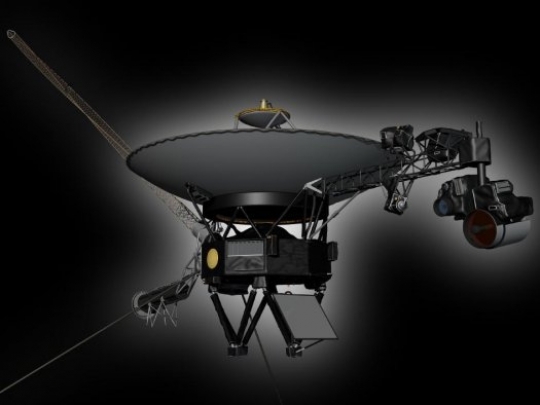
                 Located on the edge of our solar system, it is likely that Voyager 1 spacecraft to cross the border to interstellar space sooner than scientists expected, according to data from the Voyager, and the Cassini instrument, currently studying Saturn and its natural moons

                 This milestone, which marks the event leaving the field of influence of the Sun, in the absolute premiere of an object created on Earth, could thrust deep into the conquest of space history at any time from now. According to the latest estimates of the astronomers, this will happen in late 2012
.
                 Voyager 1 is getting away from the Sun with a speed of 182.648 km / h. One kilometer in 0.019 seconds. This means that it may surround the Earth in less than 15 minutes. At such a speed, the probe travels a distance of about 1.6 billion miles every three years. Now it crosses the marginal heliosphere, a region that marks the outer boundary of the huge bubble of charged particles that emanates from Sun

      
          Since astronomers do not know the exact thickness of this portion heliosphere, they can not pinpoint exactly when the Voyager probe will exceed this boundary, known as the heliopause - the sphere of influence between the Sun and interstellar space. 
          According to new data from aircraft, this limit would extend to a distance of 17.6 billion km from the Sun. So, at this time, Voyager 1 is at a distance of 17.28 billion km from the star that gives us heat and light, it can very well overcome the barrier to the universe at any given time.

                 Voyager 2 probe is about 14.5 billion kilometers away, so will go into interstellar space after its twin. Voyager aircrafts were launched in 1977, during a trip planned for decades through the solar system, took pictures and performed various measurements of Jupiter and Saturn systems, along with Uranus and Neptune.
                  Researchers should be able to precisely specify when Voyager 1 will pass the interstellar region, because the probe should record a sharp drop in density of charged particles in the heliosphere and an increase in neutral particles from interstellar plasma . However, nobody can say what will happen when Voyager 1 will cross the border. But apparently we do not have to wait long. 
www.popsci.com


by "environment clean generations"

Related Posts Plugin for WordPress, Blogger...

Search

Custom Search

 
Design by Wordpress Theme | Bloggerized by Free Blogger Templates | coupon codes