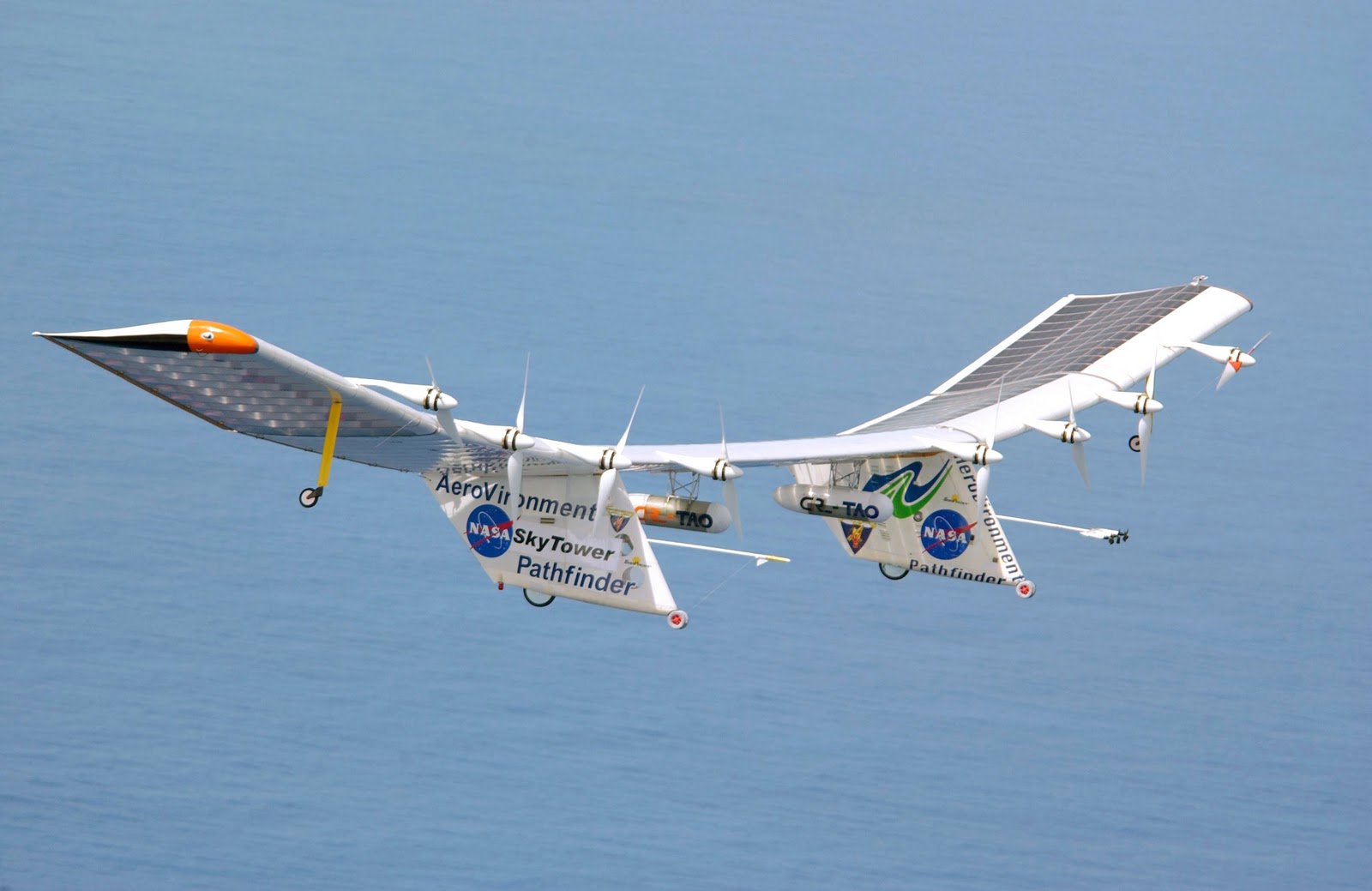
Solar energy is abundant and infinitely renewable. Therefore, it's not surprising to see the proliferation of devices that rely on the sun. From solar yard lights to solar-powered homes and businesses, many people can take advantage of the energy the sun has to offer. But you might be thinking that solar yard lights aren't all that exciting (although, the science behind them can be) and maybe you're wondering what else there is out there. Would you believe solar aircraft?
Although they've been flying since the 1970s, solar aircraft may have flown so far below your radar that they sound new. A solar airplane could take you for quite an amazing ride. You'd have to start in the morning and wait for the clouds to clear. Propellers whirring, the plane would travel with yawn-inducing slowness down the runway. As the wind caught the plane, you'd ascend so slowly that you'd hardly be pressed into your seat.
You'd climb above birds, above Mount Everest, above commercial jets and above military spy planes (NASA and AeroVironment's Helios climbed to 96, 863 feet [29,524 meters]). You'd settle into the stratosphere, home to icy cirrus clouds.
However fun such a joyride might sound, solar planes are designed for other uses. Since they're basically low-flying satellites, at first NASA envisioned parking them over cities as communications platforms, but that was before we had many cell phone towers. Now, the military is eyeing solar planes for surveillance. They can, in theory, stay aloft for years. In reality, though, the stats aren't quite there yet: The record is two weeks (really!) without landing, set by QinetiQ's unmanned "Zephyr." For manned aircraft, however, the record is 26 hours, 10 minutes and 19 seconds, held by the Swiss aircraft Solar Impulse.
With records like these on their side, some organizations hope to change attitudes that solar power is weak and inefficient.
Probably the easiest way to understand how solar aircraft work is by comparing them to more common airplanes in the sky. We'll look at one commercial jet -- Boeing's 747-400 -- and one military jet -- the F-22A Raptor.
Solar versus Traditional Airplanes
As mentioned earlier, solar airplanes are mostly surveillance craft. Boeing's 747-400, on the other hand, flies from Detroit to Tokyo, carrying hundreds of passengers on decent fuel mileage. And the F-22A Raptor, by contrast, is a fighter plane for the U.S. Air Force. It's designed to be fast, agile, quiet and almost invisible. These are the basic differences. Let's put these planes head-to-head, or wing-to-wing to find out even more.
Many solar planes are shaped like flying rulers.
NASA's Helios plane, for instance, has a 247-foot (75-meter) wingspan but is only 12 feet (3.7 meters) long [source:
NASA]. A 747's wingspan is shorter, at 211 feet (64.3 meters), and its fuselage is about the length of its wingspan [source:
Boeing]. The F-22A Raptor is a spade-shaped, stubby plane, 44.5 feet (13.6 meters) across the wings and 62 feet (18.9 meters) long [source:
Lockheed Martin].
Compared to the other planes, solar planes are practically kites. Some are launched by hand with a running toss into the air. The Helios is too heavy for that. It weighs 2,048 pounds (929 kilograms) at most, made of pricey, light and strong materials -- and Styrofoam [source:
NASA]. Amazingly, the whole plane bends. (More on that later.) A Raptor weighs a formidable 83,500 pounds (37.875 kilograms) and is most definitely not bendable. The 747 weighs up to 875,000 pounds (396, 893 kilograms), including all the luggage in the cargo hold.
You'll find a lot of electric propellers -- up to 14 -- on a solar airplane, and that's all of its propulsion. Of course, electric propellers wilt next to jet engines. The Raptor's jet engines shoot it forward with 70,000 pounds (311, 500 newtons) of total thrust [source:
Lockheed Martin]. A 747's two engines move it with up to 126,600 pounds of total thrust (563,145 newtons) [source:
Boeing].
You wouldn't be surprised by which one would win in a race. While the environment smiles on pollution-free solar planes, the gods of speed do not. When cruising at low altitudes, the Helios travels no more than 27 miles per hour (43.5 kilometers per hour) [source:
NASA]. A 747 cruises at 567 miles per hour (913 kilometers per hour), and the Raptor can reach close to Mach 2 [source:
Boeing,
Lockheed Martin].
The Raptor also wins on maneuverability. While the 747 and the Helios can turn, pitch and change their speeds, the Raptor can fly a spinning loop-the-loop.
So far, the 747 wins on distance. The farthest flight for a solar plane has been 163 miles (262 kilometers). The Raptor's maximum range is 1,841 miles (2,963 kilometers), while the 747 can fly 8,355 miles (13,446 kilometers) [source:
Lockheed Martin,
Boeing].
Solar planes win in a category you probably haven't considered -- longevity. Jets must land to refuel. Solar planes don't have to. They can stay aloft as long as their batteries are charged to get them through the night. By staying aloft for more than three days, solar planes have already surpassed jets, and many solar-plane makers share the goal of months to years.
Now that you know how a solar plane stacks up against other aircraft, let's take a closer look at its design.
Solar Aircraft Design
Solar airplanes don't have much on board. They're ridiculously flat and thin, inviting the wind to lift them instead of knocking them around. The body is strong and light, often made of carbon-fiber pipes for the frame, with a strong fabric like Kevlar stretched across it. Somewhere in the structure, you'll see an "X" or "V," which prevents the plane from rolling.
Most planes run on batteries at night, although some have used fuel cells. The batteries are light and energetic and are usually arranged in a sheet. QinetiQ's solar plane "Zephyr," which holds the current endurance record, runs on a sheet of lithium-sulfur batteries [source:
Bush]. The batteries are wired to motors that turn propellers.
You can't miss the solar panels, which are the skin and heart of the plane. They are unlike the rigid, bulky solar panels on satellites or a solar house. These panels are millimeters thick, are flexible enough to roll, and are incredibly efficient and expensive [source:
Bush,
USO]. The solar panels are also wired to the propellers.
On board, the plane will carry light, voltage and wind sensors, and it will have a method for relaying that information to the pilot.
If you're wondering where the wheels are -- there's no need to bother. "Some solar airplanes basically drop off the landing gear in flight because you're not going to need them. The plane may land on skids or crash-land. Engineers are getting rid of every bit of weight you can possibly imagine," says John Del Frate, an engineer at NASA's Dryden Flight Research Center.
Some solar airplanes are true UAVs, or unmanned aerial vehicles. Except for takeoff and landing, an autopilot flies the plane. Pilots use onboard systems to track the plane and control its motors from the ground. Unmanned planes include NASA's deceased Helios, the Zephyr, and Aurora Flight Sciences' Odysseus and SunLight Eagle.
Other solar planes can support a pilot. Examples of piloted solar aircraft are NASA and AeroVironment's retired Gossamer Penguin and Solar Challenger, and a different group's Solar Impulse, which aims to circumnavigate the globe.
Flying Solar Aircraft
A solar plane's flight starts with checks. Check the battery -- it should be charged. Check the ground winds. They shouldn't exceed about 10 miles per hour (16 kilometers per hour), or else the plane could crash on the runway. Check for turbulence in the air because the plane will have to ascend through the turbulent layers. Billows in the clouds are a bad sign. "Wind is your enemy," says Del Frate.
Morning is best for takeoff, when the sun is overhead and there are ample hours of sunlight left in the day. As a runway, you'll need a circle a little more than three football fields across, which is 10 times shorter than an average airport runway. Next, you angle the plane for takeoff, using that circle. You point the plane so the wind blows head-on, but never across it. Crosswinds spell destruction for most solar planes because they can throw the plane in unwanted directions.
When the propellers are online, a combination of battery power and solar energy can start them spinning, and the plane is ready to roll (or be hand-tossed into the air). "The plane takes off at bicycle speeds," says Del Frate, because takeoff is typically done on solar power. As a pilot, usually on the ground, you avoid shadows and steer for maximum sun to preserve power in the battery.
The plane ascends slowly. You make it ascend by speeding its central propellers, tilting it up. By 35,000 feet (10.6 kilometers) or so, you've hit the jet stream. Hold on. In this turbulent layer of the sky, planes like NASA's Helios can bend, from flat to a dramatic "U," with the wind. If the plane didn't bend, the wind could rip it apart. The plane can't stay here, where 747s cruise, because if turbulent wind doesn't kill it, the jet stream will carry it away.
Above the jet stream, dodge the puffy clouds; they block the sun. Turning is as easy as speeding the propellers on one side of the airplane. By 40,000 feet (12 kilometers), you've entered the stratosphere, a still layer with icy cirrus clouds that don't block your sun. Finally, by 65,000 feet (20 kilometers), you can relax in stillness and practically glide. If you plan to stay up overnight, make sure your battery is charged to run the propellers. Otherwise, you'll start losing altitude.
During flight, a solar plane switches automatically between battery and solar power. When there's sun, it runs the propellers and charges the batteries or fuel cells. To charge the battery faster, the pilot can fly slower. At night or in clouds, the propellers run on the battery or fuel cells alone.
When it's time to land, cut the power to stop the propellers. Solar planes glide down -- engineers would rather make them efficient fliers than fast at landing. "They descend extremely slowly," says Del Frate. "When you're trying to bring one in for a landing, you'd like to grab it and pull it down."
Environmental Benefits of Solar Aircraft
Many researchers say it's useful to park a solar aircraft in the sky. It can hover over a spot, carrying cameras or other sensors. In the stratosphere, it can sample gases near the ozone layer. It can also watch forest fires or track hurricanes on the ground.
For the military, solar airplanes can help with reconnaissance. Like spy planes, they fly high, which makes them stealthy. But while spy planes must fly over and return, solar airplanes are unblinking eyes. They can take uninterrupted photos or videos for years. "When an event happens, they can study everything that led up to it," says Del Frate. For law enforcement, they're good for border and port patrol.
It's true satellites can perform some of these tasks. But solar airplanes see more detail on the ground with less expensive cameras because they're closer to the action. They're also less expensive to build and launch. While satellites are hard to move once they're in orbit, solar airplanes are easily moved. It's also easier to bring solar planes down for maintenance.
Solar aircraft, being electric, emit no exhaust. Commercial airplanes do. In 1992, airplanes emitted 0.5 billion tons of CO
2, or 2 percent of human CO
2 emissions [source:
IPCC]. Their exhaust contains many substances linked to health and environmental effects, although the U.S. Environmental Protection Agency (EPA) regulates their levels, and health impacts near airports are being studied [source:
EPA,
Wachter]. Regardless, solar planes can't become clean passenger planes because they'll probably never have enough power to carry many passengers, says Del Frate.
Stratospheric jets, like the F-22A Raptor and U-2 spy planes, also emit exhaust. While they emit it into the stratosphere, where gases persist longer than in our troposphere below, their contribution to air pollution, ozone depletion and global warming hasn't been measured thoroughly. Solar airplanes that can accelerate and maneuver like these planes are many years off. So at this time, it's not practical to talk about solar planes being environmentally friendly alternatives to other planes. Still, they are clean vehicles for their current applications.
A surprising benefit of solar airplanes, says Del Frate, is that if solar panel manufacturers supplied a dozen solar planes a year with big, high-efficiency panels, the cost of high-efficiency panels for your home would go down.
It's hard to imagine paying $20 million for a plane as thin as a wafer, but that's about what solar airplanes cost.
Concerns About Solar Aircraft
"I remember that people never thought they'd be able to fly. After the planes set flight records, those critics were silenced," says Del Frate. But critics still take issue with solar airplanes.
"Critics tend to point out that these airplanes are fragile," says Del Frate. NASA's Pathfinder plane was damaged inside a NASA hangar by wind blowing through the door, he says. "We build in the necessary strength and no more. They're light and very minimal on material -- for a reason."
It's hard to imagine paying $20 million for a plane as thin as a wafer, but that's about what solar airplanes cost. According to Del Frate, the solar panels alone account for about half the cost. But to put it in perspective, a Boeing 747 starts at $234 million [source:
Boeing].
The planes are not heavy lifters; the strongest built to date can carry one pilot. "If they hardly carry any payload, what's the point?," says Del Frate, summarizing what critics say. He points out that solar planes can carry sensors and cameras, which are light and are getting lighter. "Look at all your cell phone can do. It hardly weighs anything."
So far, solar planes need special flight conditions. While the batteries can carry them through night and the shade, the planes can't take off or fly in storms. They can't take off in strong wind. They can't stay in cumulus clouds or turbulent layers of the sky.
"Critics will point out they're only useful nine months out of the year, and they're right," says Del Frate. During winter, the planes struggle to stay up, with days being short and nights being long. Because the sun is close to the horizon, and the solar panels usually point straight up, the plane struggles to collect enough sunlight to stay aloft. Designers are angling and placing solar panels to catch the sun no matter where it is -- and some are planning folding planes.
by "environment clean generations"


 Posted in: Aerospace,Airbus,Aircraft,airplanes,boeing,health-monitoring systems,technology,The New Boeing 787 Dreamliner Carbon-Fibre