Environment-Clean-Generations

Environment-Clean-Generations
THE DEFINITIVE BLOG FOR EVERYTHING YOU NEED TO KNOW ABOUT THE ENVIRONMENT YOU LIVE IN, WITH REFERENCE TO LIFE, EARTH AND COSMIC SPACE SCIENCES, PRESENTED BY ENVIRONMENTAL ENGINEER DORU INDREI, ENVIRONMENTAL QUALITY AND ENERGY SPACIALIST
"Life is not about what we know, but what we don't know, craving the unthinkable makes it so amazing, that is worth dying for." Doru Indrei
Custom Search
Showing posts with label stars. Show all posts

It Seems that Every Star Has at Least One Planet


Each star in the Milky Way shines its light upon at least one companion planet, according to a new analysis that suddenly renders exoplanets commonplace, the rule rather than the exception. This means there are billions of worlds just in our corner of the cosmos. This is a major shift from just a few years ago, when many scientists thought planets were tricky to make, and therefore special things. Now we know they’re more common than stars themselves.

“Planets are like bunnies; you don’t just get one, you get a bunch,” said Seth Shostak, a senior astronomer at the SETI Institute who was not involved in this research. “So really, the number of planets in the Milky Way is probably like five or 10 times the number of stars. That’s something like a trillion planets.”

Of course there’s no way to know, at least not yet, how many of these worlds could be hospitable to forms of life as we know it. But the odds alone are tantalizing, Shostak said.
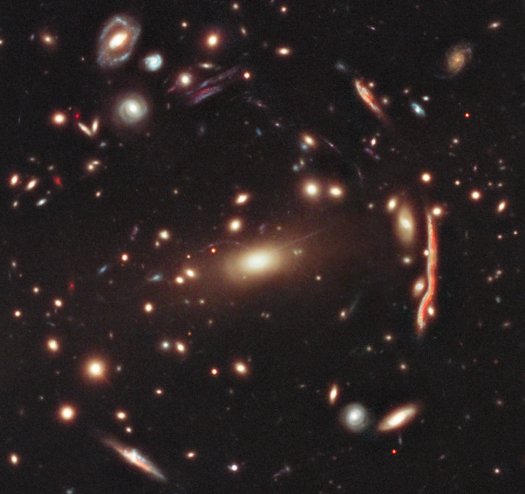

Gravitational Lensing This image of galaxy cluster MACS J1206.2-0847 shows the gravitational lensing effect of dark matter on distant galaxies. In a new exoplanet population paper, astronomers used microlensing to sense the presence of planets around other stars. The lensing was not as extreme as this, but works somewhat like a magnifying glass, brightening the light of a star lined up behind the planetary system. Space Telescope Science Institute
“It’s not unreasonable at this point to say there are literally billions of habitable worlds in our galaxy, probably as a lower limit,” he said. “Maybe they’re all sterile as an autoclave, but it doesn’t seem very likely, does it? That would make us very odd.”
Other astronomers maintain that we are odd indeed, and that increasing the known planet population does not increase the odds of finding intelligent life on any of them.
“The numbers are huge by any human standard, but we are still looking at only a tiny bit of our galaxy,” said John Gribbin, an astronomer and science writer who just published a book called “Alone in the Universe.” “[This research] does further our understanding of how things like planets form and how stars form, but there is a long way to go before we can say there is life on any of these planets, and further to go before we get to civilization.”

The new planetary plenitude is derived from a six-year survey of millions of stars studied with an international network of southern hemisphere telescopes. Astronomers used a delicate detection method called gravitational microlensing, which is one of three trusty ways to find extrasolar planets. Kepler uses the transit method, detecting blips in star brightness as planets cross in front of them.

Other observatories use the radial velocity method, measuring the wobble caused by the gravitational tug of a planet on its star. Both of these are helpful for finding planets that are either huge or hug tightly to their stars. But the gravitational microlensing method can be used to find planets over a wider mass range and a wider orbital distance.

.........................................................................................................................................................

More...

..........................................................................................................................................................

La Silla Observatory: The Milky Way seen above the dome of the Danish 1.54-metre telescope at ESO's La Silla Observatory in Chile, used to search for exoplanets using the microlensing technique. The central part of the Milky Way is visible behind the dome of the ESO 3.6-metre telescope; on the right, the Magellanic Clouds.  ESO/Z. Bardon
 
It works by using the host star and its putative planets as a lens. The gravitational field of the host solar system magnifies the light of a star in the background. If the host star does have a planet, the planet essentially widens the lens, and this is an effect that can be measured. 
 
Such an alignment is incredibly rare, so an international team of researchers examined 100 million stars every night and noted ones with promising light curve amplifications, examining them in higher resolution. From 2002 to 2007, the team observed 500 such stars. In 10 cases, they could directly see the lensing effect of a planet.
 
A statistical analysis showed one in six of the stars studied hosts a planet of similar mass to Jupiter, half have Neptune-mass planets and two thirds have super-Earths. Combining the results suggests that the average number of planets around a star is greater than one, the astronomers say in a new Nature paper.
 
“Together, the three methods are, for the first time, able to say something about how common our own solar system is, as well as how many stars appear to have Earth-size planets in the orbital area where liquid what could in principle exist as lakes, rivers and oceans — that is to say, where life as we know it from Earth could exist,” said Uffe GrÃ¥e Jørgensen, head of the Astrophysics and Planetary Science group at the Niels Bohr Institute at the University of Copenhagen and an author of the paper.

With so many planets, it could be easy to assume the odds have just gotten much better for alien life hunters, but it’s not necessarily the case because scientists still don’t know what’s necessary for life to form, said Paul Davies, a cosmologist and astrobiologist at Arizona State University.

“How much real estate is out there doesn’t matter,” he said. “My guess is there would be some hundreds of millions of Earth-like planets in the Milky Way, but that is no good to you if the probability of life forming on one of them is one in a trillion.”

The lack of knowledge hasn’t stopped scientists from making educated guesses, however — take the Drake equation, devised by astronomer Frank Drake in 1961, which seeks to estimate the number of intelligent civilizations based on an equation of assumptions.


“All of the work that has been done since 1961 when this equation was concocted has gone in the same direction, namely, that our situation here is not so weird, not so strange, not so bizarre, not so special,” Shostak said. “We’re not unique, at least astronomically.”
We’re just one in millions.


A Plethora of Planets: This artist’s impression shows how common planets are around the stars in the Milky Way. The planets, their orbits and their host stars are all vastly magnified compared to their real separations. A six-year search that surveyed millions of stars using a technique called microlensing concluded that every star has at least one planet orbiting around it.  ESO/M. Kornmesser

Youngest Exoplanet Discovered


We know that the planets in our solar system were born from a dusty disk surrounding the sun billions of years ago;wouldn't it be amazing if we could see another star system going through the birthing throes of this protoplanetary phase?

Today, a team of astronomers using the awesome power of the twin 10-meter Keck Telescopes atop Mauna Kea, Hawaii, have announced just that. 

Environment-Clean-Generations


For the first time they have directly imaged a baby world forming close to its parent star inside an empty track of a larger disk of dust. This makes it a record-breaker -- the proto(exo?)planet is five-times younger than the youngest exoplanet discovered to date.
The baby world -- called LkCa 15 b -- orbits LkCa 15, a T Tauri star located 450 light-years from Earth that is already known to possess a dusty circumstellar disk. 

T Tauri stars are very luminous, young, variable stars. In astronomical timescales, they've recently formed from a cloud of gas under gravitational collapse. The gravitational energy released is what provides the energy to power the star, a phase before nuclear fusion is ignited in their cores.  

So, when we observe LkCa 15, we know we are looking at a star that's just starting out, potentially with a whole system of worlds that might form from its protoplanetary disk.

And now we know that there will be at least one world, LkCa 15 b, that Keck can see slowly forming.

"LkCa 15 b is the youngest planet ever found, about 5 times younger than the previous record holder," said astronomer Adam Kraus of the University of Hawaii's Institute for Astronomy. "This young gas giant is being built out of the dust and gas. In the past, you couldn't measure this kind of phenomenon because it's happening so close to the star. But, for the first time, we've been able to directly measure the planet itself as well as the dusty matter around it."

Using a clever trick, Kraus and co-investigator Michael Ireland, of Macquarie University and the Australian Astronomical Observatory, were able to tease out the light being emitted by the dust surrounding the newborn star. They combined the power of Keck's Adaptive Optics with a technique called aperture mask interferometry to manipulate the starlight after it is received by the telescope.

"It's like we have an array of small mirrors," said Kraus. "We can manipulate the light and cancel out distortions." By doing this, the bright light emitted by the star can be canceled out, resolving the faint disks and gaps therein where baby worlds may be hiding. In one of those gaps, LkCa 15 b resides.

"We realized we had uncovered a super Jupiter-sized gas planet, but that we could also measure the dust and gas surrounding it. We’d found a planet, perhaps even a future solar system at its very beginning," he adds.

Kraus and Ireland intend to continue surveying other nearby stars to see if similar worlds are forming in the ultimate hope of understanding the planetary formation processes that built our own solar system.
by "environment clean generations"

Deciphering The Earth, A Brief Review


n "The Hitchhiker's Guide to the Galaxy," Arthur Dent has trouble getting his mind around the Vogon Constructor Fleet's destruction of the Earth. He can't process it -- it's just too big. Arthur tries to narrow it down, but thinking of England, New York, Bogart movies and the dollar produces no reaction. Only when he considers the extinction of McDonald's hamburgers does it finally sink in.

After deciding to write about how the Earth works, we felt a little like Arthur Dent. Even though it's tiny compared to the rest of the universe, the Earth is enormous, and it's extremely complex.

But instead of collectively going out for a burger, we decided to take another approach. Rather than examining each of the Earth's parts, we'll look at what ties it all together. Just about everything on Earth happens because of the presence of the sun. 

Power and light

Compared to the rest of the universe, the Earth is very small. Our planet and eight (or maybe nine) others orbit the sun, which is only one of about 200 billion stars in our galaxy. Our galaxy, the Milky Way, is part of the universe, which includes millions of other galaxies and their stars and planets. By comparison, the Earth is microscopic.

Compared to a person, on the other hand, the Earth is enormous. It has a diameter of 7,926 miles (12,756 kilometers) at the equator, and it has a mass of about 6 x 1024 kilograms. The Earth orbits the sun at a speed of about 66,638 miles per hour (29.79 kilometers per second). Don't dwell on those numbers too long, though; to a lot of people, the Earth is inconceivably, mind-bogglingly big. And it's just a fraction of the size of the sun.

From our perspective on Earth, the sun looks very small. This is because it's about 93 million miles away from us. The sun's diameter at its equator is about 100 times bigger than Earth's, and about a million Earths could fit inside the sun. The sun is inconceivably, mind-bogglingly bigger.
 
But without the sun, the Earth could not exist. In a sense, the Earth is a giant machine, full of moving parts and complex systems. All those systems need power, and that power comes from the sun.

The sun is an enormous nuclear power source -- through complex reactions, it transforms hydrogen into helium, releasing light and heat. Because of these reactions, every square meter of our planet's surface gets about 342 Watts of energy from the sun every year. This is about 1.7 x 10¹⁷ Watts total, or as much as 1.7 billion large power plants could generate [source: NASA]. You can learn about how the sun creates energy in How the Sun Works.


When this energy reaches the Earth, it provides power for a variety of reactions, cycles and systems. It drives the circulation of the atmosphere and the oceans. It makes food for plants, which many people and animals eat. Life on Earth could not exist without the sun, and the planet itself would not have developed without it.
To a casual observer, the sun's most visible contributions to life are light, heat and weather. Now we'll look at how the sun powers each of those.

 Night and day

Some of the sun's biggest impacts on our planet are also its most obvious. As the Earth spins on its axis, parts of the planet are in the sun while others are in the shade. In other words, the sun appears to rise and set. The parts of the world that are in daylight get warmer while the parts that are dark gradually lose the heat they absorbed during the day.

You can get a sense of how much the sun affects the Earth's temperature by standing outside on a partly cloudy day. When the sun is behind a cloud, you feel noticeably cooler than when it isn't. The surface of our planet absorbs this heat from the sun and emits it the same way that pavement continues to give off heat in the summer after the sun goes down. Our atmosphere does the same thing -- it absorbs the heat that the ground emits and sends some of it back to the Earth.


The Earth's relationship with the sun also creates seasons. The Earth's axis tips a little -- about 23.5 degrees. One hemisphere points toward the sun as the other points away. The hemisphere that points toward the sun is warmer and gets more light -- it's summer there, and in the other hemisphere it's winter. This effect is less dramatic near the equator than at the poles, since the equator receives about the same amount of sunlight all year. The poles, on the other hand, receive no sunlight at all during their winter months, which is part of the reason why they're frozen.

Most people are so used to the differences between night and day (or summer and winter) that they take them for granted. But these changes in light and temperature have an enormous impact on other systems on our planet. One is the circulation of air through our atmosphere. For example:

  1. The sun shines brightly over the equator. The air gets very warm because the equator faces the sun directly and because the ozone layer is thinner there.
  2. As the air warms, it begins to rise, creating a low pressure system. The higher it rises, the more the air cools. Water condenses as the air cools, creating clouds and rainfall. The air dries out as the rain falls. The result is warm, dry air, relatively high in our atmosphere.
  3. Because of the lower air pressure, air rushes toward the equator from the north and south. As it warms, it rises, pushing the dry air away to the north and the south.
  4. The dry air sinks as it cools, creating high-pressure areas and deserts to the north and south of the equator.
This is just one piece of how the sun circulates air around the world -- ocean currents, weather patterns and other factors also play a part. But in general air moves from high-pressure to low-pressure areas, much the way that high-pressure air rushes from the mouth of an inflated balloon when you let go. Heat also generally moves from the warmer equator to the cooler poles.


Imagine a warm drink sitting on your desk -- the air around the drink gets warmer as the drink gets colder. This happens on Earth on an enormous scale.

The Coriolis Effect, a product of the Earth's rotation, affects this system as well. It causes large weather systems, like hurricanes, to rotate. It helps create westward-running trade winds near the equator and eastward-running jet streams in the northern and southern hemispheres. These wind patterns move moisture and air from one place to another, creating weather patterns. (The Coriolis Effect works on a large scale -- it doesn't really affect the water draining from the sink like some people suppose.)

The sun gets much of the credit for creating both wind and rain. When the sun warms air in a specific location, that air rises, creating an area of low pressure. More air rushes in from surrounding areas to fill the void, creating wind. Without the sun, there wouldn't be wind. There also might not be breathable air at all. 
  
Sun and Moon
  
The Carbon Cycle
 Image courtesy SOHO Consortium. SOHO is a project of international cooperation between ESA and NASA.


How Do We Know?

As with evolution, the Big Bang Theory has caused some controversy. Here are a few of the reasons scientists think it's accurate:
  • All of the matter in the universe is moving away from all the other matter at a very fast rate. Scientists have proven this by measuring stars' Hubble red shift, or how light waves get stretched out as they rush away from us.
  • Scientists can detect and measure low-level radiation called cosmic microwave background (CMB) or primordial background radiation. This seems to be an aftereffect of the Big Bang. New analysis of the CMB suggests that the universe changed from a microscopic point to an enormous system in a fraction of a second
Planets and stars

The most prominent scientific theory about the origin of the Earth involves a spinning cloud of dust called a solar nebula. This nebula is a product of the Big Bang. Philosophers, religious scholars and scientists have lots of ideas about where the universe came from, but the most widely-held scientific theory is the Big Bang Theory. According to this theory, the universe originated in an enormous explosion.

Before the Big Bang, all of the matter and energy now in the universe was contained in a singularity. A singularity is a point with an extremely high temperature and infinite density. It's also what's found at the center of a black hole. This singularity floated in a complete vacuum until it exploded, flinging gas and energy in all directions. Imagine a bomb going off inside an egg -- matter moved in all directions at high speeds.


As the gas from the explosion cooled, various physical forces caused particles to stick together. As they continued to cool, they slowed down and became more organized, eventually growing into stars. This process took about a billion years.

About five billion years ago, some of this gas and matter became our sun. At first, it was a hot, spinning cloud of gas that also included heavier elements. As the cloud spun, it collected into a disc called a solar nebula. Our planet and others probably formed inside this disc. The center of the cloud continued to condense, eventually igniting and becoming a sun.

There's no concrete evidence for exactly how the Earth formed within this nebula. Scientists have two main theories. Both involve accretion, or the sticking together of molecules and particles. They have the same basic idea -- about 4.6 billion years ago, the Earth formed as particles collected within a giant disc of gas orbiting what would become our sun. Once the sun ignited, it blew all of the extra particles away, leaving the solar system as we know it. Our moon formed in the solar nebula as well.

At first, the Earth was very hot and volcanic. A solid crust formed as the planet cooled, and impacts from asteroids and other debris caused lots of craters. As the planet continued to cool, water filled the basins that had formed in the surface, creating oceans.
Through earthquakes, volcanic eruptions and other factors, the Earth's surface eventually reached the shape that we know today. Its mass provides the gravity that holds everything together and its surface provides a place for us to live. But the whole process would not have started without the sun.
by"environment clean generations"

The Dark Flow


"Dark Flow" sounds like a new SciFi Channel series. It's not! Back in the Middle Ages, maps showed terrifying images of sea dragons at the boundaries of the known world.

Today, scientists have observed strange new motion at the very limits of the known universe - kind of where you'd expect to find new things, but they still didn't expect this.  A huge swath of galactic clusters seem to be heading to a cosmic hotspot and nobody knows why.
The unexplained motion has hundreds of millions of stars dashing towards a certain part of the sky at over eight hundred kilometers per second.  Not much speed in cosmic terms, but the preferred direction certainly is: most cosmological models have things moving in all directions equally at the extreme edges of the universe.  Something that could make things aim for a specific spot on such a massive scale hasn't been imagined before.  The scientists are keeping to the proven astrophysical strategy of calling anything they don't understand "dark", terming the odd motion a "dark flow".
A black hole can't explain the observations - objects would accelerate into the hole, while the NASA scientists see constant motion over a vast expanse of a billion light-years.  You have no idea how big that is.  This is giant on a scale where it's not just that we can't see what's doing it; it's that the entire makeup of the universe as we understand it can't be right if this is happening.


 Which is fantastic!  Such discoveries force a whole new set of ideas onto the table which, even if they turn out to be wrong, are the greatest ways to advance science and our understanding of everything. One explanation that's already been offered is that our universe underwent a period of hyper-inflation early in its existence, and everything we think of as the vast and infinite universe is actually a small corner under the sofa of the real expanse of reality.  Which would be an amazing, if humbling, discovery.

by "environment clean generations"

Related Posts Plugin for WordPress, Blogger...

Search

Custom Search

 
Design by Wordpress Theme | Bloggerized by Free Blogger Templates | coupon codes