Environment-Clean-Generations

Environment-Clean-Generations
THE DEFINITIVE BLOG FOR EVERYTHING YOU NEED TO KNOW ABOUT THE ENVIRONMENT YOU LIVE IN, WITH REFERENCE TO LIFE, EARTH AND COSMIC SPACE SCIENCES, PRESENTED BY ENVIRONMENTAL ENGINEER DORU INDREI, ENVIRONMENTAL QUALITY AND ENERGY SPACIALIST
"Life is not about what we know, but what we don't know, craving the unthinkable makes it so amazing, that is worth dying for." Doru Indrei
Custom Search
Showing posts with label Fukushima. Show all posts

New Leaks at Fukushima Plant

A radioactive gas has been detected at Japan's crippled Fukushima nuclear plant, the facility's operator says.
Tepco said xenon had been found in reactor two, which was previously thought to be near a stable shutdown.
There has been no increase in temperature or pressure, but the discovery may indicate a problem with the reactor.Environment Clean Generations
Boric acid - used to suppress nuclear reactions - has been injected as a precaution.
Ever since the meltdowns in March triggered by the huge earthquake and tsunami, engineers have been working to bring the Fukushima reactors under control.
The government and Tepco - the Tokyo Electric Power Company - have said they are on track to achieve a stable shutdown by the end of the year.Environment Clean Generations

But now they have found what could be a problem - radioactive xenon gas detected in a filter in reactor two.

Since it has a short half-life, it indicates a possibility of resumed nuclear fission in recent days.

Tepco says the temperature of the reactor, which has been below boiling point, has not increased, indicating any reaction would be small.

It is not ruling out a false reading but boric acid, which suppresses fission, was injected into the reactor overnight.Environment Clean Generations


Meanwhile, elsewhere in Japan a reactor has been switched on for the first time since the disaster.

Safety fears mean local authorities have been refusing permission for restarts after routine maintenance.

Dozens of facilities are offline amid concern about electricity shortages.
by "environment clean generations"

Safer Nuclear Reactors For The Future?


Areva's Taishan 1 EPR Facility Under Construction in China.

At this time last week, the Nuclear Renaissance was in full swing. Plans were moving forward to use the $36 billion in loan guarantees for new reactors in President Obama's 2012 budget. 

China was approving reactor stations at a steady pace, and nations across Europe were considering new nuclear sites of their own. Seven days later, the push toward more and better nuclear power has come to a full stop, as the crisis at Japan’s crippled Fukushima Daiichi power station threatens to unravel into the worst nuclear disaster in history.
 
But amid a strong, worldwide nuclear backlash, it's important to remember that the next generation of nuclear reactors are designed to prevent exactly what went wrong at the 40-year-old Fukushima Daiichi plant. Which is good, because according to the experts, a future weaned from fossil fuels will include nuclear power whether we like it or not. Here's what that future may look like. 

In the days since the 9.0-magnitude quake and resulting tsunami heaped human tragedy and potential atomic disaster on Japan, things have gone from bad to worse at Fukushima Daiichi, sparking a flood of conjecture about the future of nuclear energy worldwide. Switzerland quickly suspended the approval process for three new plants, Germany's Chancellor announced that country would undertake a "measured" exit from nuclear power, and even China--the vanguard of the global nuclear energy charge--showed apprehension, freezing all new approvals for new nuclear power plants.

It’s too early to begin tallying the lessons learned in Japan, but technically speaking most of what’s gone wrong with Fukushima Daiichi's 1970s-era reactors has already been learned and accounted for in the latest nuclear power plant technology. 

Keeping a nuclear plant safe means keeping it cool in any circumstances, including those in which man-made or natural disaster knocks out the usual cooling methods. This highlights the importance of safety features built into so-called Generation III-plus nuclear plant models, the latest feasible plant designs. These redundant and passive safety systems work without the help of an operator, or even electricity, during times of duress, be it man-made or natural.

Generation III-plus includes a handful of high-tech plant designs, many of which still await regulatory approval. Others, like France-based Areva’s Evolutionary Power Reactor (EPR) and Westinghouse’s AP1000 (both are pressurized water reactors) are already under construction, and they are designed to withstand exactly the crisis the 40-year-old Japanese reactors are failing to deal with, whether operators are around to trigger emergency countermeasures or not.

“The new reactors really have a lot of features that were not available thirty, forty years ago,” says Michael Podowski, a visiting professor in MIT’s department of nuclear engineering and an expert on nuclear plant safety systems. “These new advanced reactors will employ more passive safety systems that will make them safe without any external intervention.”

Areva is currently building four EPR reactors, two in China and two in Europe. The design includes four independent redundant cooling systems, two of which are engineered to survive an airplane crash.
Westinghouse’s AP1000 packs a battery of passive systems that use natural air flow, gravity, and other natural phenomena to remove pumps and valves from the equation; if the plant begins to overheat these measures will automatically cool the core for up to three days with no external intervention whatsoever.

 by "environment clean generations"

Fukushima - 770,000 terabecquerels of radiation got into the atmosphere


The Nuclear and Industrial Safety Agency (NISA) says it believes 770,000 terabecquerels of radiation escaped into the atmosphere following the initial nuclear crisis. The revision, almost three months after the quake, is likely to fuel criticism of the initially slow and vague flow of information from the government.

             Japan has more than doubled its initial estimate of radiation released from the crippled Fukushima nuclear plant in the week after the March 11 tsunami, ahead of the launch of an official probe Tuesday.

            The nation's watchdog, the Nuclear and Industrial Safety Agency (NISA), now says it believes 770,000 terabecquerels escaped into the atmosphere in the first week -- compared to its earlier estimate of 370,000 terabecquerels.

            The findings were released on the eve of the first meeting Tuesday of an independent 10-member academic and expert panel that will look into the causes of the world's worst nuclear accident since Chernobyl a quarter-century ago.

            The group's leader, a Tokyo University researcher on human error, Yotaro Hatamura, said at the meeting that "nuclear power has higher energy density and is dangerous. It was a mistake to consider it safe".

            NISA's new figure is closer to that of Japan's independent Nuclear Safety Commission which had initially estimated a release at 630,000 terabecquerels in the first month.

            The revision, almost three months after the quake, is likely to fuel criticism of the initially slow and vague flow of information from the government, and plant operator Tokyo Electric Power Company (TEPCO).

            Japanese experts have stressed that most of the radiation released in the first days after the quake, amid a series of hydrogen explosions at the plant, was blown across the Pacific Ocean, not over inhabited areas.

            Prime Minister Naoto Kan's special advisor on the nuclear crisis, Goshi Hosono, said Monday that the latest findings were unlikely to affect the TEPCO roadmap to bring all reactors to stable "cold shutdown" by October-January.

           NISA also said in its review that it believes much of the nuclear fuel inside the three reactors melted down faster than previously believed after the tectonic disaster knocked out the plant's cooling systems.
The agency said melted fuel in unit one dropped to the bottom of the pressure vessel and damaged it some five hours after the quake hit the plant at 2:46 pm on March 11, followed by a 14-metre (46 foot) tsunami.

         The agency said the same happened in unit two at about 10:50 p.m. on March 14, and that number three suffered damage at 10:10 p.m. on March 14.
         TEPCO has said it believes the molten fuel is now being cooled by water at the bottom of the number one, two and three reactor pressure vessels, citing the relatively low outside temperatures of the containers.

          Months of hosing operations have left over 100,000 tons of highly radioactive water in buildings, basements and tunnels at the plant, and TEPCO is struggling to remove the runoff so it can resume crucial repair work.
         Contaminated water has spilled or been released several times into the Pacific Ocean, and environmental group Greenpeace has warned that it has found unsafe radiation levels in marine species as far as 50 kilometers (31 miles) offshore.

        TEPCO has been testing water decontamination equipment, some provided by US and French companies, to remove radioactive substances, oil and seasalt from the runoff water so it can be reused as a reactor coolant from about mid-June.
        With the advent of the summer rainy season in the region, they have also started to ship to the plant 370 truck-sized water tanks with a total capacity of more than 40,000 tons to store excess contaminated water.

 http://news.discovery.com/videos/tech-measuring-nuclear-disasters.html


 by "environment clean generations"

What happened at Fukushima


                Here is something to calm you down about what happened recently in Japan. In short, the situation of Japanese nuclear reactors is quite serious, but it is under control. The text is quite long, but reading it, you'll learn more about nuclear power than all the journalists on the planet combined.

              It was not and will not be a relevant release of radioactivity. By relevant i understand a higher level of radiation, more than you would receive,  for example,  a long flight or a glass of beer that comes from an area with high levels of natural radiation

                   Construction of atomic power plant at Fukushima

              Plants at Fukushima are BWR type (Boiling Water Reactors). The principle on which these reactors rely on is similar to a pressure cooker. Nuclear fuel heats water, water boils and creates steam, the steam moves turbines that produce electricity, and steam is cooled and condenses it again, being reused. The pressure normally operates at a temperature of 250 degrees Celsius. 
              Nuclear fuel is uranium oxide, a ceramic material with a melting point high enough, around 3000 degrees Celsius. The fuel is produced in capsules of about the size of Lego pieces.
              These pieces are placed in a larger tube, made of an alloy called zircaloy, which has a melting point at 2200 degrees. This set is a fuel rod. These bars are then grouped in packets and inserted into reactor. All these packages form the core.

                      Example of nuclear fuel rod 

             Zircaloy packaging is the first layer (compartment) insulator. He separates radioactive fuel from the rest of the world. Reactor core is then placed in the pressure vessel. This vessel is the second layer (compartment) insulator, resisting to temperatures several hundred degrees, where cooling is stopped, but restarted later. The entire system pressure vessel, piping, pumps, cooler (water) is protected by a third insulating layer, made from a steel alloy highly resistant and tightly closed. The third insulating layer has been designed, built and tested for one purpose: to support for an indefinite period, a total melting of the reactor core. For this reason, a large bowl and thick vessel under pressure (the second protective layer), graphite-filled, placed in the third protective layer.
  
             This third ring is surrounded by the reactor building protection, within which usually maintains a lower pressure, for leaks outside, but the building itself offers no real protection against radiation

                        Fundamental aspects of nuclear reactions.

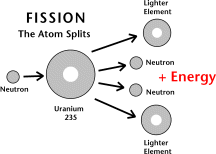
            Uranium fuel generates heat through nuclear fission. Large and heavy atoms of uranium "break" into two smaller atoms, a process that generates energy (heat) plus a few neutrons (one of the particles inside an atom). When a neutron hits another uranium atom, it "breaks", generating heat and more neutrons and so on. This is what is called a chain reaction.
            Grouping together several fuel rods described above will lead quite quickly to over-heating and melting plant fuel rods. It is worth mentioning and remember, it is why a nuclear reactor can never explode like a nuclear bomb
        
            Regarding the Chernobyl incident, the explosion was caused by excessive pressure buildup, followed by an explosion of hydrogen and penetrating all layers of the reactor protection, scattering radioactive material into the environment  (it was basically a "dirty bomb" and not nuclear explosion). Why something alike will not happen in Japan, you will see by reading on.
            To control the nuclear chain reaction, those who control the reactor use so-called moderating rods. A moderating bar absorbs neutrons, instantly killing the nuclear reaction that occurs in the reactor core.
            A nuclear reactor is constructed so as to function normally so moderating bars are not need . Coolant (water) takes excessive heat (which turns into steam and then electricity) at the same rate as the reactor core produces. The problem is that after inserting moderating bars and stop the chain reaction, the core continues to produce some heat. Fissionable uranium no longer, but a number of radioactive elements created by uranium fission process continues, releasing heat (radioactive isotopes like cesium and iodine, which eventually will create stable atoms which will produce no radioactivity).
           Because uranium is not fissionable anymore, cesium and iodine isotopes are not produced in fuel rods, so that within a few days will cool the reactor core after consuming these isotopes. The residual heat gives Japanese headaches now. 
          There is also a second type of radioactive material occurred outside the fuel rods.
The big difference is, however, that these radioactive materials have very low half-life which means that these radioactive atoms decay rapidly into non-radioactive elements. Rapid meaning a few seconds. If these items come into the environment, yes, we can say that the environment has been contaminated with radiation, but this is not dangerous. Why? Until someone pronounce the word "radionuclide" the elements will cause no harm because most of them have already turned into elements that are not radioactive. Radioactive elements that we talk about are N-16 (a type of nitrogen atom, a constituent of air) and noble gases (xenon). But where do they come?
                    
           When the uranium atom fissions it generates two or three neutrons. Much of the neutrons produced strike other uranium atoms and maintains the chain reaction, but few of them can get into water or in the air in the water of reactor. When an element is not radioactive (stable) , will capture a neutron, it becomes radioactive. But it will get rid of extra neutron and shall cease to be radioactive. This second type of radiation is very important to see what was expelled into the environment regarding the Fukushima nuclear plant.

                 So.. what really happened? 


            Earthquake that hit Japan was 7 times stronger than the earthquake which was the nuclear plant designed. Richter scale is logarithmic, so the difference between an earthquake of 8.2 - value taken into account in building the plant - and 8.9 is a factor of 7 and not 0.7).  So the japanese engineers deserve the first wave of applause because everything was left standing after the earthquake


            When the earthquake of 8.9 degrees occurred, the plant stopped automatically. Within seconds of beginning earthquake moderating rods were inserted in the core and nuclear reaction was immediately stopped following the cooling system to transport heat from outside the system. Waste heat is about 3% of the total heat when the plant is working properly.
 
          The earthquake destroyed the external source of electricity for nuclear reactor. This event is one of the worst accidents that can get a nuclear plant and is treated very seriously by the project team. Electricity is needed to keep running pumps that provide coolant flow.
           Things have functioned for an hour as a set of diesel generators have provided electricity. Then came the tsunami, much higher than plant designers took into account, the wave that swept the generators. When diesel generators were not available, the reactor passed emergency power generated by batteries. These batteries are a kind of backup of backup, ensuring operation of the reactor cooling system for 8 hours. And so it happened.
                 In  those 8 hrs they had to find some other source of energy to be connected to the plant. 
National power grid was not available because of the earthquake. Diesel generators were swept away by the tsunami. So mobile generators were brought.             
                Unfortunately, from this point, things began to go from bad to worse for the station. External generators could not be connected to the plant because they do not match. When the batteries were consumed, waste heat could not be transported outside the reactor. At this time, plant personnel began to follow standard procedures for such emergencies. Electricity supply cooling system would not be interrupted under any circumstances, but stopped so that the staff retired to the next line of defense.

               Only now we can start  talking about the possibility of core melting. If, by the end of the day cooling system had not somehow been put into operation, the core would have melted in the end and then would've come into action last line of defense, graphite pool that would've captured and buried the reactor core.
               But the priority at that time was to maintain the integrity of zircaloy tubes and pressure vessel structure, to give engineers time to repair the cooling system. Since the reactor core cooling is so important, it has a large number of cooling options. So far it is unclear which of them gave up and not.

               Imagine a pressure vessel located on a flame. A weak flame, but still warm enough to still heat the vessel. The heat must be dissipated by any means control room of the plant have at hand , otherwise the pressure will increase. Priority is to maintain the integrity of the first compartment (fuel rods maintain the temperature below 2,200 degrees) and of the second chamber (pressure vessel). For this, the pressure should be reduced by releasing steam from time to time. This is so important, this vessel has 11 valves that allow such an operation, which has already taken place, thus maintaining a temperature of 550 degrees inside the core.
               It was when the media reported the plant's radioactive leak from Fukushima. We explained above why this is not dangerous to the environment or surrounding populations
                        Explosion time at Fukushima nuclear plant  
              
       During these operations of ventilating the pressurised vessel, explosion occurred. This took place outside of the third compartment of protection within the walls of the plant, the wall that has a role in radiation isolation. It is unclear exactly what happened, but a very plausible scenario is as follows:
engineers decided not to release excess steam directly into the environment, but in the space between the third compartment and the reactor's building wall to allow radioactivity levels to fall before it reaches the environment. The problem is that at high temperatures in the core, it may happen that the water molecules to dissociate, to break H2O into hydrogen and oxygen, an explosive combination. 
             And so the explosion took place outside of the third compartment, damaging the  reactor's building
This explosion took place at Chernobyl, but it was inside the pressurised vessel, because of design and its misuse by Soviet personnel. This has not happened and will not happen at Fukushima, because different design of the vessel concerned. Water dissociation and accumulation of hydrogen and oxygen is one of the biggest problems encountered during construction of a nuclear plant, so the reactor was designed so that this does not happen within it. It happened outside, an undesirable thing, but without serious environmental implications. 


              At this point, the pressure was under control, the steam excess being evacuated. The core is covered with several meters of water, but after a few hours or days, it will decrease significantly. When fuel rods are immersed in water no longer, they will melt in 45 minutes. This is when the zircaloy tube will melt. This began to happen. Cooling could not be achieved before some fuel rods to be damaged by melting. Nuclear naterial from inside (uranium) is intact, but the packaging of zircaloy begins to melt. 

                 Unfortunately radioactive isotopes of cesium and iodine will be get in the steam.
The most important aspect is that the pills of uranium remain intact up to 3000 degrees and they have not yet get to vapors. It was confirmed the presence of small amounts of radioactive cesium and iodine steam reached into the atmosphere at which point they started  plan B. Water used for cooling is very clean and demineralized (a kind of distilled water, but with a high degree of purity). The reason for using pure water is given by the activation of the neutrons from uranium, pure water is not working too much, so it does not become radioactive. Impurities in the water or salts can absorb neutrons faster as water quickly becomes radioactive.
 
                To prevent a meltdown of the general core and didn't have at hand the necessary supplies of pure water, plant operators have decided to use seawater for cooling. Nuclear fuel rods were cooled. The nuclear chain reaction was discontinued long ago and now was only left to dissipate the remaining residual heat that I have mentioned before. Because heat is no longer produced, so no steam, the pressure 
decreases significantly. In addition, boric acid was added to seawater, which is a kind of bar liquid moderator, capturing any neutrons that could be produced, contributing to the cooling system. 

              Nuclear plant at Fukushima was very close to a meltdown core, but this was avoided by pumping seawater to cool it and reduce the pressure of the reactor.If this would not have been possible, venting steam into the atmosphere was the only thing that could be done to keep the pressure under control. The third compartment was completely isolated, thus allowing safe meltdown the core, without this process to spread radioactive substances into the environment. 
             Finally the cooling system had been put back into service, to allow safe operation of reactor systems to remove uranium from the molten core capsules, which were to be transported back to the nuclear fuel processing plants . Depending on the damage, the plant would be repaired or scrapped.

Related Posts Plugin for WordPress, Blogger...

Search

Custom Search

 
Design by Wordpress Theme | Bloggerized by Free Blogger Templates | coupon codes