Environment-Clean-Generations

Environment-Clean-Generations
THE DEFINITIVE BLOG FOR EVERYTHING YOU NEED TO KNOW ABOUT THE ENVIRONMENT YOU LIVE IN, WITH REFERENCE TO LIFE, EARTH AND COSMIC SPACE SCIENCES, PRESENTED BY ENVIRONMENTAL ENGINEER DORU INDREI, ENVIRONMENTAL QUALITY AND ENERGY SPACIALIST
"Life is not about what we know, but what we don't know, craving the unthinkable makes it so amazing, that is worth dying for." Doru Indrei
Custom Search
Showing posts with label reactor. Show all posts

The Future of Cold Fusion Could be Here


Good science is always rooted in good data, but the most entertaining science is the stuff that transcends the need for data by rooting itself fantastical claims and a rejection of the idea that data is even necessary. So naturally it’s a thrill to learn that two Italian scientists claim to have successfully developed a cold fusion reactor that produces 12,400 watts of heat power per 400 watts of input. Not only that, but they’ll be commercially available in just three months. Maybe.


Cold fusion is a tricky business—some say a theoretically implausible business—and exactly zero of the previous claims of successful cold fusion have proven legitimate (remember when North Korea developed cold fusion?). Hypothetically (and broadly) speaking, the process involves fusing two smaller atomic nuclei together into a larger nucleus, a process that releases massive amounts of energy. If harnessed, cold fusion could provide cheap and nearly limitless energy with no radioactive byproduct or massive carbon emissions.

Andrea Rossi and Sergio Focardi claim to have done exactly that. Their reactor, they claim, fuses atomic nuclei of nickel and hydrogen using about 1,000 watts of electricity which, after a few minutes, is reduced to an input of just 400 watts. This reaction purportedly can turn 292 grams of 68 degree water to turbine-turning steam – a process that would normally require 12,400 watts of electricity, netting them a power gain of about 12,000 watts. They say that commercially-scaled their process could generate eight units of output per unit of input and would cost roughly one penny per kilowatt-hour, drastically cheaper than your average coal plant.

The problem is, they haven’t provided any details on how the process works. After their paper was rejected by several peer reviewed scientific journals, it was published in the Journal of Nuclear Physics—an online journal apparently founded by Rossi and Focardi. Further, they say they can’t account for how the cold fusion is triggered, fostering deep skepticism from others in the scientific community.

Based on this lack of even a theoretical basis for the device’s function, a patent application was rejected. Their credibility isn’t helped by the fact that Rossi apparently has something of a rap sheet, which allegedly includes illegally importing gold and tax fraud.

But the duo does have something going for them in the fact that they’ve demonstrated their device publicly. In a press conference last week they fired up their reactor and, if the video evidence and reports are to be believed, generated some power. Whether or not they achieved cold fusion is unclear, but other physicists present confirmed that electricity was produced.

It’s anyone’s guess what’s really going on with this bizarre story, but should it turn out Rossi and Focardi have achieved true cold fusion you’ll hear more about it here—and everywhere else.
You can catch a glimpse of their setup in the video below, though a lack of English subtitles makes the full nature of the press conference difficult to parse. If you speak italian and can lend some insight, please do so in the comments.


by "environment clean generations"

5 Biggest Nuclear Reactors


In December of 1942, an experiment that would change the world was taking place at the University of Chicago. After years of research and a month of construction, the world's first nuclear reactor, Chicago Pile-1, was ready for testing. Constructed of a lattice of uranium and graphite blocks stacked 57 layers high, Chicago Pile-1 bore little resemblance to today's nuclear reactors. A three person "suicide squad" was waiting to step in and shut the reactor down in case the reactor's safety features failed. Fortunately, the 50 people in attendance that day were able to share a collective sigh of relief -- as the squad was not needed. The reactor worked without a hitch, and the nuclear era was born.


Today, more than 400 nuclear power plants are located in 30 countries across the globe. Together, these plants produce 15 percent of the world's electricity and 2 percent of the world's total power supply [source: World Nuclear Association]. Nuclear power certainly has its pros and cons, but no one can deny its importance. So now that we know a little about how far nuclear power has come over the past 60 years, we're ready to take a look at the five biggest nuclear reactors on Earth, starting with a couple of reactors that might not be around much longer. 

Today, more than 400 nuclear power plants are located in 30 countries across the globe. See more nuclear power pictures.
  
5: Isar II

Germany has long had an uneasy relationship with nuclear energy. While the country currently depends on nuclear energy for nearly 20 percent of its electricity, concerns about plant safety and nuclear waste storage have resulted in plans to close some of the country's largest reactors. Included on that list are two reactors located in Essenbach, Germany. Together the reactors, known as Isar I and Isar II, generate enough electricity to power more than 1.5 million households each year [source: Nuclear Energy Institute].
 

But Isar II is the reason the reactors are on this list. The reactor, commissioned in 1988, has a net installed electric capacity of 1,400 megawatts [source: E.ON]. According to E.ON, the Germany utility company that runs Isar II, creating that electricity using fossil fuels would add 12 million tons (11 million metric tons) of carbon dioxide to the environment [source: Crowley]. Perhaps that explains why some are rethinking the current plan to decommission Isar I in 2011 and its bigger brother in 2020. Read on to learn about another German reactor that's inspired more than its share of controversy. 

4: Brokdorf

On the banks of the river Elbe, sheep graze lazily on fields of lush green grass, entirely unimpressed with the massive nuclear reactor located only 100 feet (30 meters) away. Brokdorf reactor, which takes its name from the surrounding city, houses more than 110 tons (100 metric tons) of uranium [source: E.ON]. Construction on the plant began in 1981, and by 1986, the plant was operational. One of the world's largest reactors, Brokdorf claimed the title of World Champion of gross annual output in both 1992 and 2005 [source: E.ON]. With an impressive net installed electric capacity of 1,410 megawatts, Brokdorf could easily recapture the title before its scheduled decommissioning in 2018 [source: E.ON].


Brokdorf's electrical capacity makes the reactor the largest in Germany. So perhaps it's fitting that, throughout the 1980s, it was also the site of the country's largest protests against nuclear power. The protests drew tens of thousands of people a day at their peak. The demonstrations often turned violent, with protestors hurling bricks, bottles and even gasoline bombs at riot police, prompting the police to respond with tear gas and mass arrests. Hundreds of injuries resulted, affecting both citizens and riot police alike. Today, the site still draws a few peaceful protestors, but as concerns rise over global warming and increasing energy costs, Germany's attitude toward nuclear power appears to be shifting. Of course, not all countries have had such a contentious relationship with nuclear power. The next reactor on our list is located in a country that gets more of its electricity from nuclear power than any other country on Earth

3: Civaux 1 and 2

"No oil, no gas, no coal, no choice." The phrase has become a mantra explaining French support of nuclear power. As instability in the Middle East forced oil prices higher and higher throughout the 1960s, France recognized a need to move away from its fossil-fuel-burning power plants. Today, the country has 59 nuclear reactors responsible for producing 76 percent of France's electricity, and two reactors located in the city of Civaux are among its largest. Fully operational in 1999, Civaux 1 and Civaux 2 cost an estimated $4.1 billion to construct [source: Power-Technology].


While that's a hefty price tag, reactors in other countries can be much more expensive. In fact, power produced by Civaux 1 and Civaux 2 costs about as much as traditionally cheaper electricity generated from coal and natural gas. Turbines in the reactors are more than half a football field in length and weigh nearly 3,000 tons (2,722 metric tons), which helps explain how each of the Civaux reactors produces 1,450 megawatts (net) [source: Power-Technology].


The reactors have some impressive safety features as well, including the ability to shut down in only 2.15 seconds. Even so, Civaux 1 was closed for nearly a year after coolant leaks were discovered. The pipe work was replaced and the reactor was ready to come back online when regulators discovered a problem with harmful bacteria forming in the cooling circuits of similar reactors. To address the problem, engineers added an ultraviolet treatment system capable of killing the bacteria. Now both Civaux 1 and Civaux 2 are up and running, helping France to power not only its own homes and businesses but even export energy to neighboring countries. 

2: Chooz B1 and 2

Like their sister reactors in Civaux, the two reactors known as Chooz B1 and Chooz B2 are part of France's series of technologically advanced N4 reactors. Among the technological innovations are computerized control rooms that provide operators detailed information about the reactors' systems, as well as very efficient steam generators and cooling pumps. Yet even with the advanced technology, Chooz B1 took only 12 years to construct. Even more impressive, the Chooz B reactors have a net installed electric capacity of 1,455 megawatts [source: Davis]. That makes the reactors the most powerful in the world in terms of individual output, capable of generating more than 5 percent of France's nuclear power [sources: Areva].
The advanced technology behind the N4 reactors caused some problems, however; like the reactors in Civaux, Chooz B1 and Chooz B2 had some problems during early operations. They shared the same faulty cooling design as Civaux 1 and 2, for instance, so the reactors were taken offline for a year as their systems were redesigned and replaced. For the time being, though, the kinks seem to be worked out and all four N4 reactors are fully operational.


And if providing a huge portion of France's electricity isn't enough, the Chooz reactors may even provide some perspective on the very nature of matter itself. In July 2009, the construction of a laboratory on the site of the Chooz B reactors was announced. The lab, designed to study the elusive neutrino, could give scientists insight into the very origins of the universe itself.


The next reactors on our list may not solve any scientific mysteries, but in terms of sheer power, they can't be beat. Read on to find out more. 

1: Kashiwazaki-Kariwa

Japan's Kashiwazaki-Kariwa reactors, which were completed in 1997, won't break any records for individual output, but their combined electrical output is uncontested. The power plant, which has seven separate reactors, has a rated capacity of 8,212 megawatts. That's enough capacity to power more than 16 million households each year, providing more than 5 percent of Japan's total electricity [source: Power-Technology].

The Kashiwazaki-Kariwa reactors, like all Japanese reactors, were constructed with extensive safety mechanisms designed to withstand Japan's frequent earthquakes

The plant extends deep into the surrounding water where it attaches to the solid ground below, providing a sturdy foundation to withstand shocks. Even so, the reactors were taken offline after a magnitude 6.8 earthquake struck the plant in July of 2007. The earthquake caused extensive damage to the plants, including fires and radiation leaks, though many expected the damage to be much worse. As of today, most of the reactors remain offline as regulators inspect the plants for further damage, though some of the reactors have received approval to resume operation.

by "environment clean generations"


Next Nuclear Generation


Nuclear power is the most efficient emissions-free energy available. But can it be made safe? Two new reactor designs do just that. Safety Plan The Generation III+ reactors at the Vogtle facility in Georgia will feature a passive safety system to safeguard the plant in the absence of power.

          In the aftermath of the Fukushima disaster in March, the appetite for new nuclear power plants slipped to post-Chernobyl lows. Regulators from Italy to Switzerland to Texas moved to stop pending nuclear-power projects, and the U.S. Nuclear Regulatory Commission (NRC) began to reevaluate the safety of all domestic plants. Yet nuclear power still provides 20 percent of America’s total electric power and 70 percent of its emissions-free energy, in large part because no alternative energy source can match its efficiency.

          One nuclear plant with a footprint of one square mile provides the energy equivalent of 20 square miles of solar panels, 1,200 windmills or the entire Hoover Dam. If the country wants to significantly reduce its dependence on carbon-based energy, it will need to build more nuclear power plants. The question is how to do so safely.

The U.S. has 104 nuclear reactors operating at 65 sites in 31 states, all of them approved before 1980.
          In the 30 years since regulators last approved the construction of a new nuclear plant in the U.S., engineers have improved reactor safety considerably. (You can see some of the older, not-so-safe ones in this sweet gallery.) The newest designs, called Generation III+, are just beginning to come online. (Generation I plants were early prototypes; Generation IIs were built from the 1960s to the 1990s and include the facility at Fukushima; and Generation IIIs began operating in the late 1990s, though primarily in Japan, France and Russia.) 

           Unlike their predecessors, most Generation III+ reactors have layers of passive safety elements designed to stave off a meltdown, even in the event of power loss. Construction of the first Generation III+ reactors is well under way in Europe. China is also in the midst of building at least 30 new plants. In the U.S., the Southern Company recently broke ground on the nation’s first Generation III+ reactors at the Vogtle nuclear plant near Augusta, Georgia. The first of two reactors is due to come online in 2016.

            
           Like many of the 20 or so pending Generation III+ facilities in the U.S., the Vogtle plant will house Westinghouse AP1000 reactors. A light-water reactor, the AP1000 prompts uranium-235 into a chain reaction that throws off high-energy neutrons. The particles heat water into steam, which then turns a turbine that generates electricity.

          The greatest danger in a nuclear plant is a meltdown, in which solid reactor fuel overheats, melts, and ruptures its containment shell, releasing radioactive material. (Want more information? Check out our explainer on how nuclear reactors work--and how they fail.) Like most reactors, the AP1000 is cooled with electrically powered water pumps and fans, but it also has a passive safety system, which employs natural forces such as gravity, condensation and evaporation to cool a reactor during a power outage.

          A central feature of this system is an 800,000-gallon water tank positioned directly above the containment shell. The reservoir’s valves rely on electrical power to remain closed. When power is lost, the valves open and the water flows down toward the containment shell. Vents passively draw air from outside and direct it over the structure, furthering the evaporative cooling.

          Depending on the type of emergency, an additional reservoir within the containment shell can be manually released to flood the reactor. As water boils off, it rises and condenses at the top of the containment shell and streams back down to cool the reactor once more. Unlike today’s plants, most of which have enough backup power onsite to last just four to eight hours after grid power is lost, the AP1000 can safely operate for at least three days without power or human intervention.

          Even with their significant safety improvements, Generation III+ plants can, theoretically, melt down. Some people within the nuclear industry are calling for the implementation of still newer reactor designs, collectively called Generation IV. The thorium-powered molten-salt reactor (MSR) is one such design. In an MSR, liquid thorium would replace the solid uranium fuel used in today’s plants, a change that would make meltdowns all but impossible.


              MSRs were developed at Tennessee’s Oak Ridge National Laboratory in the early 1960s and ran for a total of 22,000 hours between 1965 and 1969. “These weren’t theoretical reactors or thought experiments,” says engineer John Kutsch, who heads the nonprofit Thorium Energy Alliance. “[Engineers] really built them, and they really ran.” Of the handful of Generation IV reactor designs circulating today, only the MSR has been proven outside computer models. “It was not a full system, but it showed you could successfully design and operate a molten-salt reactor,” says Oak Ridge physicist Jess Gehin, a senior program manager in the lab’s Nuclear Technology Programs office.

One pound of thorium produces as much power as 300 pounds of uranium--or 3.5 million pounds of coal.
            The MSR design has two primary safety advantages. Its liquid fuel remains at much lower pressures than the solid fuel in light-water plants. This greatly decreases the likelihood of an accident, such as the hydrogen explosions that occurred at Fukushima. Further, in the event of a power outage, a frozen salt plug within the reactor melts and the liquid fuel passively drains into tanks where it solidifes, stopping the fission reaction. “The molten-salt reactor is walk-away safe,” Kutsch says. “If you just abandoned it, it had no power, and the end of the world came--a comet hit Earth--it would cool down and solidify by itself.”

           Although an MSR could also run on uranium or plutonium, using the less-radioactive element thorium, with a little plutonium or uranium as a catalyst, has both economic and safety advantages. Thorium is four times as abundant as uranium and is easier to mine, in part because of its lower radioactivity. 

          The domestic supply could serve the U.S.’s electricity needs for centuries. Thorium is also exponentially more efficient than uranium. “In a traditional reactor, you’re burning up only a half a percent to maybe 3 percent of the uranium,” Kutsch says. “In a molten-salt reactor, you’re burning 99 percent of the thorium.” The result: One pound of thorium yields as much power as 300 pounds of uranium--or 3.5 million pounds of coal.

          Because of this efficiency, a thorium MSR would produce far less waste than today’s plants. Uranium-based waste will remain hazardous for tens of thousands of years. With thorium, it’s more like a few hundred. As well, raw thorium is not fissile in and of itself, so it is not easily weaponized. “It can’t be used as a bomb,” Kutsch says. “You could have 1,000 pounds in your basement, and nothing would happen.” 

          Without the need for large cooling towers, MSRs can be much smaller than typical light-water plants, both physically and in power capacity. Today’s average nuclear power plant generates about 1,000 megawatts. A thorium-fueled MSR might generate as little as 50 megawatts. Smaller, more numerous plants could save on transmission loss (which can be up to 30 percent on the present grid).

One nuclear plant provides the energy equivalent of 1,200 windmills or 20 square miles of solar panels.
           The U.S. Army is interested in using MSRs to power individual bases, Kutsch says, and Google, which relies on steady power to keep its servers running, held a conference on thorium reactors last year. “The company would love to have a 70- or 80-megawatt reactor sitting next door to a data center,” Kutsch says. 

             Even with military and corporate support, the transition to a new type of nuclear power generation is likely to be slow, at least in the U.S. Light-water reactors are already established, and no regulations exist to govern other reactor designs. Outside the U.S., the transition could come more quickly. In January the Chinese government launched a thorium reactor program. “The Chinese Academy of Sciences has approved development of an MSR with relatively near-term deployment--maybe 10 years,” says Gehin, who thinks the Chinese decision may increase work on the technology worldwide. Even after Fukushima, “there’s still interest in advanced nuclear,” he says. “I don’t see that changing.”


by "environment clean generations" 

What happened at Fukushima


                Here is something to calm you down about what happened recently in Japan. In short, the situation of Japanese nuclear reactors is quite serious, but it is under control. The text is quite long, but reading it, you'll learn more about nuclear power than all the journalists on the planet combined.

              It was not and will not be a relevant release of radioactivity. By relevant i understand a higher level of radiation, more than you would receive,  for example,  a long flight or a glass of beer that comes from an area with high levels of natural radiation

                   Construction of atomic power plant at Fukushima

              Plants at Fukushima are BWR type (Boiling Water Reactors). The principle on which these reactors rely on is similar to a pressure cooker. Nuclear fuel heats water, water boils and creates steam, the steam moves turbines that produce electricity, and steam is cooled and condenses it again, being reused. The pressure normally operates at a temperature of 250 degrees Celsius. 
              Nuclear fuel is uranium oxide, a ceramic material with a melting point high enough, around 3000 degrees Celsius. The fuel is produced in capsules of about the size of Lego pieces.
              These pieces are placed in a larger tube, made of an alloy called zircaloy, which has a melting point at 2200 degrees. This set is a fuel rod. These bars are then grouped in packets and inserted into reactor. All these packages form the core.

                      Example of nuclear fuel rod 

             Zircaloy packaging is the first layer (compartment) insulator. He separates radioactive fuel from the rest of the world. Reactor core is then placed in the pressure vessel. This vessel is the second layer (compartment) insulator, resisting to temperatures several hundred degrees, where cooling is stopped, but restarted later. The entire system pressure vessel, piping, pumps, cooler (water) is protected by a third insulating layer, made from a steel alloy highly resistant and tightly closed. The third insulating layer has been designed, built and tested for one purpose: to support for an indefinite period, a total melting of the reactor core. For this reason, a large bowl and thick vessel under pressure (the second protective layer), graphite-filled, placed in the third protective layer.
  
             This third ring is surrounded by the reactor building protection, within which usually maintains a lower pressure, for leaks outside, but the building itself offers no real protection against radiation

                        Fundamental aspects of nuclear reactions.

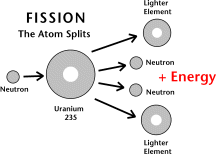
            Uranium fuel generates heat through nuclear fission. Large and heavy atoms of uranium "break" into two smaller atoms, a process that generates energy (heat) plus a few neutrons (one of the particles inside an atom). When a neutron hits another uranium atom, it "breaks", generating heat and more neutrons and so on. This is what is called a chain reaction.
            Grouping together several fuel rods described above will lead quite quickly to over-heating and melting plant fuel rods. It is worth mentioning and remember, it is why a nuclear reactor can never explode like a nuclear bomb
        
            Regarding the Chernobyl incident, the explosion was caused by excessive pressure buildup, followed by an explosion of hydrogen and penetrating all layers of the reactor protection, scattering radioactive material into the environment  (it was basically a "dirty bomb" and not nuclear explosion). Why something alike will not happen in Japan, you will see by reading on.
            To control the nuclear chain reaction, those who control the reactor use so-called moderating rods. A moderating bar absorbs neutrons, instantly killing the nuclear reaction that occurs in the reactor core.
            A nuclear reactor is constructed so as to function normally so moderating bars are not need . Coolant (water) takes excessive heat (which turns into steam and then electricity) at the same rate as the reactor core produces. The problem is that after inserting moderating bars and stop the chain reaction, the core continues to produce some heat. Fissionable uranium no longer, but a number of radioactive elements created by uranium fission process continues, releasing heat (radioactive isotopes like cesium and iodine, which eventually will create stable atoms which will produce no radioactivity).
           Because uranium is not fissionable anymore, cesium and iodine isotopes are not produced in fuel rods, so that within a few days will cool the reactor core after consuming these isotopes. The residual heat gives Japanese headaches now. 
          There is also a second type of radioactive material occurred outside the fuel rods.
The big difference is, however, that these radioactive materials have very low half-life which means that these radioactive atoms decay rapidly into non-radioactive elements. Rapid meaning a few seconds. If these items come into the environment, yes, we can say that the environment has been contaminated with radiation, but this is not dangerous. Why? Until someone pronounce the word "radionuclide" the elements will cause no harm because most of them have already turned into elements that are not radioactive. Radioactive elements that we talk about are N-16 (a type of nitrogen atom, a constituent of air) and noble gases (xenon). But where do they come?
                    
           When the uranium atom fissions it generates two or three neutrons. Much of the neutrons produced strike other uranium atoms and maintains the chain reaction, but few of them can get into water or in the air in the water of reactor. When an element is not radioactive (stable) , will capture a neutron, it becomes radioactive. But it will get rid of extra neutron and shall cease to be radioactive. This second type of radiation is very important to see what was expelled into the environment regarding the Fukushima nuclear plant.

                 So.. what really happened? 


            Earthquake that hit Japan was 7 times stronger than the earthquake which was the nuclear plant designed. Richter scale is logarithmic, so the difference between an earthquake of 8.2 - value taken into account in building the plant - and 8.9 is a factor of 7 and not 0.7).  So the japanese engineers deserve the first wave of applause because everything was left standing after the earthquake


            When the earthquake of 8.9 degrees occurred, the plant stopped automatically. Within seconds of beginning earthquake moderating rods were inserted in the core and nuclear reaction was immediately stopped following the cooling system to transport heat from outside the system. Waste heat is about 3% of the total heat when the plant is working properly.
 
          The earthquake destroyed the external source of electricity for nuclear reactor. This event is one of the worst accidents that can get a nuclear plant and is treated very seriously by the project team. Electricity is needed to keep running pumps that provide coolant flow.
           Things have functioned for an hour as a set of diesel generators have provided electricity. Then came the tsunami, much higher than plant designers took into account, the wave that swept the generators. When diesel generators were not available, the reactor passed emergency power generated by batteries. These batteries are a kind of backup of backup, ensuring operation of the reactor cooling system for 8 hours. And so it happened.
                 In  those 8 hrs they had to find some other source of energy to be connected to the plant. 
National power grid was not available because of the earthquake. Diesel generators were swept away by the tsunami. So mobile generators were brought.             
                Unfortunately, from this point, things began to go from bad to worse for the station. External generators could not be connected to the plant because they do not match. When the batteries were consumed, waste heat could not be transported outside the reactor. At this time, plant personnel began to follow standard procedures for such emergencies. Electricity supply cooling system would not be interrupted under any circumstances, but stopped so that the staff retired to the next line of defense.

               Only now we can start  talking about the possibility of core melting. If, by the end of the day cooling system had not somehow been put into operation, the core would have melted in the end and then would've come into action last line of defense, graphite pool that would've captured and buried the reactor core.
               But the priority at that time was to maintain the integrity of zircaloy tubes and pressure vessel structure, to give engineers time to repair the cooling system. Since the reactor core cooling is so important, it has a large number of cooling options. So far it is unclear which of them gave up and not.

               Imagine a pressure vessel located on a flame. A weak flame, but still warm enough to still heat the vessel. The heat must be dissipated by any means control room of the plant have at hand , otherwise the pressure will increase. Priority is to maintain the integrity of the first compartment (fuel rods maintain the temperature below 2,200 degrees) and of the second chamber (pressure vessel). For this, the pressure should be reduced by releasing steam from time to time. This is so important, this vessel has 11 valves that allow such an operation, which has already taken place, thus maintaining a temperature of 550 degrees inside the core.
               It was when the media reported the plant's radioactive leak from Fukushima. We explained above why this is not dangerous to the environment or surrounding populations
                        Explosion time at Fukushima nuclear plant  
              
       During these operations of ventilating the pressurised vessel, explosion occurred. This took place outside of the third compartment of protection within the walls of the plant, the wall that has a role in radiation isolation. It is unclear exactly what happened, but a very plausible scenario is as follows:
engineers decided not to release excess steam directly into the environment, but in the space between the third compartment and the reactor's building wall to allow radioactivity levels to fall before it reaches the environment. The problem is that at high temperatures in the core, it may happen that the water molecules to dissociate, to break H2O into hydrogen and oxygen, an explosive combination. 
             And so the explosion took place outside of the third compartment, damaging the  reactor's building
This explosion took place at Chernobyl, but it was inside the pressurised vessel, because of design and its misuse by Soviet personnel. This has not happened and will not happen at Fukushima, because different design of the vessel concerned. Water dissociation and accumulation of hydrogen and oxygen is one of the biggest problems encountered during construction of a nuclear plant, so the reactor was designed so that this does not happen within it. It happened outside, an undesirable thing, but without serious environmental implications. 


              At this point, the pressure was under control, the steam excess being evacuated. The core is covered with several meters of water, but after a few hours or days, it will decrease significantly. When fuel rods are immersed in water no longer, they will melt in 45 minutes. This is when the zircaloy tube will melt. This began to happen. Cooling could not be achieved before some fuel rods to be damaged by melting. Nuclear naterial from inside (uranium) is intact, but the packaging of zircaloy begins to melt. 

                 Unfortunately radioactive isotopes of cesium and iodine will be get in the steam.
The most important aspect is that the pills of uranium remain intact up to 3000 degrees and they have not yet get to vapors. It was confirmed the presence of small amounts of radioactive cesium and iodine steam reached into the atmosphere at which point they started  plan B. Water used for cooling is very clean and demineralized (a kind of distilled water, but with a high degree of purity). The reason for using pure water is given by the activation of the neutrons from uranium, pure water is not working too much, so it does not become radioactive. Impurities in the water or salts can absorb neutrons faster as water quickly becomes radioactive.
 
                To prevent a meltdown of the general core and didn't have at hand the necessary supplies of pure water, plant operators have decided to use seawater for cooling. Nuclear fuel rods were cooled. The nuclear chain reaction was discontinued long ago and now was only left to dissipate the remaining residual heat that I have mentioned before. Because heat is no longer produced, so no steam, the pressure 
decreases significantly. In addition, boric acid was added to seawater, which is a kind of bar liquid moderator, capturing any neutrons that could be produced, contributing to the cooling system. 

              Nuclear plant at Fukushima was very close to a meltdown core, but this was avoided by pumping seawater to cool it and reduce the pressure of the reactor.If this would not have been possible, venting steam into the atmosphere was the only thing that could be done to keep the pressure under control. The third compartment was completely isolated, thus allowing safe meltdown the core, without this process to spread radioactive substances into the environment. 
             Finally the cooling system had been put back into service, to allow safe operation of reactor systems to remove uranium from the molten core capsules, which were to be transported back to the nuclear fuel processing plants . Depending on the damage, the plant would be repaired or scrapped.

Related Posts Plugin for WordPress, Blogger...

Search

Custom Search

 
Design by Wordpress Theme | Bloggerized by Free Blogger Templates | coupon codes