Environment-Clean-Generations

Environment-Clean-Generations
THE DEFINITIVE BLOG FOR EVERYTHING YOU NEED TO KNOW ABOUT THE ENVIRONMENT YOU LIVE IN, WITH REFERENCE TO LIFE, EARTH AND COSMIC SPACE SCIENCES, PRESENTED BY ENVIRONMENTAL ENGINEER DORU INDREI, ENVIRONMENTAL QUALITY AND ENERGY SPACIALIST
"Life is not about what we know, but what we don't know, craving the unthinkable makes it so amazing, that is worth dying for." Doru Indrei
Custom Search
Showing posts with label explosion. Show all posts

The Most-Studied Star Explosion Ever


New Supernova Type Ia supernova PTF 11kly, the youngest ever detected, is seen above over three successive nights. The left image, taken Aug. 22, shows the event before it exploded supernova, approximately 1 million times fainter than the human eye can detect. The center image, from Aug. 23, shows the supernova at about 10,000 times fainter than the human eye can detect. The right image, from Aug. 24, shows that the event is 6 times brighter than the previous day.

Astronomers just spotted a brand-new supernova mere hours after it exploded, thanks to a robotic telescope and some smart computer algorithms. Now they’re scrambling to use as many telescopes as possible, on Earth and in space, to observe the star’s death throes. 

New supernovae are not terribly rare, but this one is unique because it is so close — 21 million light years away — and it’s of a type that is crucial to astronomical measurements. The supernova, PTF 11kly, is the youngest ever detected.

It showed up in the spiral galaxy M101, the Pinwheel Galaxy, a rather large spiral (10 times the size of the Milky Way) located in the constellation Ursa Major, known to its friends as the Big Dipper. It’s a Type Ia supernova, a very bright type that is used for gauging distances among galaxies. The use of Type Ia supernovae as standard candles helped astronomers prove how rapidly the universe is expanding, and led to the discovery of dark energy. So it’s an important type, and the discovery of a super-new, superclose supernova is tantalizing news for astronomers.


 The Palomar Transient Factory (PTF) survey, which is designed to observe and discover astronomical events as they happen, spotted the supernova earlier this week, according to a news release from the Lawrence Berkeley National Laboratory. First, a robotic observation system mounted on the 48-inch Samuel Oschin Telescope at Palomar Observatory scans the sky, and feeds data to a supercomputer at Berkeley Lab. 

The computers use machine learning algorithms to comb through the PTF data and flag interesting astronomical phenomena. Within a couple hours of spotting PTF 11kly, the system sent its coordinates to telescopes around the world so others could check it out, according to LBL.

Three hours later, telescopes in the Canary Islands captured the supernova’s spectral signature, and 12 hours later, astronomers using the Keck and Lick observatories determined it was a Type Ia. This makes the Canary Islands spectra the earliest Type Ia spectra ever taken. Afterward, astronomers sent an emergency request to NASA to use the Hubble Space Telescope, which will observe the supernova this weekend.

Over at Bad Astronomy, Phil Plait describes that Type Ia supernovae occur when a super-dense white dwarf siphons material off a companion star. If the white dwarf siphons off enough material, it can start to fuse hydrogen into helium, and the whole star will explode. This ginormous energy release makes the supernovae very bright, which makes them useful for gauging intergalactic distances. Type Ia are all thought to explode in similar ways, allowing them to be used as standard benchmarks — standard candles in astronomical parlance. (Click through to Bad Astronomy for a full rundown of what this supernova may mean to astronomy.)
In a fortuitous find, astronomers may actually have a picture of the supernova progenitors. Hubble Space Telescope images taken back in 2002 show two red giant stars very close to the location of PTF 11kly, Plait points out. If a white dwarf was nearby, it could have siphoned material from one of those red giants, sparking the runaway fusion event that led to supernova. Follow-up observations will help prove this.


Catching this supernova so early will give astronomers a glimpse into its outermost layers, which will tell them about the exploded star’s characteristics, according to astronomer Andrew Howell of UC Santa Barbara and Las Cumbres Global Telescope Network. “When you catch them this early, mixed in with the explosion you can actually see unburned bits from star that exploded! It is remarkable,” he said in a news release. “We are finding new clues to solving the mystery of the origin of these supernovae that has perplexed us for 70 years. Despite looking at thousands of supernovae, I’ve never seen anything like this before.”

You can see it, too. The supernova is getting brighter every night, and it should be visible with a decent pair of binoculars within the next couple weeks, according to astronomers at LBL and Oxford University. The best time to see it will be just after evening twilight in the Northern hemisphere.

by "environment clean generations"

What happened at Fukushima


                Here is something to calm you down about what happened recently in Japan. In short, the situation of Japanese nuclear reactors is quite serious, but it is under control. The text is quite long, but reading it, you'll learn more about nuclear power than all the journalists on the planet combined.

              It was not and will not be a relevant release of radioactivity. By relevant i understand a higher level of radiation, more than you would receive,  for example,  a long flight or a glass of beer that comes from an area with high levels of natural radiation. 

                   Construction of atomic power plant at Fukushima

              Plants at Fukushima are BWR type (Boiling Water Reactors). The principle on which these reactors rely on is similar to a pressure cooker. Nuclear fuel heats water, water boils and creates steam, the steam moves turbines that produce electricity, and steam is cooled and condenses it again, being reused. The pressure normally operates at a temperature of 250 degrees Celsius. 
              Nuclear fuel is uranium oxide, a ceramic material with a melting point high enough, around 3000 degrees Celsius. The fuel is produced in capsules of about the size of Lego pieces.
              These pieces are placed in a larger tube, made of an alloy called zircaloy, which has a melting point at 2200 degrees. This set is a fuel rod. These bars are then grouped in packets and inserted into reactor. All these packages form the core.

                      Example of nuclear fuel rod 

             Zircaloy packaging is the first layer (compartment) insulator. He separates radioactive fuel from the rest of the world. Reactor core is then placed in the pressure vessel. This vessel is the second layer (compartment) insulator, resisting to temperatures several hundred degrees, where cooling is stopped, but restarted later. The entire system pressure vessel, piping, pumps, cooler (water) is protected by a third insulating layer, made from a steel alloy highly resistant and tightly closed. The third insulating layer has been designed, built and tested for one purpose: to support for an indefinite period, a total melting of the reactor core. For this reason, a large bowl and thick vessel under pressure (the second protective layer), graphite-filled, placed in the third protective layer.
  
             This third ring is surrounded by the reactor building protection, within which usually maintains a lower pressure, for leaks outside, but the building itself offers no real protection against radiation. 

                        Fundamental aspects of nuclear reactions.

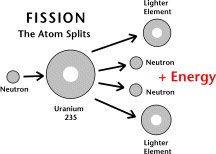
            Uranium fuel generates heat through nuclear fission. Large and heavy atoms of uranium "break" into two smaller atoms, a process that generates energy (heat) plus a few neutrons (one of the particles inside an atom). When a neutron hits another uranium atom, it "breaks", generating heat and more neutrons and so on. This is what is called a chain reaction.
            Grouping together several fuel rods described above will lead quite quickly to over-heating and melting plant fuel rods. It is worth mentioning and remember, it is why a nuclear reactor can never explode like a nuclear bomb. 
        
            Regarding the Chernobyl incident, the explosion was caused by excessive pressure buildup, followed by an explosion of hydrogen and penetrating all layers of the reactor protection, scattering radioactive material into the environment  (it was basically a "dirty bomb" and not nuclear explosion). Why something alike will not happen in Japan, you will see by reading on.
            To control the nuclear chain reaction, those who control the reactor use so-called moderating rods. A moderating bar absorbs neutrons, instantly killing the nuclear reaction that occurs in the reactor core.
            A nuclear reactor is constructed so as to function normally so moderating bars are not need . Coolant (water) takes excessive heat (which turns into steam and then electricity) at the same rate as the reactor core produces. The problem is that after inserting moderating bars and stop the chain reaction, the core continues to produce some heat. Fissionable uranium no longer, but a number of radioactive elements created by uranium fission process continues, releasing heat (radioactive isotopes like cesium and iodine, which eventually will create stable atoms which will produce no radioactivity).
           Because uranium is not fissionable anymore, cesium and iodine isotopes are not produced in fuel rods, so that within a few days will cool the reactor core after consuming these isotopes. The residual heat gives Japanese headaches now. 
          There is also a second type of radioactive material occurred outside the fuel rods.
The big difference is, however, that these radioactive materials have very low half-life which means that these radioactive atoms decay rapidly into non-radioactive elements. Rapid meaning a few seconds. If these items come into the environment, yes, we can say that the environment has been contaminated with radiation, but this is not dangerous. Why? Until someone pronounce the word "radionuclide" the elements will cause no harm because most of them have already turned into elements that are not radioactive. Radioactive elements that we talk about are N-16 (a type of nitrogen atom, a constituent of air) and noble gases (xenon). But where do they come?
                    
           When the uranium atom fissions it generates two or three neutrons. Much of the neutrons produced strike other uranium atoms and maintains the chain reaction, but few of them can get into water or in the air in the water of reactor. When an element is not radioactive (stable) , will capture a neutron, it becomes radioactive. But it will get rid of extra neutron and shall cease to be radioactive. This second type of radiation is very important to see what was expelled into the environment regarding the Fukushima nuclear plant.

                 So.. what really happened? 


            Earthquake that hit Japan was 7 times stronger than the earthquake which was the nuclear plant designed. Richter scale is logarithmic, so the difference between an earthquake of 8.2 - value taken into account in building the plant - and 8.9 is a factor of 7 and not 0.7).  So the japanese engineers deserve the first wave of applause because everything was left standing after the earthquake. 


            When the earthquake of 8.9 degrees occurred, the plant stopped automatically. Within seconds of beginning earthquake moderating rods were inserted in the core and nuclear reaction was immediately stopped following the cooling system to transport heat from outside the system. Waste heat is about 3% of the total heat when the plant is working properly.
 
          The earthquake destroyed the external source of electricity for nuclear reactor. This event is one of the worst accidents that can get a nuclear plant and is treated very seriously by the project team. Electricity is needed to keep running pumps that provide coolant flow.
           Things have functioned for an hour as a set of diesel generators have provided electricity. Then came the tsunami, much higher than plant designers took into account, the wave that swept the generators. When diesel generators were not available, the reactor passed emergency power generated by batteries. These batteries are a kind of backup of backup, ensuring operation of the reactor cooling system for 8 hours. And so it happened.
                 In  those 8 hrs they had to find some other source of energy to be connected to the plant. 
National power grid was not available because of the earthquake. Diesel generators were swept away by the tsunami. So mobile generators were brought.             
                Unfortunately, from this point, things began to go from bad to worse for the station. External generators could not be connected to the plant because they do not match. When the batteries were consumed, waste heat could not be transported outside the reactor. At this time, plant personnel began to follow standard procedures for such emergencies. Electricity supply cooling system would not be interrupted under any circumstances, but stopped so that the staff retired to the next line of defense.

               Only now we can start  talking about the possibility of core melting. If, by the end of the day cooling system had not somehow been put into operation, the core would have melted in the end and then would've come into action last line of defense, graphite pool that would've captured and buried the reactor core.
               But the priority at that time was to maintain the integrity of zircaloy tubes and pressure vessel structure, to give engineers time to repair the cooling system. Since the reactor core cooling is so important, it has a large number of cooling options. So far it is unclear which of them gave up and not.

               Imagine a pressure vessel located on a flame. A weak flame, but still warm enough to still heat the vessel. The heat must be dissipated by any means control room of the plant have at hand , otherwise the pressure will increase. Priority is to maintain the integrity of the first compartment (fuel rods maintain the temperature below 2,200 degrees) and of the second chamber (pressure vessel). For this, the pressure should be reduced by releasing steam from time to time. This is so important, this vessel has 11 valves that allow such an operation, which has already taken place, thus maintaining a temperature of 550 degrees inside the core.
               It was when the media reported the plant's radioactive leak from Fukushima. We explained above why this is not dangerous to the environment or surrounding populations. 
                        Explosion time at Fukushima nuclear plant  
              
       During these operations of ventilating the pressurised vessel, explosion occurred. This took place outside of the third compartment of protection within the walls of the plant, the wall that has a role in radiation isolation. It is unclear exactly what happened, but a very plausible scenario is as follows:
engineers decided not to release excess steam directly into the environment, but in the space between the third compartment and the reactor's building wall to allow radioactivity levels to fall before it reaches the environment. The problem is that at high temperatures in the core, it may happen that the water molecules to dissociate, to break H2O into hydrogen and oxygen, an explosive combination. 
             And so the explosion took place outside of the third compartment, damaging the  reactor's building. 
This explosion took place at Chernobyl, but it was inside the pressurised vessel, because of design and its misuse by Soviet personnel. This has not happened and will not happen at Fukushima, because different design of the vessel concerned. Water dissociation and accumulation of hydrogen and oxygen is one of the biggest problems encountered during construction of a nuclear plant, so the reactor was designed so that this does not happen within it. It happened outside, an undesirable thing, but without serious environmental implications. 


              At this point, the pressure was under control, the steam excess being evacuated. The core is covered with several meters of water, but after a few hours or days, it will decrease significantly. When fuel rods are immersed in water no longer, they will melt in 45 minutes. This is when the zircaloy tube will melt. This began to happen. Cooling could not be achieved before some fuel rods to be damaged by melting. Nuclear naterial from inside (uranium) is intact, but the packaging of zircaloy begins to melt. 

                 Unfortunately radioactive isotopes of cesium and iodine will be get in the steam.
The most important aspect is that the pills of uranium remain intact up to 3000 degrees and they have not yet get to vapors. It was confirmed the presence of small amounts of radioactive cesium and iodine steam reached into the atmosphere at which point they started  plan B. Water used for cooling is very clean and demineralized (a kind of distilled water, but with a high degree of purity). The reason for using pure water is given by the activation of the neutrons from uranium, pure water is not working too much, so it does not become radioactive. Impurities in the water or salts can absorb neutrons faster as water quickly becomes radioactive.
 
                To prevent a meltdown of the general core and didn't have at hand the necessary supplies of pure water, plant operators have decided to use seawater for cooling. Nuclear fuel rods were cooled. The nuclear chain reaction was discontinued long ago and now was only left to dissipate the remaining residual heat that I have mentioned before. Because heat is no longer produced, so no steam, the pressure 
decreases significantly. In addition, boric acid was added to seawater, which is a kind of bar liquid moderator, capturing any neutrons that could be produced, contributing to the cooling system. 

              Nuclear plant at Fukushima was very close to a meltdown core, but this was avoided by pumping seawater to cool it and reduce the pressure of the reactor.If this would not have been possible, venting steam into the atmosphere was the only thing that could be done to keep the pressure under control. The third compartment was completely isolated, thus allowing safe meltdown the core, without this process to spread radioactive substances into the environment. 
             Finally the cooling system had been put back into service, to allow safe operation of reactor systems to remove uranium from the molten core capsules, which were to be transported back to the nuclear fuel processing plants . Depending on the damage, the plant would be repaired or scrapped.

Related Posts Plugin for WordPress, Blogger...

Search

Custom Search

 
Design by Wordpress Theme | Bloggerized by Free Blogger Templates | coupon codes